
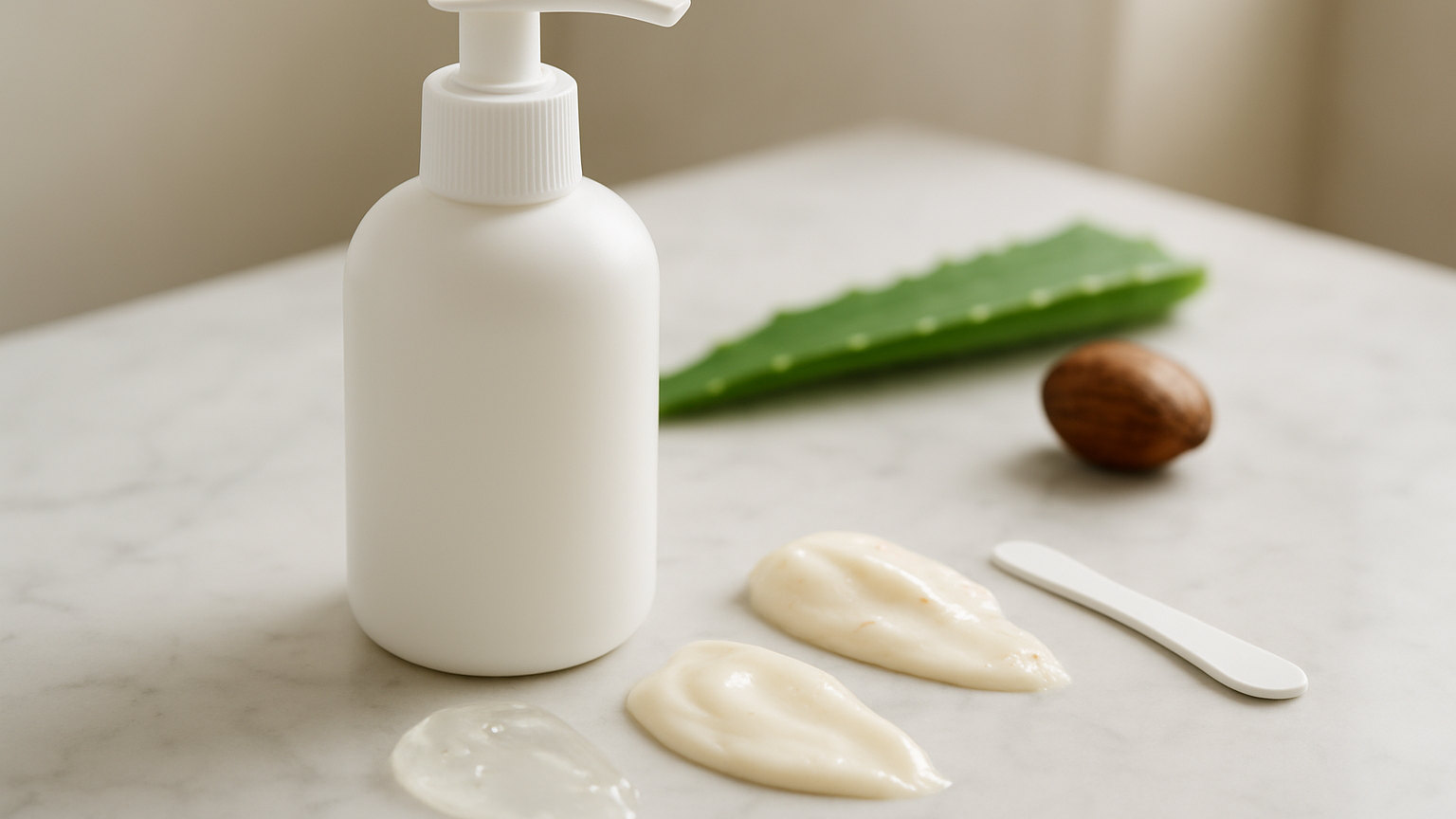
Body moisturisers range from water with fragrance to genuinely effective emollients, and the difference is legible on the label. Three ingredient categories determine whether something works.
What are the three categories?
Humectants draw water into the skin: glycerin, urea, lactic acid, hyaluronic acid, panthenol, sorbitol.
Emollients smooth and soften the surface: shea butter, squalane, plant oils, fatty alcohols, ceramides.
Occlusives prevent water leaving: petrolatum, dimethicone, lanolin, mineral oil, beeswax.
An effective body moisturiser contains all three. Many pleasant ones contain only the first two, which is why they feel lovely and stop working within an hour.
What is the difference between lotion, cream and ointment?
Water content. Lotions are mostly water, absorb quickly, feel light, and are the least effective for genuinely dry skin.
Creams balance oil and water, suit most people, and are the sensible default.
Ointments are largely oil with little or no water. Greasy, considerably more effective, and best used at night or on specific areas.
The drier the skin, the greasier the product should be. Comfort is usually what makes people choose wrongly.
Which suits which situation?
Normal skin in summer: a lotion is adequate.
Dry skin, or any skin in winter: a cream with glycerin or urea and an occlusive.
Very dry, cracked or eczematous skin: an ointment, at least at night.
Rough thickened areas such as heels, elbows and knees: urea at twenty per cent or higher, which softens as well as hydrates.
Keratosis pilaris: urea at ten to twenty per cent, or lactic acid at around twelve.
Does fragrance matter?
For dry, itchy, eczema-prone or reactive skin, yes. Fragrance is the commonest cause of contact allergy in cosmetics, and body moisturiser is applied to a very large surface area.
Fragrance-free rather than unscented, since unscented can mean a masking fragrance was added.
For skin that tolerates it, fragrance is a preference, and one worth having if it means you apply the product consistently.
What about ceramides and hyaluronic acid?
Ceramides are lipids naturally present in the skin barrier, and replacing them has reasonable evidence, particularly for eczema-prone skin. Worth having and not essential.
Hyaluronic acid is a humectant that draws water in. It needs an occlusive over it to be useful, and in dry air it can draw water out of the skin rather than in if there is nothing to trap.
Neither justifies a large price premium on a body product, where quantity matters more.
How much should you buy?
More than you think. A full body application takes a substantial amount, and dermatology guidance for emollient use in eczema runs to several hundred grams a week for whole-body application.
If a bottle of body lotion lasts six months, you are not using enough for it to do anything.
Buy in large sizes or refills, which reduces the cost per use considerably and removes the temptation to ration it.
Is expensive better?
Rarely in proportion to the price. Glycerin, urea, petrolatum and dimethicone are inexpensive commodity ingredients, and a pharmacy cream containing them outperforms most luxury body products.
What money buys is texture, fragrance and packaging. Those are legitimate things to want for a product used daily.
The exception is medicated or high-urea preparations, where the formulation genuinely differs.
How do you know if it is working?
Skin should feel comfortable rather than tight a few hours after application, and flaking should reduce within a fortnight.
If it feels dry again within an hour, the product lacks an occlusive or you are not using enough.
If it stings, something in it is irritating your skin, and fragrance is the first suspect.
Give any change a month, since the barrier takes two to four weeks to rebuild.
Does it matter when you apply it?
More than which one you choose. Within three minutes of washing, on damp skin, traps the water absorbed during the shower. Applied an hour later to dry skin, the same product achieves considerably less.
A second application before bed helps anyone with genuinely dry skin, since water loss through the skin peaks overnight.
Where you keep it determines whether this happens at all. A bottle in the bathroom gets used; one in a bedroom cupboard does not.


