
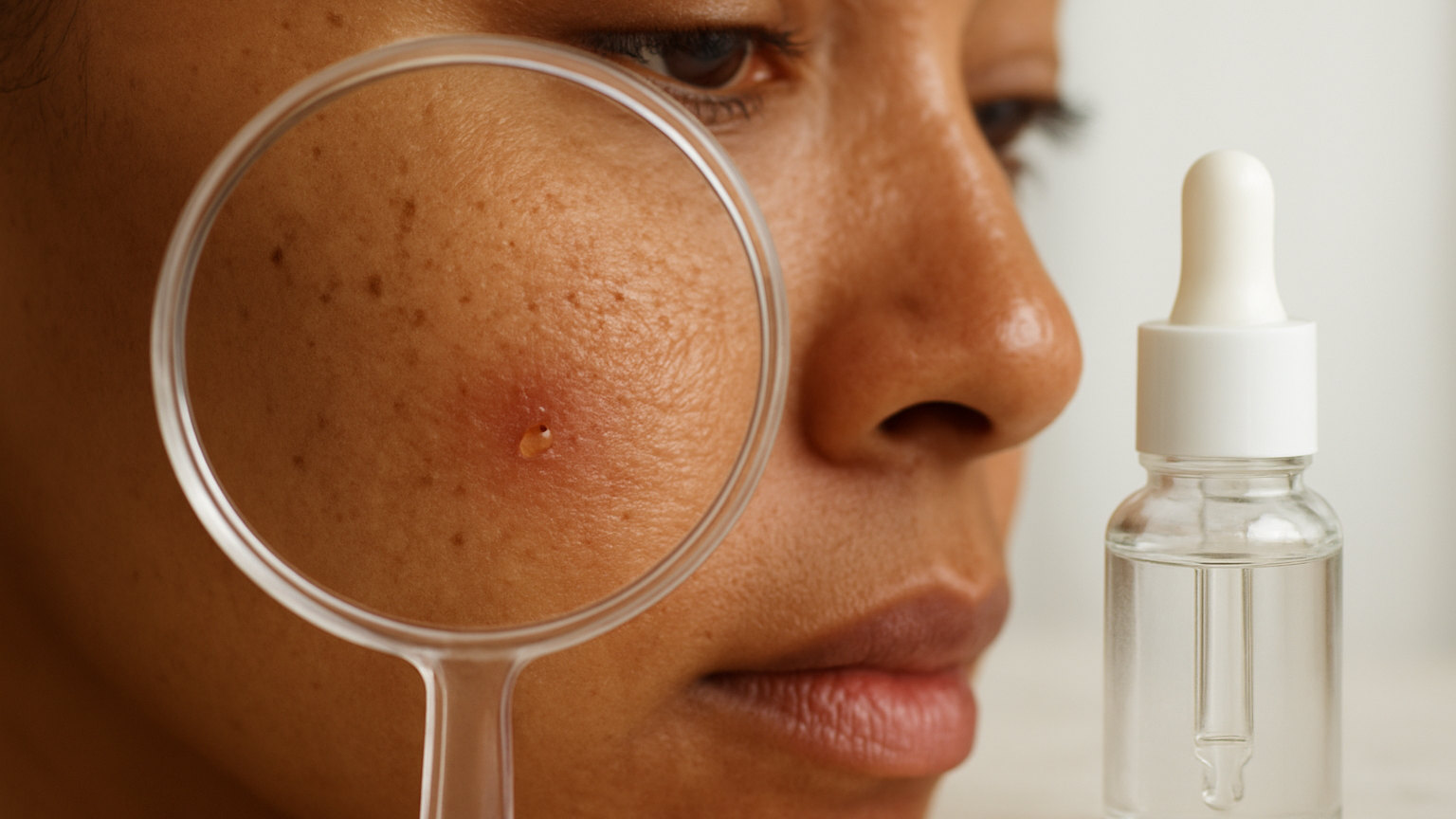
Acne is not a hygiene problem, and that single misunderstanding costs people years of scrubbing skin that was never dirty. Four things happen inside a pore, usually together, and every treatment with real evidence behind it works by interrupting at least one of them. Once you know which four, the whole shelf of products in a chemist stops looking like a lottery.
What is actually happening inside a pore?
Every pore contains a hair follicle and a sebaceous gland. The gland produces sebum, an oil that travels up the follicle and out onto the skin, where it keeps the surface flexible and water-resistant. In skin that is not breaking out, dead cells lining the follicle shed steadily and are carried out with the oil.
In acne, four things go wrong. The gland produces more sebum than usual, generally because androgens have told it to. The dead cells lining the follicle become stickier and clump together instead of shedding, forming a plug at the opening. A bacterium called Cutibacterium acnes, which lives harmlessly on everybody, finds the trapped oil an ideal food source and multiplies. Finally, the immune system responds to that population growth with inflammation, which is the redness, swelling and soreness you can actually see.
Why does the same process make different kinds of spot?
What appears on your face depends on how far the process gets and how deep it happens. A plug that stays open at the surface oxidises and darkens, which is a blackhead. The colour is oxidation, not trapped dirt, which is why no amount of washing removes it.
A plug that closes over stays pale, and that is a whitehead. If bacteria and inflammation follow, you get a papule, the small red bump with no visible head, or a pustule, which is the same thing with white or yellow pus at the tip. When the inflammation happens deep in the follicle and the wall ruptures below the surface, the contents spill into surrounding tissue and you get a nodule or a cyst: a large, painful lump with nothing to squeeze out.
That last point matters more than any other. A cyst has no channel to the surface, so squeezing pushes the contents sideways and widens the damage, which is precisely how a two-week spot becomes a permanent scar.
Why does washing more often make it worse?
Because washing only reaches the surface, and the plug is inside the follicle. Removing surface oil does nothing to the blockage a few millimetres down.
What it does do is strip the skin barrier. Aggressive foaming cleansers, alcohol toners and physical scrubs remove the lipids that hold the barrier together. Skin responds to that in two unhelpful ways: it produces more oil to compensate, and it becomes more reactive, so the inflammatory part of the process gets stronger rather than weaker. People who wash three or four times a day very often have skin that is simultaneously oily and irritated, which is a barrier problem sitting on top of an acne problem.
Twice a day with a gentle cleanser is enough. It is not a compromise or a gentler-is-better platitude; it is simply the point past which more washing has nothing left to remove.
Which treatments target which step?
Knowing the four steps tells you what any product is for. Salicylic acid is oil-soluble, so it travels into the pore and loosens the plug, which makes it the sensible choice for blackheads, whiteheads and general congestion. Benzoyl peroxide reduces the bacterial population and calms inflammation, which suits red, sore, raised spots. Retinoids work on the shedding problem at its root by normalising how the follicle lining turns over, which is why they treat both the blocked and the inflamed kind. Azelaic acid does a little of all three and is usually the gentlest option.
Hormonal treatment, whether a combined pill or spironolactone, works one step further back, on the signal telling the gland to produce more oil in the first place.
How long before any of it works?
Longer than most packaging suggests. You are waiting for pores that were already blocked when you started to work their way through, so nothing you apply today affects what appears this week.
Expect noticeable change in texture and blackheads between weeks four and six, and in inflamed spots between weeks eight and twelve. Judging a product after a fortnight is the single most common reason people conclude that nothing works for them.
When should you stop treating it yourself?
See a GP if spots are deep and painful, if they leave marks or indentations that persist, if three months of consistent treatment has changed nothing, or if acne is affecting your mood and how much you want to leave the house. That last reason is a clinically valid one and worth saying plainly at the appointment.
Scarring is the reason not to wait it out. Once it forms, treatment becomes considerably harder, and prescription options exist precisely for the acne that shop shelves cannot reach.


