
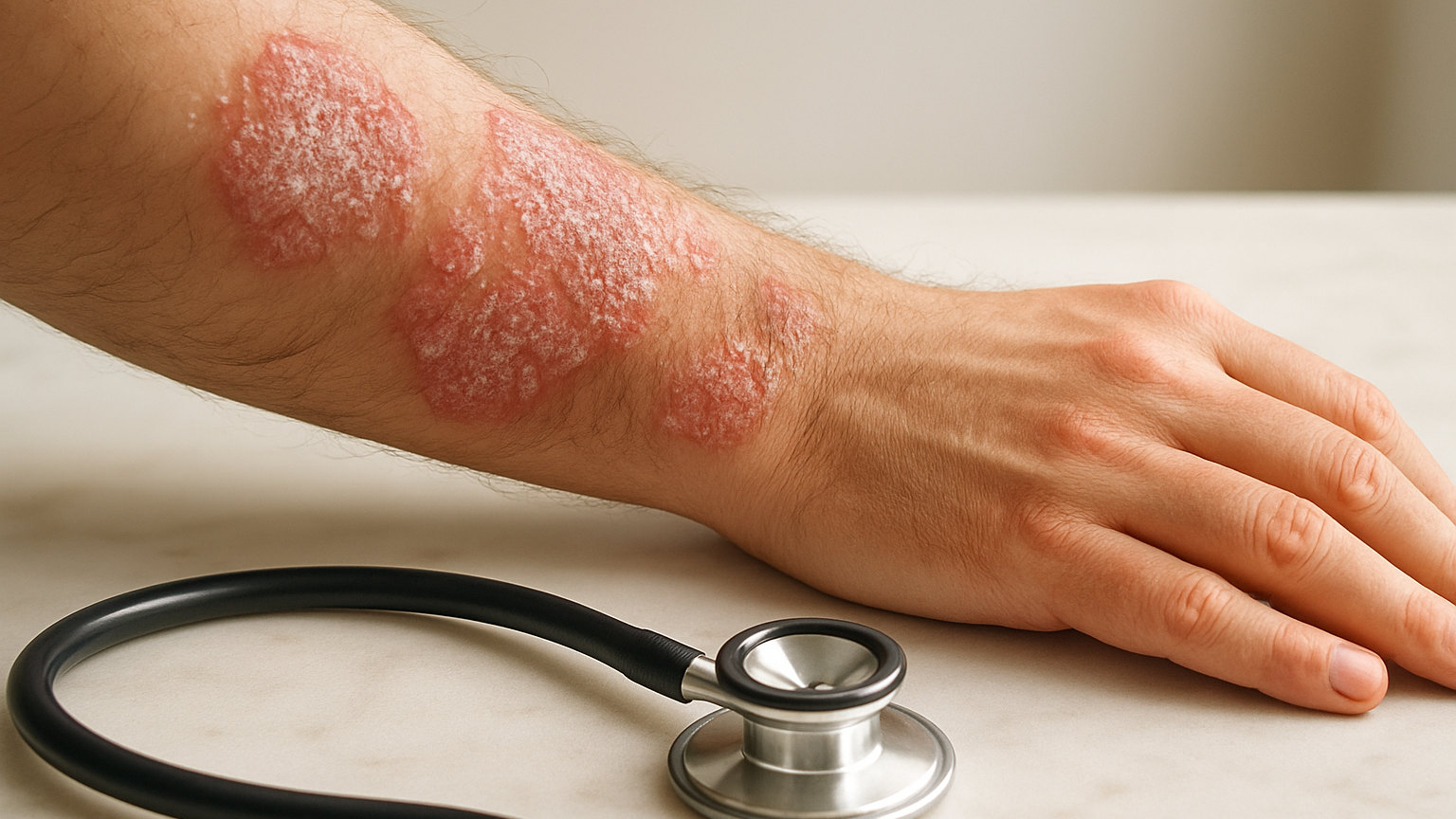
Psoriasis affects around two per cent of people in the UK. It is an immune-mediated condition in which skin cells are produced far faster than they are shed, and it is associated with joint disease and cardiovascular risk in a way that is frequently not explained at diagnosis.
What is happening in the skin?
Normal skin cells take around a month to travel from the base of the epidermis to the surface. In psoriasis that process takes a few days.
Cells accumulate before they have matured, producing the thickened, scaly plaques characteristic of the condition.
Underneath, immune cells drive inflammation, which is why treatments targeting the immune system work and why the condition is systemic rather than confined to skin.
What does it look like?
Plaque psoriasis, the commonest form, produces well-defined raised patches with silvery-white scale, typically on the elbows, knees, lower back and scalp.
On deeper skin tones the plaques often appear violet, grey or dark brown rather than red, which contributes to delayed diagnosis.
Guttate psoriasis produces small drop-like spots, often following a streptococcal throat infection, particularly in younger people.
Inverse psoriasis appears in skin folds as smooth red areas without scale. Pustular and erythrodermic forms are less common and more serious.
Nail changes affect a substantial proportion: pitting, thickening, discolouration and separation from the nail bed.
How is it different from eczema?
Psoriasis plaques are well-demarcated with a clear edge; eczema tends to be diffuse and less defined.
Psoriasis scale is thicker and silvery; eczema is more likely to weep and crust.
Psoriasis favours extensor surfaces, the outsides of elbows and knees; eczema favours flexural surfaces, the insides.
Itch is usually more prominent in eczema, though psoriasis can itch considerably.
Nail involvement is much more common in psoriasis.
What triggers it?
Streptococcal infection, particularly for guttate psoriasis.
Skin injury, including cuts, sunburn and tattoos, which can produce new plaques at the site. This is called the Koebner phenomenon and is characteristic.
Stress, which is one of the most commonly reported triggers.
Smoking and alcohol, both of which worsen severity and reduce treatment response.
Certain medications, including lithium, beta blockers, antimalarials and, notably, withdrawal of oral steroids.
Cold weather and reduced sunlight, which is why most people flare in winter.
What treatments work?
Emollients, which reduce scale and discomfort and improve how well other treatments penetrate.
Vitamin D analogues such as calcipotriol, which slow cell turnover and are a mainstay of treatment. Frequently combined with a topical steroid in one preparation.
Topical steroids for flares, used as prescribed rather than long term.
Coal tar preparations, which are effective, unfashionable and still useful.
Phototherapy with narrowband ultraviolet B, delivered under dermatology supervision, which is effective for widespread disease.
Systemic treatments including methotrexate and ciclosporin, and biologic therapies for moderate to severe disease, which have changed outcomes considerably.
What is psoriatic arthritis?
An inflammatory arthritis affecting up to a third of people with psoriasis, which can develop years after the skin symptoms or occasionally before them.
It causes joint pain, stiffness and swelling, often with prolonged morning stiffness, and can affect fingers and toes producing sausage-like swelling.
Lower back pain and heel pain are also common presentations.
It causes irreversible joint damage if untreated, so early diagnosis genuinely matters. Anyone with psoriasis and persistent joint pain should raise it specifically.
What else is associated with it?
Increased cardiovascular risk, which is now well established and relates to chronic systemic inflammation.
Higher rates of metabolic syndrome, type 2 diabetes and obesity.
Depression and anxiety, at rates higher than the visible severity alone would predict.
This is why psoriasis reviews increasingly include blood pressure, cholesterol and glucose checks, and why it is worth attending them.
When should you see a GP?
For diagnosis, since psoriasis is frequently mistaken for eczema or fungal infection and the treatments differ.
If topical treatment is not controlling it, since there is a great deal available beyond the first line.
For any joint pain, stiffness or swelling, which needs assessing for psoriatic arthritis.
For rapid worsening, widespread redness, pustules or feeling unwell, which need urgent attention.
And for the impact on mood and daily life, which is a legitimate reason for referral in its own right.


