
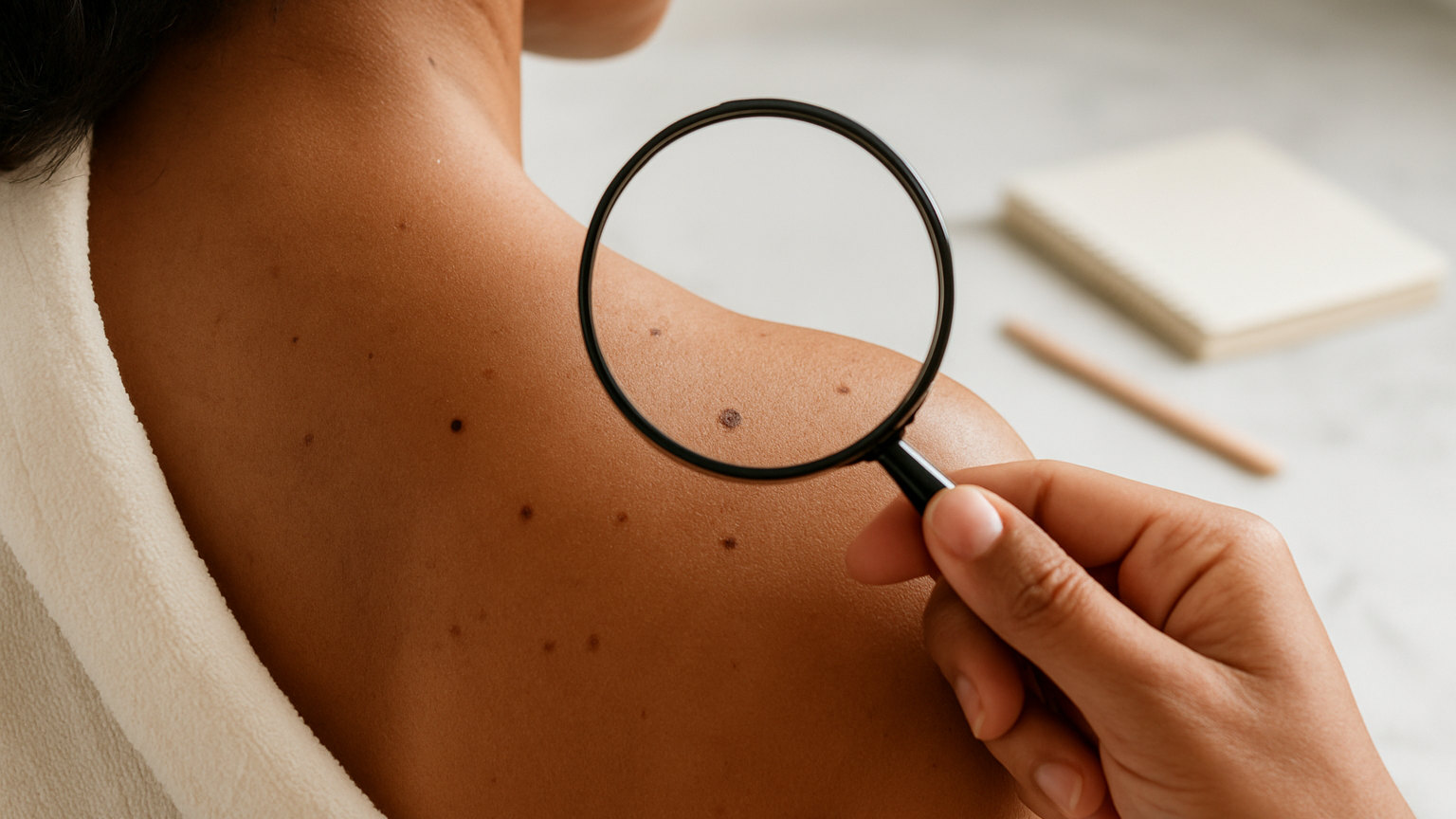
Most moles are harmless and stay that way. Melanoma is far more treatable when found early, and the difference between early and late is usually whether anyone was looking. A monthly check takes about five minutes.
What is the ABCDE rule?
A framework for spotting the features associated with melanoma.
Asymmetry: one half does not match the other.
Border: edges are irregular, ragged, notched or blurred rather than smooth.
Colour: more than one colour, or uneven distribution, including brown, black, red, white or blue.
Diameter: larger than six millimetres, roughly the width of a pencil end, though melanomas can be smaller.
Evolving: any change in size, shape, colour, elevation or symptoms such as itching, bleeding or crusting.
Evolving is the most important letter, since change over time is the most reliable signal.
What is the ugly duckling sign?
Most people's moles look broadly similar to each other. A mole that stands out as different from the rest is worth attention even if it does not tick any ABCDE box.
It is a useful complement to the rule, since it uses your own pattern as the comparison rather than a general standard.
How do you actually check?
In good light, ideally natural, with a full-length mirror and a handheld one.
Face, ears, neck and scalp, parting the hair or using a comb to check the scalp systematically.
Chest and torso, lifting the breasts to check underneath.
Arms, including the underarms, the backs of the hands, between the fingers and under the nails.
Legs front and back, the buttocks and the groin.
Feet: the tops, the soles, between the toes and under the toenails.
The back, which needs a second mirror, a phone camera or another person.
Which areas do people miss?
The back, by a considerable margin, which is the commonest site for melanoma in men and where it is diagnosed later and thicker because nobody sees it.
The scalp, which needs deliberate parting rather than a glance.
The soles of the feet and under the nails, where acral melanoma occurs. This form affects people of all skin tones and is proportionally more common in deeper skin tones, where sun-focused messaging often does not reach.
The buttocks, the backs of the legs and behind the ears.
Is photography useful?
Genuinely, and it is the most practical improvement most people can make.
Photograph the whole body section by section, including the back, every few months in the same light. Comparing images detects change far better than memory does.
Include a ruler or a coin next to any mole you are watching, so size is comparable.
Formal mole mapping is available privately and is worth considering for anyone with many moles or a family history.
Who is at higher risk?
Fair skin that burns easily, red or blonde hair, and freckles.
A large number of moles, or unusual-looking moles.
Previous melanoma or non-melanoma skin cancer, or a family history of melanoma.
A history of sunburn, particularly blistering sunburn in childhood, and any sunbed use.
A weakened immune system, including after organ transplant.
Anyone in these groups should check more often and have a lower threshold for seeking advice.
What about nail changes?
A brown or black stripe running lengthwise down a nail warrants a GP appointment, particularly if it affects one nail only, is widening or darkening, or the pigment spreads onto the surrounding skin.
A bruise moves out as the nail grows; melanoma does not.
Longitudinal pigmented bands affecting several nails are common and normal in deeper skin tones, which is why the single-nail pattern is the one to notice.
When should you see a GP?
Any mole meeting an ABCDE criterion, any ugly duckling, or any new mole appearing in adulthood.
Any mole that itches, bleeds, crusts, becomes raised or does not heal.
Any sore or scab that has not healed within four weeks, which can indicate other skin cancers.
Do not wait to see whether it changes further. Melanoma found early is usually curable with excision alone, and the difference a few months makes to the outlook is substantial.


