
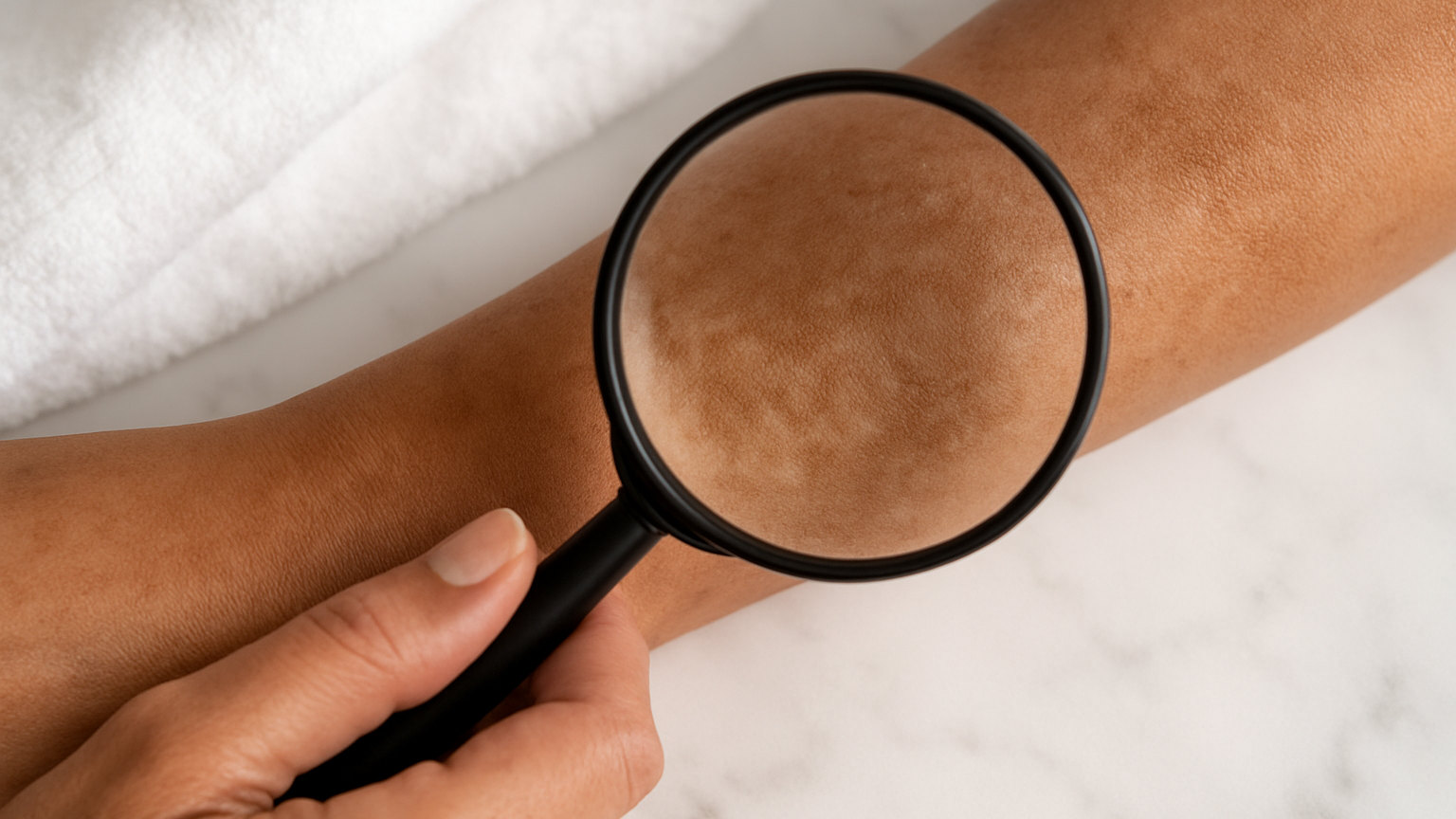
Patches of skin lighter or darker than the surrounding area have a manageable list of causes. Distinguishing them matters, since some respond quickly to treatment, some need medical management, and some need nothing at all.
What is tinea versicolor?
A common fungal condition caused by malassezia yeast, which lives naturally on the skin and occasionally overgrows.
It produces small patches of discolouration, usually on the chest, back, shoulders and upper arms, sometimes with fine scale.
The patches can be lighter or darker than the surrounding skin. They are more noticeable after sun exposure, because affected areas do not tan.
It is more common in hot humid conditions, in people who sweat heavily, and in adolescents and young adults.
It responds to antifungal shampoo used as a body wash, left on for five to ten minutes several times a week, or to prescription treatment. The colour takes months to even out after the fungus has cleared, which is worth knowing before concluding treatment has failed.
What is vitiligo?
An autoimmune condition where melanocytes are destroyed, producing well-defined patches of complete pigment loss.
The patches are chalk-white rather than merely lighter, often symmetrical, and commonly affect the hands, face, around the eyes and mouth, and areas of friction.
It affects around one per cent of people worldwide and is associated with other autoimmune conditions, particularly thyroid disease.
Treatments include topical steroids, calcineurin inhibitors and phototherapy, with better results on the face than the hands and feet. Newer topical treatments have improved options.
It carries no physical health risk and can have a significant psychological impact, which is a legitimate reason for support and referral.
What is pityriasis alba?
Pale, slightly scaly patches, usually on the cheeks and upper arms, most common in children and adolescents.
It is thought to be a mild form of eczema and is entirely harmless.
It is more noticeable in summer and on deeper skin tones because the patches do not tan.
It resolves on its own over months to years. Moisturising and sun protection help the appearance in the meantime.
What causes darker patches?
Post-inflammatory hyperpigmentation, following spots, insect bites, ingrown hairs, injuries or any inflammation. It is the commonest cause and fades over six to twelve months on the body.
Acanthosis nigricans, which produces velvety thickened darkening in the neck, underarms and groin. It is associated with insulin resistance and warrants a GP appointment.
Friction pigmentation on elbows, knees and knuckles.
Melasma, which affects the face predominantly and can occur on the forearms and chest.
Sun damage, producing solar lentigines on the shoulders, chest, forearms and backs of the hands.
What about patches after sun exposure?
Sun makes almost every form of discolouration more obvious, since unaffected skin tans and affected skin does not.
Poikiloderma of Civatte produces mottled reddish-brown discolouration on the sides of the neck and upper chest, characteristically sparing the shaded area under the chin. It is cumulative sun damage.
Polymorphic light eruption produces an itchy rash on sun-exposed skin in spring, which settles as tolerance builds through summer.
What helps generally?
Sun protection, which is the foundation for every cause here. Ultraviolet increases the contrast and restimulates pigment production.
Azelaic acid and niacinamide for hyperpigmentation.
Antifungal treatment for tinea versicolor, and an antifungal wash monthly afterwards to prevent recurrence, which is common.
Time, since almost everything here changes slowly and body skin turns over more slowly than facial skin.
Avoid unregulated skin lightening products, which frequently contain mercury or potent steroids and cause lasting harm.
When is a patch worth checking?
Any patch that is new in adulthood and does not fit an obvious cause.
Any patch that is growing, changing colour, itching, bleeding, ulcerating or not healing.
Pale patches with loss of sensation, which is uncommon in the UK and can indicate leprosy in people who have lived in endemic areas.
Velvety thickened darkening in body folds, which warrants a diabetes check.
And any single patch that looks different from everything else on your skin, which is the same ugly duckling principle used for moles.


