
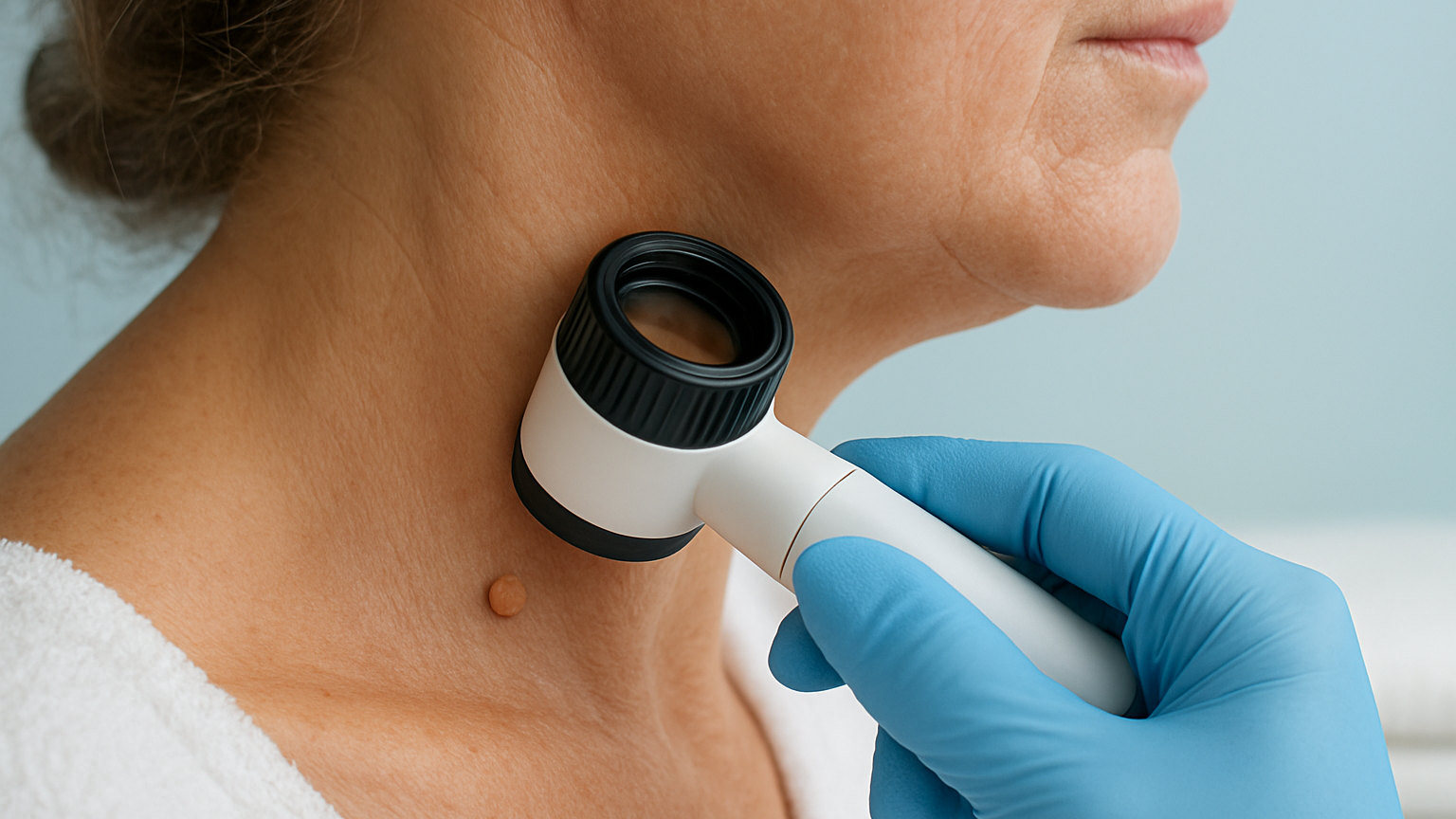
Skin tags are small, soft growths of skin attached by a narrow stalk. They are entirely benign, extremely common, and grow in the places where skin rubs against skin or clothing.
What are they?
Medically called acrochordons, they consist of loose collagen fibres and blood vessels surrounded by normal skin.
They are usually a few millimetres across, skin-coloured or slightly darker, and hang from a stalk rather than sitting flat.
They are not contagious, do not turn cancerous, and cause no symptoms unless they catch on something.
Where do they appear?
Areas of friction: the neck, underarms, groin, eyelids, under the breasts and in skin folds generally.
They become considerably more common with age, and around half of adults have at least one.
What causes them?
Friction is the main factor, which is why they appear where skin rubs.
Genetics, since they clearly run in families.
Weight, since more skin folds mean more friction, and insulin resistance appears to play a role independently.
Pregnancy, driven by hormonal change, and they frequently persist afterwards.
Age, and conditions including type 2 diabetes and metabolic syndrome.
Multiple skin tags appearing rapidly, particularly with darkened velvety skin in the folds, is worth mentioning to a GP, since the combination is associated with insulin resistance.
Do they need removing?
Medically, no. They are harmless and removal is cosmetic.
Reasons people choose to: catching on jewellery, clothing or a razor, which causes bleeding and irritation; discomfort in a fold; or appearance.
Because removal is cosmetic, it is not generally available on the NHS, which is why home kits are so widely sold.
Why is home removal a poor idea?
Three reasons, and the first is the most important.
You may be removing something that is not a skin tag. Moles, warts, seborrhoeic keratoses and, rarely, skin cancers can look similar, and removing one at home destroys the tissue that would have allowed a diagnosis. Melanoma has been removed at home in the belief it was a skin tag.
Infection and scarring, since home removal is not sterile and the wound is unmanaged.
Bleeding, which can be considerable given the blood supply through the stalk.
Ligation kits, freezing kits and acid preparations sold online all carry these risks, and acid products in particular cause burns and lasting marks.
What about tying it off with thread?
The traditional method, cutting off the blood supply until the tag drops off.
It sometimes works and is not sterile, is painful, and can leave an infected wound.
Doing it on the eyelids or near the eyes is particularly inadvisable.
The same objection applies: if it is not a skin tag, you have removed the evidence.
How are they removed properly?
By a GP, dermatologist or a suitably qualified practitioner, usually in minutes.
Snip excision with sterile scissors, sometimes with local anaesthetic. Cryotherapy with liquid nitrogen. Cautery, which burns the stalk and seals it.
All are quick and leave minimal marking. Anything unusual can be sent for examination.
Since it is cosmetic, expect to pay privately. Some GP practices offer minor surgery privately, which is frequently cheaper than a dermatology clinic.
Can you prevent them?
Partly. Reducing friction helps: better-fitting clothing, avoiding tight collars and straps, and a barrier balm in areas that rub.
Weight management reduces the number of skin folds and appears to reduce formation.
They tend to recur in the same areas regardless, since the underlying tendency persists.
When should you see a GP?
Any growth that bleeds without being caught, changes colour, grows quickly, becomes painful, or looks different from your other skin tags.
Anything you are not certain is a skin tag, which is the main reason to have it looked at rather than removed at home.
Multiple new tags appearing rapidly, particularly with velvety darkening in the folds.
And any tag that has become inflamed, infected or has partially torn.
How do they differ from warts and other growths?
A skin tag hangs from a narrow stalk and is soft and the same colour as your skin. That combination is fairly distinctive.
A wart is rough, firm and sits flat against the skin rather than hanging, and it is caused by a virus, so it can spread.
A seborrhoeic keratosis is a waxy, stuck-on brown or black growth, common with age and entirely harmless.
A mole is flat or slightly raised, pigmented and usually broadly attached rather than stalked. The important point is that anything you cannot confidently place in one of these categories is worth a GP looking at, which takes minutes and costs nothing.


