
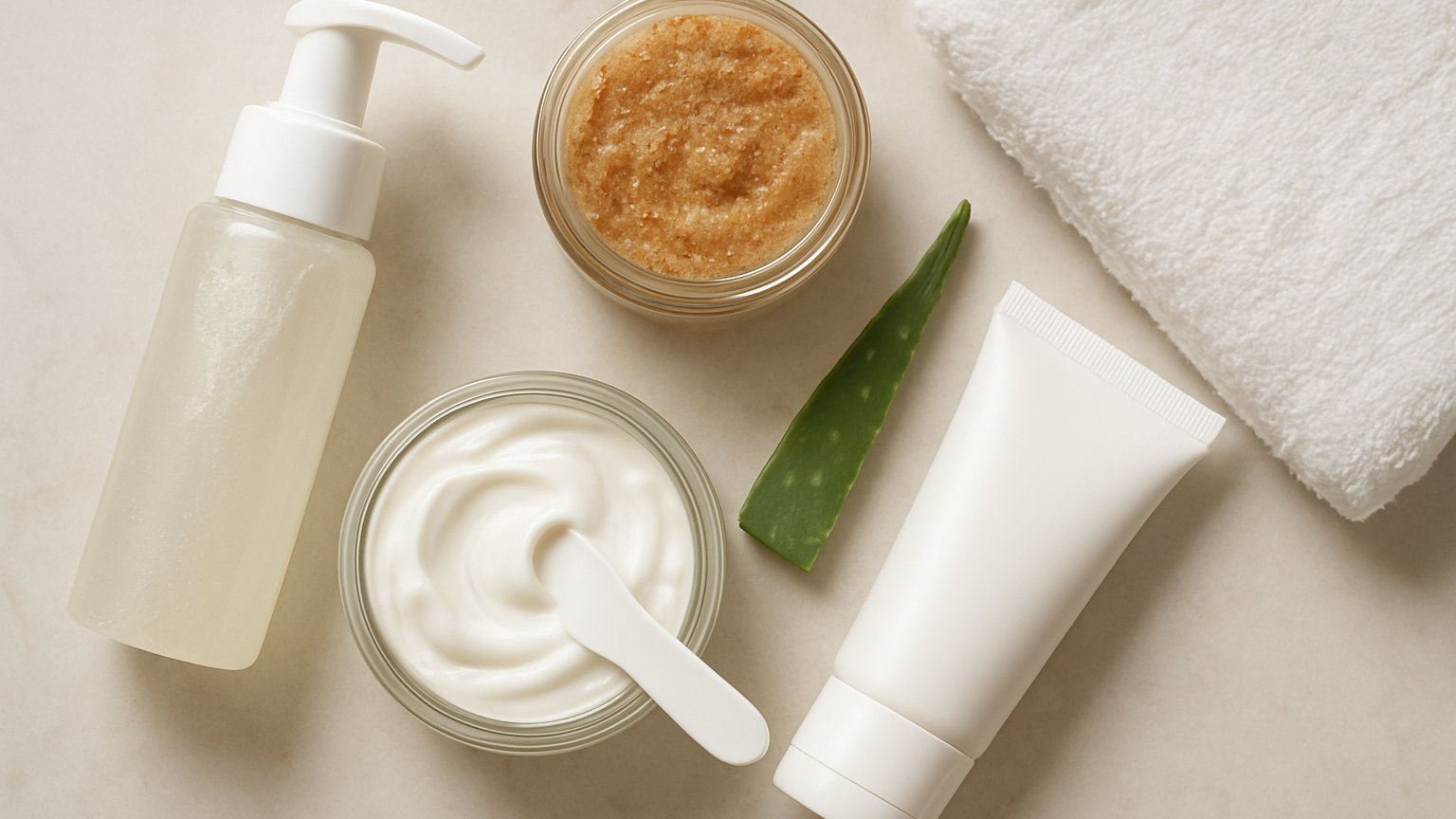
Body routines get far less attention than facial ones, which is reasonable given the difference in visibility and cost. Four things cover almost everything, and most people are doing one of them occasionally.
What are the four?
Wash gently, using soap only where it is needed. Moisturise within three minutes of getting out, on damp skin. Exfoliate chemically once or twice a week if you have a reason to. Protect exposed skin from the sun.
That is a complete routine for most people. It takes about two minutes beyond what you already do.
What does the daily version look like?
A short lukewarm shower rather than a long hot one. A gentle wash on underarms, groin and feet, and water elsewhere unless visibly dirty.
Pat dry rather than rubbing, leaving the skin slightly damp.
Moisturise generously, particularly shins, forearms, elbows and knees. Something with glycerin or urea alongside an occlusive.
Sunscreen on anything that will be uncovered.
What is weekly?
Chemical exfoliation once or twice, if you have keratosis pilaris, ingrown hairs, body acne or rough patches. Lactic acid for dry rough skin, salicylic for follicular problems.
Urea at twenty per cent or above on heels, elbows and knees.
Checking your skin: moles, any new or changing mark, and areas you cannot easily see.
Changing bedding, which affects back and chest skin more than any product does.
What order should things go in?
Thinnest to thickest, as with facial products. Any treatment or active first, moisturiser over it, occlusive last if you use one.
Sunscreen goes last in the morning, after moisturiser has absorbed.
Actives such as retinoids or acids at night rather than in the morning, since several increase photosensitivity.
How do you adapt it for specific concerns?
Keratosis pilaris: urea or lactic acid daily on the affected areas, no scrubbing.
Body acne: salicylic acid or benzoyl peroxide wash two or three times a week, prompt showering after exercise, and washing the body after rinsing conditioner out.
Ingrown hairs: chemical exfoliation two or three times a week between shaving sessions rather than immediately before or after.
Very dry or eczema-prone skin: emollient several times daily, an ointment at night, and soap avoided almost entirely.
Pigmentation: azelaic acid or niacinamide, and rigorous sun protection, for six to twelve months.
Which areas get forgotten?
The back, because of reach. A long-handled applicator or a spray formulation solves it.
The neck and chest, which have thin skin and heavy sun exposure and are usually where the facial routine stops.
The backs of the hands, which need reapplication rather than a single morning application.
Feet, which need urea rather than body lotion. And the tops of the ears and feet for sunscreen.
What can be skipped?
Body scrubs used regularly, which irritate more than they improve. Dry brushing, beyond mild exfoliation if you enjoy it.
Separate products for every body part, most of which are the same formulation in different packaging.
Expensive body serums, since the ingredients doing the work are inexpensive and the surface area makes cost per use matter.
Anything promising to remove cellulite or stretch marks.
How long before it works?
Dryness improves within a fortnight. Texture and keratosis pilaris take four to eight weeks.
Body acne takes eight to twelve weeks. Pigmentation takes six to twelve months, which is roughly double the facial timeline.
Body skin is thicker and turns over more slowly, so patience is doing more of the work here than product choice is.
What matters most?
Moisturising promptly after washing, which resolves the majority of ordinary body skin complaints on its own.
Sun protection on exposed areas, which prevents most of what people later try to treat.
And not scrubbing, which is the commonest self-inflicted problem in this whole area.
Does it need to cost much?
No, and the surface area involved makes this the area where cost per use matters most. A litre of pharmacy cream with glycerin and an occlusive does more than a small jar of anything expensive, and you can use enough of it.
Urea cream, lactic acid lotion and a body sunscreen are all available cheaply. The whole routine described here comes to a few pounds a month.
Where spending more is defensible is a texture you will genuinely apply to your whole body daily, since the one that stays in the cupboard protects nothing.


