
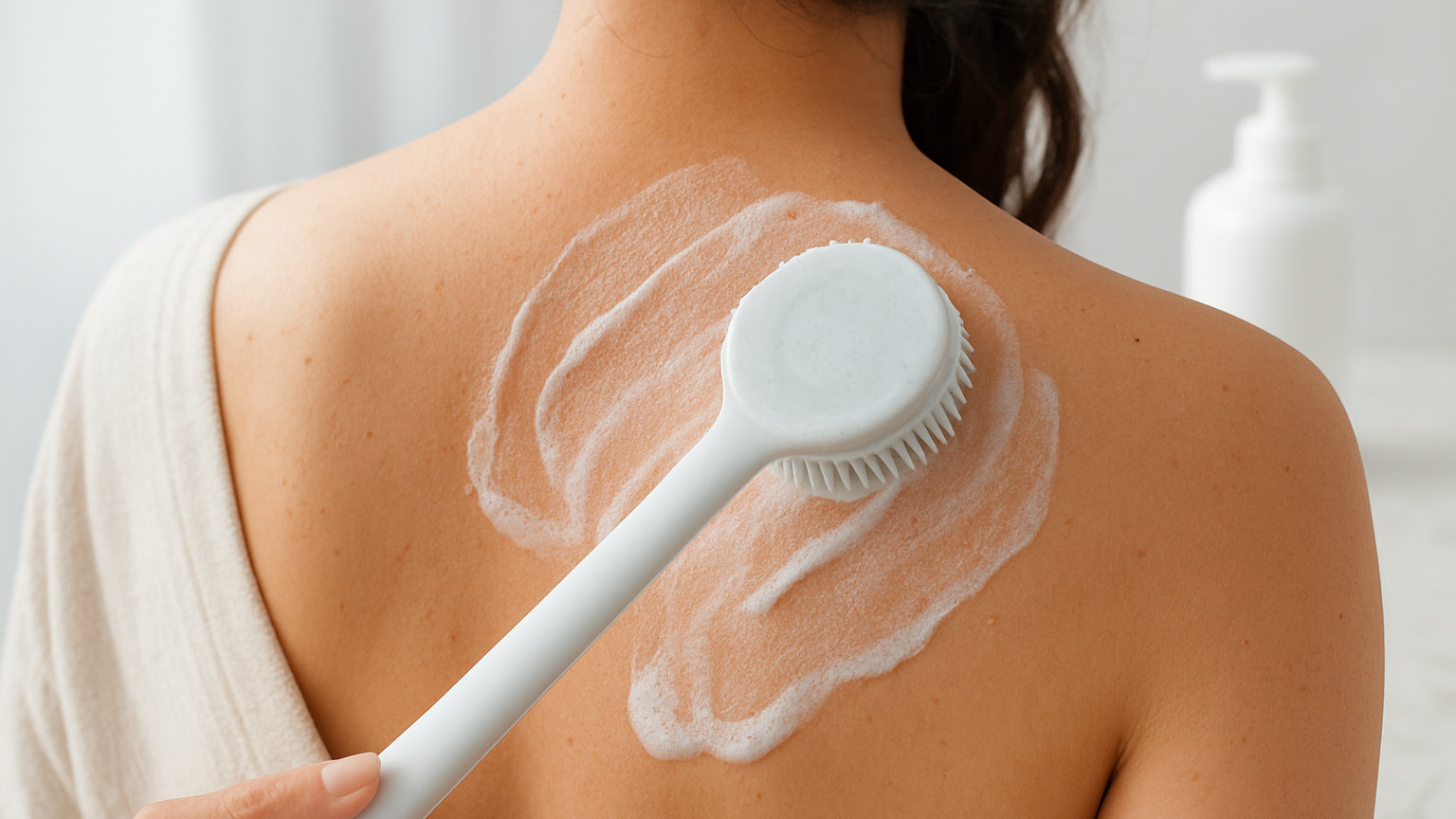
The back has a high density of sebaceous glands, thick skin, constant contact with clothing and seats, and the significant disadvantage of being out of reach. That combination explains most of what goes wrong with it.
Why does it break out?
Because sebaceous glands are concentrated there, second only to the face, and the area is occluded by clothing for most of the day.
Friction from backpacks, seats and tight clothing contributes, producing acne mechanica in the areas under pressure.
Sweat left to dry under synthetic fabric is a major factor, which is why it worsens in summer and after exercise.
Hair conditioner and styling products running down the back during rinsing is a genuine and under-recognised cause, and washing the body after rinsing hair fixes it for nothing.
Is it acne or something else?
Worth checking, since the treatments differ.
Acne produces a mix of blackheads, whiteheads and inflamed spots of varying sizes.
Fungal folliculitis produces strikingly uniform, itchy small bumps with no blackheads, clustered rather than scattered, worse in heat. It is common on the back and does not respond to acne treatment. Antifungal shampoo used as a body wash twice weekly, left on for five minutes, is the treatment.
Bacterial folliculitis produces pustules each centred on a follicle, often after sweating.
How do you actually reach it?
This is the practical obstacle and there are reasonable solutions.
A long-handled lotion applicator for moisturiser and treatments. A back brush or a long cloth for washing.
Body washes containing salicylic acid or benzoyl peroxide, which reach everywhere a shower reaches without needing precision.
Spray formulations of treatments, which exist specifically for this and are considerably easier than creams.
And asking someone, which is the simplest answer for sunscreen in particular.
What treatments work?
A salicylic acid body wash two or three times a week, left on for a minute before rinsing.
Benzoyl peroxide wash at two point five to five per cent, which is effective and bleaches fabric, so white towels and thorough rinsing.
A leave-on treatment or spray for stubborn areas. Azelaic acid for the marks left behind, which last considerably longer on the back than on the face.
Twelve weeks before judging any of it, since back skin is thick and slow.
What should change day to day?
Shower promptly after exercise rather than letting sweat dry. Change out of damp kit immediately if a shower is not possible.
Breathable fabrics rather than tight synthetics. Wash gym clothes properly, since bacteria persist in synthetic fibres.
Change sheets and pillowcases weekly, particularly if you sleep on your back.
Avoid heavy body oils and butters on the area.
Why do marks last so long?
Because back skin is thick, turns over slowly, and lesions there tend to be deeper than facial ones.
Post-inflammatory pigmentation frequently takes six to twelve months to fade, and longer in deeper skin tones.
Picking is the single largest factor in whether marks form at all, and back spots are particularly tempting because they are felt rather than seen.
Sunscreen on the area when exposed genuinely speeds fading, since ultraviolet restimulates the pigment.
What about moles?
This is the most important part of the article. The back is the commonest site for melanoma in men and a frequent site in women, and it is the hardest place to monitor.
Melanomas on the back are diagnosed later and thicker than those elsewhere, precisely because nobody sees them.
Ask someone to check every few months, or photograph your back with a phone. Look for anything new, changing, asymmetrical, irregularly edged, multi-coloured, larger than six millimetres, or that itches, bleeds or does not heal.
Anything meeting those descriptions warrants a GP appointment rather than watching.
What about sun protection?
The back is frequently exposed and frequently missed when applying sunscreen, particularly the shoulders and the area between the shoulder blades.
A spray formulation or a long-handled applicator makes it achievable alone. A rash vest or a t-shirt is more reliable than either.
Sunburn on the back is common precisely because reaching it is awkward, and it is the site where that omission matters most.


