
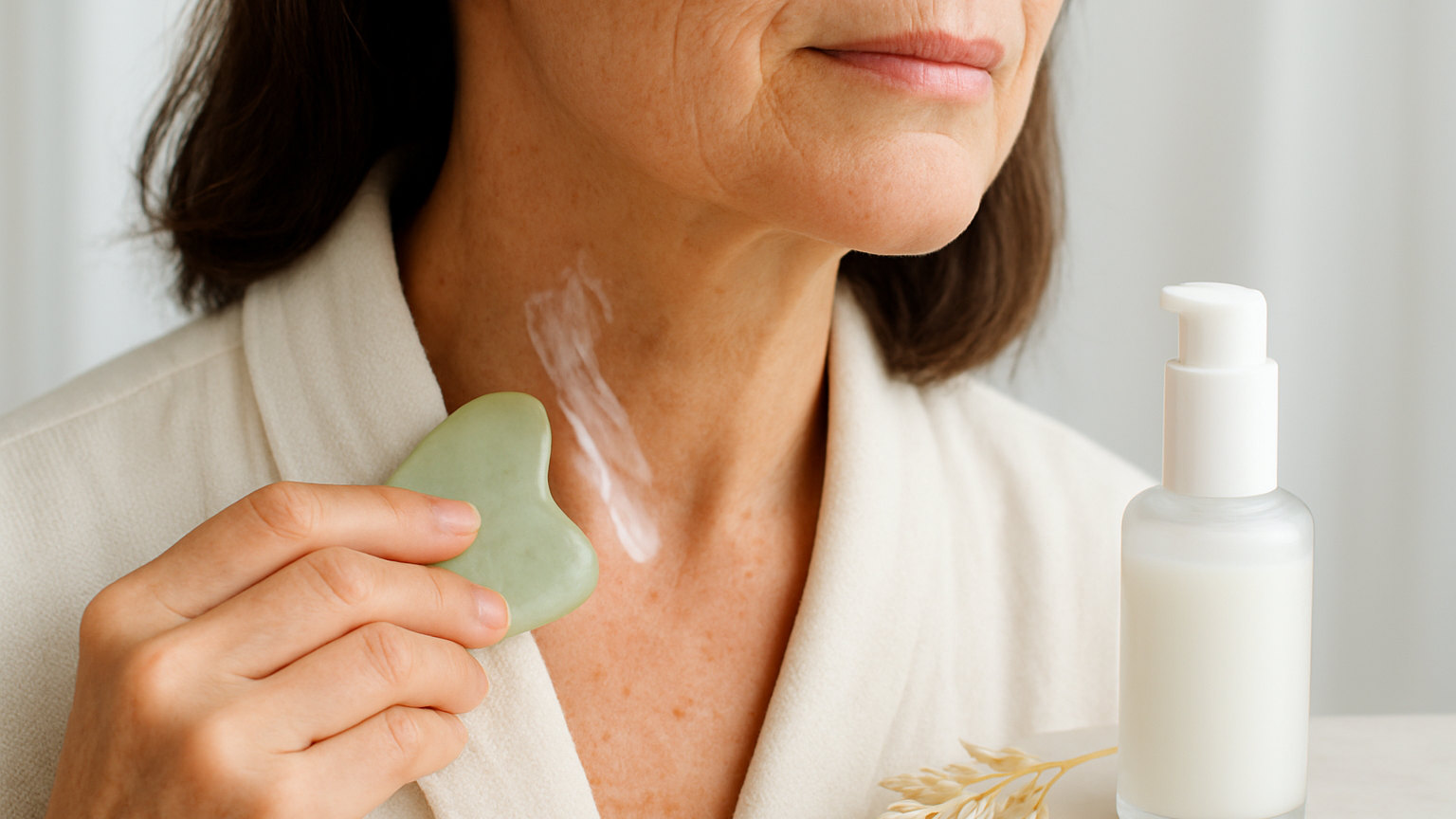
The neck and chest have thinner skin than the face, fewer oil glands, and comparable sun exposure. They are also where most facial routines stop, which is why the mismatch between a well-cared-for face and the area below it becomes obvious over decades.
Why do they age faster?
Thinner skin with less subcutaneous fat, so volume loss and laxity show sooner.
Fewer sebaceous glands than the face, so the area dries out more readily and has less natural protection.
Constant movement from head turning and looking down, which creates horizontal lines across the neck.
And sun exposure that is comparable to the face while receiving a fraction of the sunscreen, since most people stop at the jawline.
What is the mottled redness on the chest?
Poikiloderma of Civatte, which is extremely common and rarely named. It produces reddish-brown mottled discolouration on the sides of the neck and the upper chest, characteristically sparing the shaded area under the chin.
That sparing is the giveaway: it is cumulative ultraviolet damage, and the patch the chin shades is the control.
It responds partially to intense pulsed light and vascular lasers, and to consistent sunscreen, which prevents it worsening. It does not resolve on its own.
What causes chest wrinkles?
Two different things, and they need different responses.
Sun damage produces general crepiness and loss of elasticity across the whole area.
Vertical lines between the breasts are largely compression lines from sleeping on one side, where the skin is folded for hours at a time. They are the chest equivalent of sleep wrinkles on the face.
Sleeping on the back prevents them. Silicone chest patches worn overnight hold the skin flat and produce a genuine if modest improvement.
What should the routine be?
Simply extend what you do on your face downward, which costs nothing extra beyond a little more product.
Sunscreen every morning to the neck, chest and upper back, applied as thoroughly as to the face. This is the single most valuable step.
Moisturiser twice daily, since the area dries out more than the face.
A retinoid two or three times a week, building up slowly. The skin here is thinner and irritates more easily than facial skin, so the same strength used nightly on the face is usually too much.
Do neck creams do anything special?
Not by virtue of being sold for the neck. The ingredients are the same as facial products, and the price is frequently higher.
What matters is that the formulation suits thinner, drier skin: richer texture, and actives introduced gradually.
Using your facial moisturiser and retinoid on the neck, at lower frequency, achieves the same thing for less.
What treats existing damage?
Retinoids, which improve texture and pigmentation over six to twelve months. Slower here than on the face.
Vitamin C and azelaic acid for pigmentation. Gentle chemical exfoliation, less often than on the face.
Intense pulsed light for the redness and brown mottling of poikiloderma, which is the treatment with the clearest results for that specific presentation.
Microneedling and radiofrequency for laxity, which are clinical procedures with modest results.
What about tech neck?
Horizontal neck lines are partly natural creases present from childhood and partly deepened by repeated flexion.
Looking down at a phone for hours daily does contribute, and raising the device to eye level helps, though the evidence for the phenomenon is more observational than measured.
The larger contributor by some distance is sun exposure and skin thinning rather than posture.
What is worth starting now?
Sunscreen on the neck and chest daily, which prevents the majority of what this article describes.
Extending the moisturiser. Adding a retinoid gradually if you already use one.
And checking the area for moles, since the chest and upper back are common sites and the shoulders are frequently missed.
Does anything help with laxity?
Modestly, and expectations are worth setting before spending anything. Loose skin under the chin and on the neck is a structural change involving fat, muscle and bone as well as skin, and topical products cannot address most of it.
A retinoid used consistently for a year improves texture and thickens the skin slightly, which softens the appearance. Radiofrequency and ultrasound devices in clinic produce modest tightening that requires repeating.
What genuinely prevents further laxity is sun protection, since ultraviolet degrades the collagen and elastin that hold the skin taut.


