
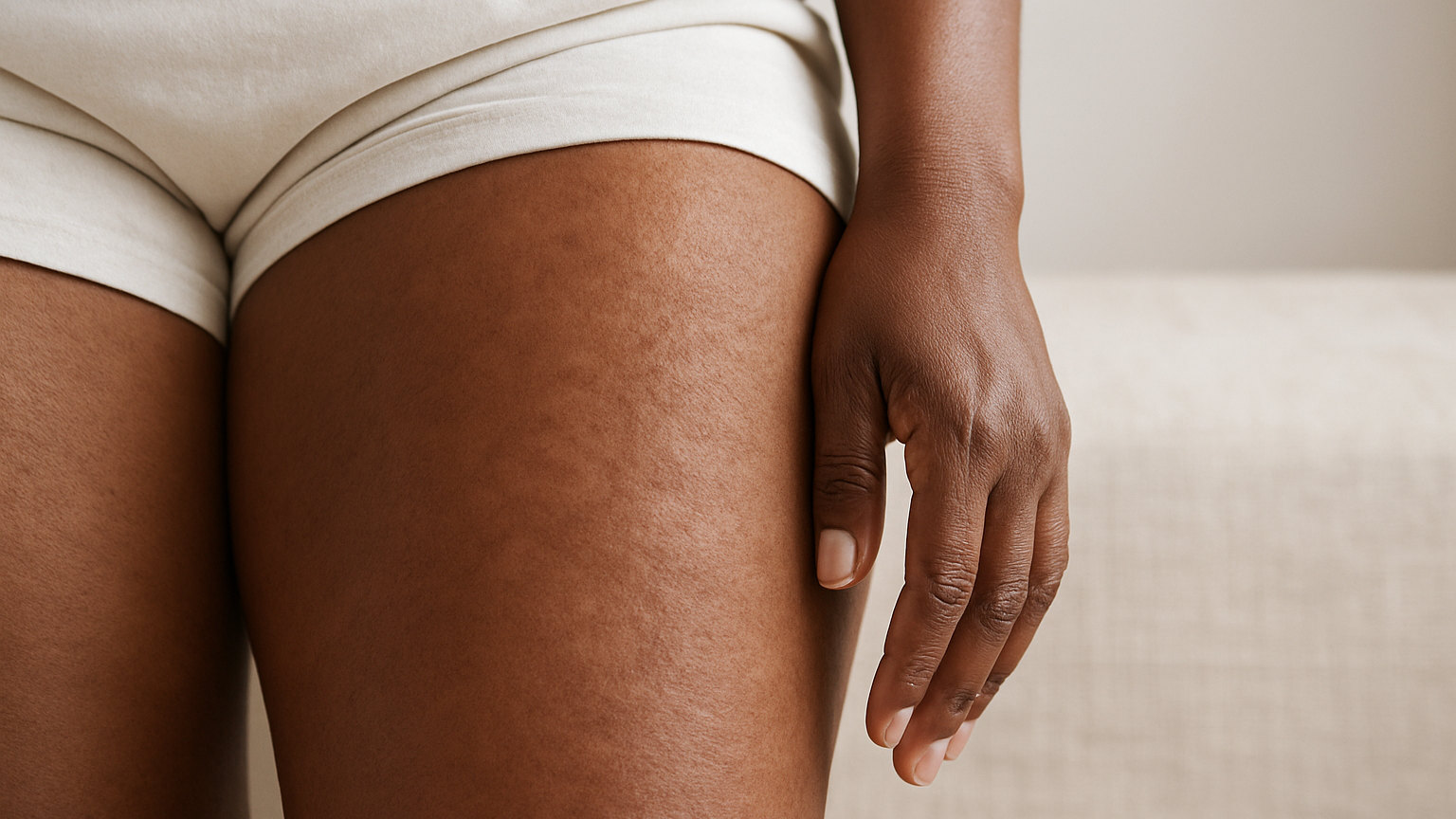
Cellulite affects the large majority of women after puberty regardless of weight or fitness. It is a structural feature of how female skin and fat are arranged rather than a disease, and the enormous market built around it is largely selling a solution to normal anatomy.
What is actually happening?
Fat sits in chambers separated by fibrous connective tissue bands running from the muscle to the skin.
In women, those bands run mostly vertically, perpendicular to the skin surface. As fat chambers expand, they push upward between the bands while the bands hold the skin down, producing the dimpled surface.
In men, the bands run in a criss-cross lattice, which distributes the pressure and prevents the pattern. This is the main reason cellulite is overwhelmingly a female phenomenon.
Women also have thinner skin over these areas, so the underlying structure shows more readily.
Who gets it?
Estimates put it at eighty to ninety per cent of women after puberty. It is not a marker of weight, fitness or health.
Thin women get cellulite. Athletes get cellulite. Losing weight reduces it in some people and makes it more visible in others, since less fat can mean less support beneath the skin.
Genetics is the strongest determinant, followed by oestrogen, which is why it appears at puberty and often changes during pregnancy and menopause.
Age contributes through skin thinning and collagen loss, which makes the underlying structure more visible.
Do creams work?
No, and the reason is structural. The problem is fibrous bands and fat chambers in the deep tissue, and a topical cream does not reach them.
Caffeine-containing products cause temporary dehydration of the surface tissue, which can slightly reduce the appearance for a few hours. That is a cosmetic effect lasting less time than it takes to apply.
Retinol may modestly thicken the skin over time, which can make dimpling marginally less visible. The effect is small and takes months.
Everything else marketed as a cellulite cream is a moisturiser with a claim.
What about massage and dry brushing?
Both produce temporary improvement through increased blood flow and mild tissue swelling, lasting hours rather than days.
Mechanical massage devices used in clinics have somewhat better evidence for temporary improvement with repeated sessions, and the effect requires ongoing treatment to maintain.
Lymphatic drainage claims are not supported by evidence for this purpose.
Which treatments have evidence?
Treatments targeting the fibrous bands, since that is where the mechanism is.
Subcision, where the bands are cut with a needle or blade beneath the skin, has the best evidence and produces lasting improvement in treated dimples. It is a clinical procedure with bruising and downtime.
Injectable collagenase, which dissolves the bands enzymatically, is licensed in some countries and works on the same principle.
Acoustic wave therapy and certain laser and radiofrequency devices have modest supporting evidence.
Liposuction does not treat cellulite and can worsen it, since removing fat unevenly beneath a tethered surface increases irregularity.
Does diet or exercise help?
Exercise helps indirectly by building muscle beneath the area, which improves the contour, and by reducing fat volume in the chambers.
It does not remove the fibrous bands, so the dimpling pattern persists. Very fit women commonly have visible cellulite.
Diet affects it only through weight, and even then unpredictably. There is no food, supplement or drink that addresses the structure.
Staying hydrated and not smoking are reasonable general advice and are not treatments.
What is worth doing?
Realistically: strength training for the legs and glutes, which improves how the area looks more than anything topical.
Fake tan, which genuinely reduces the visible contrast that makes dimpling noticeable, and is the most cost-effective option available.
And, for anyone considering clinical treatment, going straight to the procedures that target the bands rather than working through creams first.
Is it a medical problem?
No. It causes no symptoms, indicates nothing about health, and requires no treatment.
It is worth saying plainly given the size of the industry built on the opposite implication: the large majority of adult women have it, and the photographs suggesting otherwise are lit, posed and edited.


