
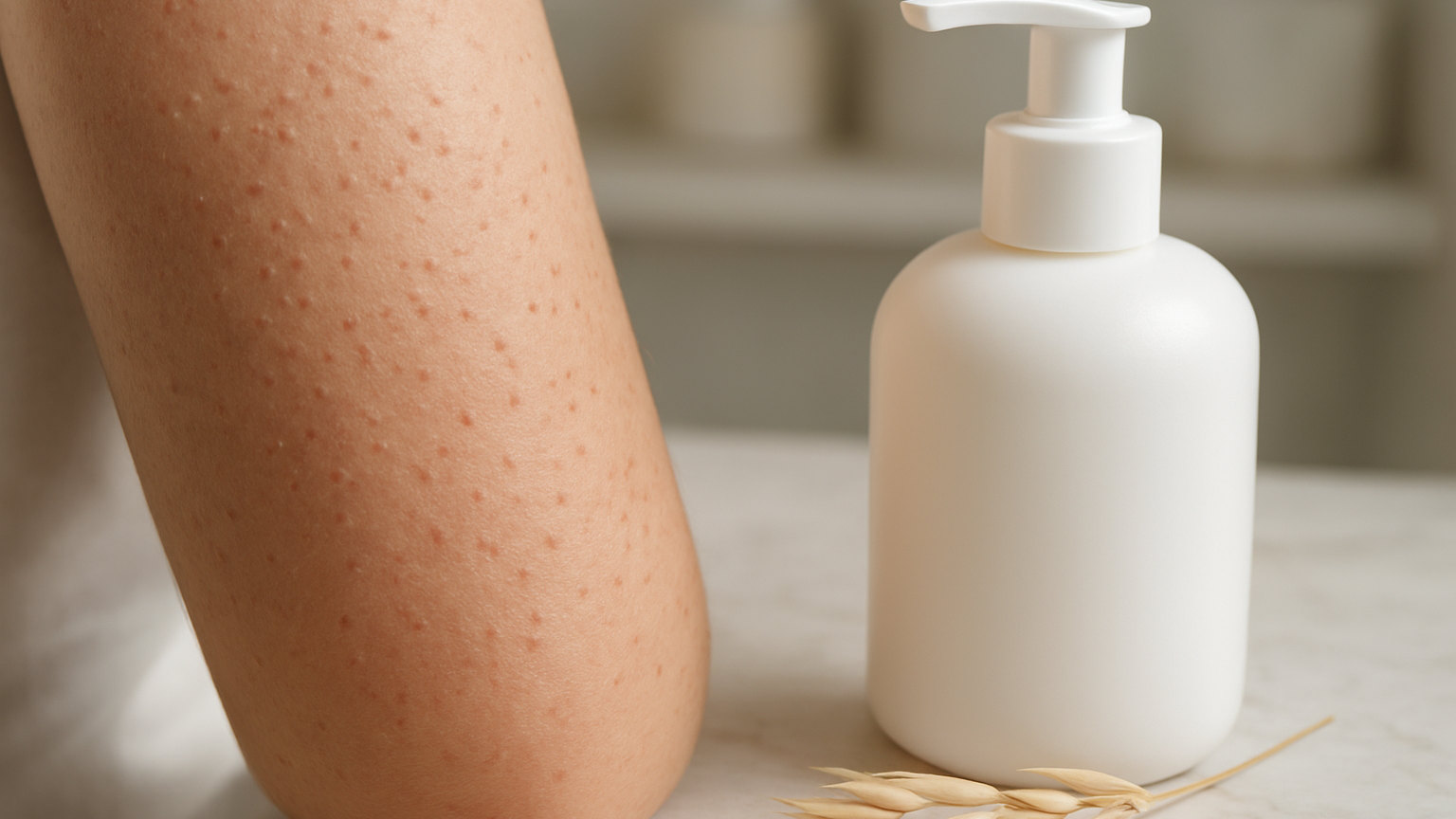
Keratosis pilaris produces small rough bumps, usually on the upper arms, thighs, buttocks and sometimes cheeks. It affects a substantial proportion of people, is completely harmless, and cannot be cured, which makes managing it the realistic aim.
What is actually happening?
Keratin, the protein making up the outer skin layer, accumulates around the opening of a hair follicle and forms a plug.
The plug traps the hair beneath it, which sometimes coils under the surface, and the surrounding skin becomes slightly raised and rough. The result is the sandpaper texture and the small bumps.
Some bumps look red or brown, which is inflammation or pigment around the follicle rather than the plug itself.
Who gets it?
Around a third to half of people at some point, and it is particularly common in children and adolescents.
It runs in families and is inherited in most cases. It is associated with dry skin, eczema and asthma, and is more noticeable in people with those conditions.
It frequently improves with age, often substantially by the thirties or forties, and it worsens in winter for almost everyone.
Why does it get worse in winter?
Because dry skin makes the plugs more pronounced and the surrounding skin rougher.
Cold air and central heating both reduce skin hydration, which is why the same arms that look reasonably smooth in August feel like sandpaper in January.
Hormonal changes affect it too, and pregnancy commonly makes it more noticeable.
What treatments work?
Chemical exfoliation rather than scrubbing. Lactic acid, glycolic acid, salicylic acid and urea all dissolve the keratin plugs.
Urea at ten to twenty per cent, or a lactic acid cream at around twelve per cent, are the two most effective options and both are available without prescription. Applied daily, they produce noticeable improvement within four to eight weeks.
A topical retinoid helps by normalising keratin production, and it is more irritating and takes longer.
Simple consistent moisturising helps considerably even without an active, since much of what makes it noticeable is dryness.
What makes it worse?
Scrubbing, which is the universal instinct and inflames the follicles rather than clearing them. It converts rough skin into red rough skin.
Picking at the bumps, which causes scarring and lasting pigmentation.
Hot showers and harsh soaps, which dry the skin.
Shaving over affected areas with a blunt blade, which irritates the follicles further.
How long does it take to improve?
Four to eight weeks for texture with consistent daily use of an acid or urea cream.
Redness and pigmentation take considerably longer, frequently several months, and they fade only if the area is not being repeatedly irritated.
It returns if treatment stops, which is the part worth accepting early. This is management rather than cure, and a maintenance routine of a few times a week usually holds it.
Does anything remove it permanently?
No. The follicular tendency is genetic and persists.
Laser treatment can reduce the redness component, and laser hair removal sometimes helps by removing the trapped hairs. Neither addresses the keratin plugging itself.
Claims of permanent cure are not credible, and the honest position is that it usually improves substantially with age and can be kept unobtrusive in the meantime.
When is it something else?
If the bumps are itchy, spreading or pustular, which suggests folliculitis rather than keratosis pilaris.
If they appear suddenly in adulthood having never been present, which is unusual.
If there is hair loss or scarring in the affected area, or if the skin is markedly red and inflamed, which warrants a GP appointment since some related conditions do cause permanent change.
Does it affect the face?
Sometimes, and it looks different enough to be mistaken for acne. Keratosis pilaris rubra faceii produces persistent redness with fine rough bumps across the cheeks, most often in children and adolescents.
It has no blackheads or pustules, which distinguishes it. Treatment is gentler than on the body, since facial skin tolerates less: a low-strength lactic acid, careful moisturising, and avoiding scrubs entirely.
It frequently improves substantially after adolescence, and the redness responds to azelaic acid better than the texture does.


