
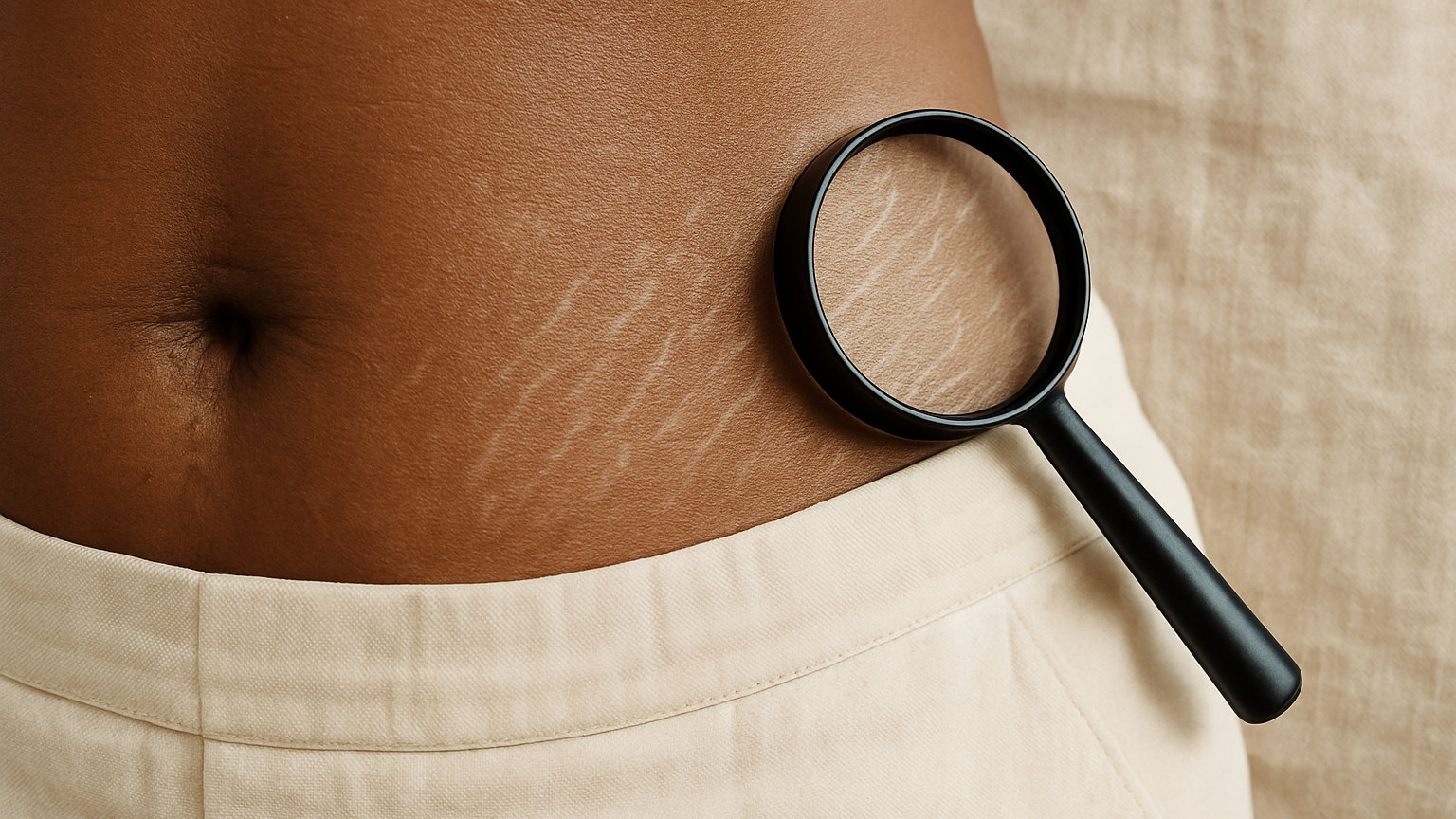
Stretch marks are a form of scarring in the dermis, the layer beneath the surface. That single fact explains why they are permanent, why creams applied to the surface do so little, and why the early red stage responds far better than the mature white one.
What is happening in the skin?
Rapid stretching disrupts the collagen and elastin network in the dermis. The fibres tear and reorganise, and the skin heals with scar tissue that is structurally different from the surrounding skin.
Corticosteroids play a significant role. Cortisol weakens elastic fibres, which is why stretch marks are associated with puberty, pregnancy, rapid growth and steroid use rather than with stretching alone.
They appear perpendicular to the direction of stretch: horizontal on the abdomen in pregnancy, vertical on the thighs and breasts.
What are the stages?
Striae rubrae, the early stage, are red, purple or pink, sometimes slightly raised and occasionally itchy. Inflammation and increased blood flow are present, and the tissue is still remodelling.
Striae albae, the mature stage, are white, silvery, flattened and slightly depressed. The remodelling has finished.
This distinction determines what treatment can achieve. The red stage responds meaningfully; the white stage responds poorly to almost everything.
Who gets them?
Most people, at some point. Estimates suggest the majority of women and a substantial proportion of men.
The strongest risk factor is family history, which suggests a genetic component to how skin responds to stretching.
Others include pregnancy, adolescent growth spurts, rapid weight change, bodybuilding, and long-term oral or topical corticosteroid use.
Certain medical conditions, particularly Cushing's syndrome and connective tissue disorders, produce them extensively and warrant investigation if they appear without an obvious cause.
Can they be prevented?
Not reliably, which is the honest answer and rarely the one given.
Reviews of prevention studies have found little good evidence that any topical product prevents them. Cocoa butter, olive oil and almond oil have all been tested against placebo without convincing results.
What may help modestly is avoiding rapid weight change where that is within your control, and keeping skin well moisturised, which improves comfort and reduces the itching that leads to scratching.
Massage itself may have a small effect, which is a plausible explanation for why oils appear to help in some studies: the rubbing rather than the oil.
Which treatments have evidence?
Topical tretinoin, a prescription retinoid, has the best evidence and works only on the early red stage. It stimulates collagen production and can reduce their appearance meaningfully over several months. It is not suitable during pregnancy or breastfeeding.
Microneedling, which stimulates collagen remodelling and has reasonable evidence for both stages.
Fractional laser, which improves texture and colour, with better results on newer marks.
Centella asiatica and hyaluronic acid have some limited supporting evidence in prevention studies.
All of these reduce appearance rather than removing them.
What does not work?
Cocoa butter, shea butter and most oils, which moisturise pleasantly and do not reach the dermis where the problem is.
Most creams sold specifically for stretch marks, which are moisturisers with a claim attached.
Dry brushing, coffee scrubs and anything promising removal.
Surgery removes skin containing them rather than treating them, which is only relevant alongside procedures done for other reasons.
Do they fade on their own?
Yes, considerably. The red stage typically fades to white over six to twelve months, and they become less noticeable over years.
They flatten and pale but do not disappear. Most people find them substantially less visible a few years after they appear, particularly against pale skin.
They tan less than surrounding skin, so they become more obvious after sun exposure rather than less, which is worth knowing before deliberately tanning to disguise them.
When are they worth investigating?
If they appear extensively without pregnancy, weight change or a growth spurt to explain them.
If they are accompanied by easy bruising, weight gain around the trunk, muscle weakness or high blood pressure, which together can suggest Cushing's syndrome.
And if they follow prolonged use of a topical steroid, which is worth raising with whoever prescribed it.


