
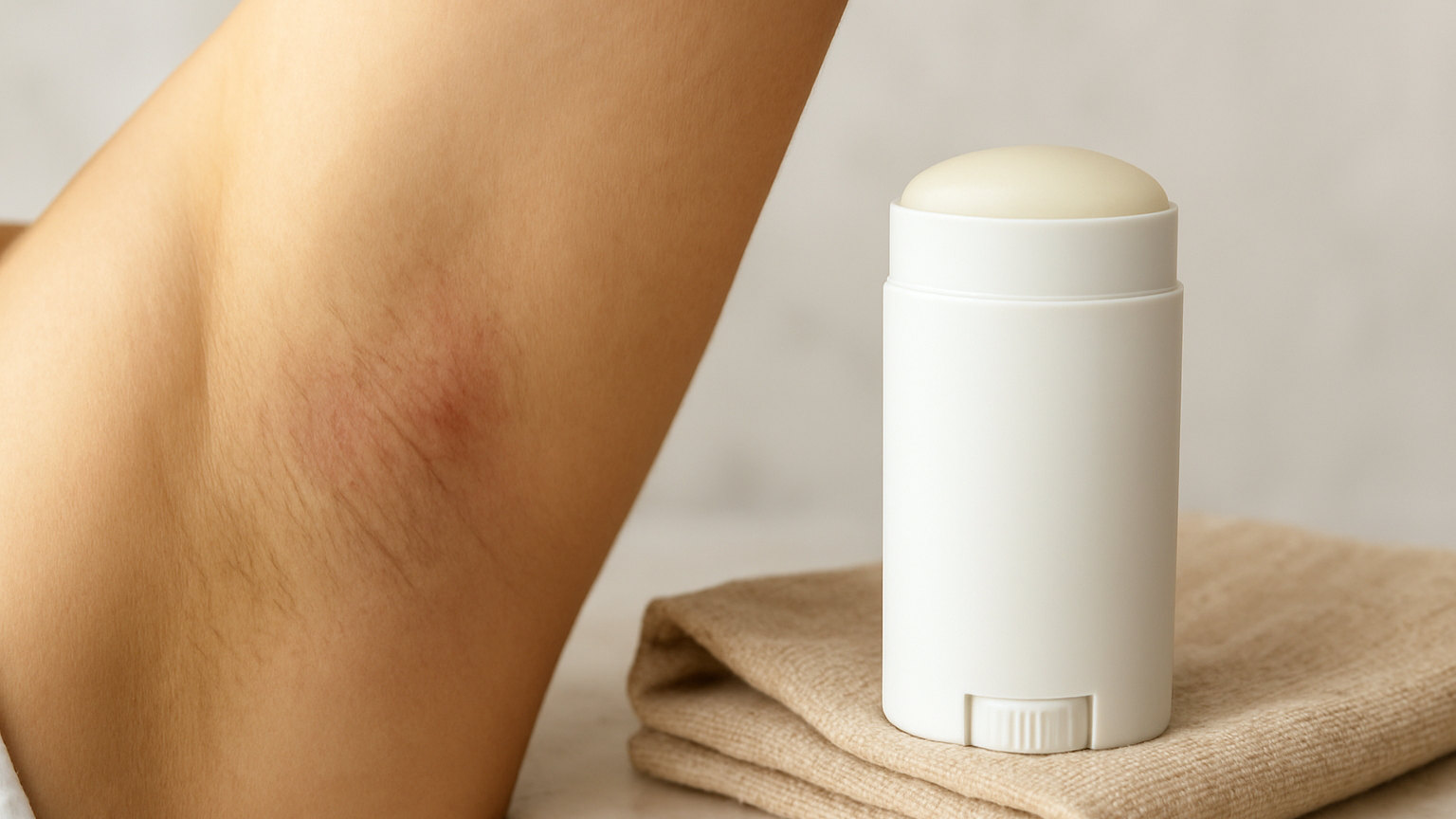
A red, itchy underarm after using a deodorant is common. In most cases it is irritation rather than allergy, which matters because irritation means using less and allergy means never again.
How do you tell them apart?
Irritant contact dermatitis is dose-dependent and appears fairly quickly, within hours. It stings or burns more than it itches, stays where the product was applied, and improves if you use less or less often.
Allergic contact dermatitis is an immune response requiring prior sensitisation. It itches rather than stings, appears twelve to forty-eight hours later, can spread beyond the application area, and occurs at any amount once established.
An allergy can develop suddenly after years of using the same product without trouble, which surprises people and is entirely typical.
Which ingredients cause it?
Fragrance, by a considerable distance. It is the commonest cause of cosmetic contact allergy, and deodorant is applied daily to thin, frequently shaved skin.
Alcohol, which stings on shaved skin and is drying, and is a common irritant rather than allergen.
Bicarbonate of soda in natural deodorants, which is strongly alkaline at around pH 9 against skin at pH 5. It causes irritant dermatitis in a substantial minority.
Propylene glycol, essential oils, lanolin and preservatives all appear in reported cases.
Aluminium salts themselves are a less common cause than the fragrance they are combined with.
Why does shaving make it worse?
Because shaving removes the top layer of skin along with the hair, so the barrier is temporarily compromised.
Applying any product to freshly shaved skin means more of it penetrates and more of it stings.
The most useful single change is to shave at night and apply deodorant the following morning, or to shave and apply at opposite ends of the day. This resolves a surprising proportion of underarm irritation on its own.
How do you treat it?
Stop the product entirely, which is the first and most important step.
Wash the area gently with water and a bland cleanser to remove residue.
Apply a fragrance-free emollient several times daily. A short course of hydrocortisone one per cent from a pharmacy settles significant inflammation, used for a few days rather than ongoing.
Avoid shaving the area until it has healed. Wear loose cotton clothing.
Most cases settle within one to two weeks once the cause is removed.
How do you work out what caused it?
Stop everything applied to the area and return to nothing for a week or two.
Reintroduce one product at a time with several days between each, keeping the packaging so you have the ingredient list.
Patch test anything new on the inner forearm twice daily for five to seven days before using it under the arm. Repeated application matters, since allergic reactions require sensitisation and a single dab reveals nothing.
If reactions recur across several unrelated products, ask a GP about referral for clinical patch testing, which uses standardised allergen panels and identifies the specific compound.
What should you switch to?
Fragrance-free, which removes the commonest cause at a stroke. Note that unscented can mean a masking fragrance was added; fragrance-free is the phrase to look for.
Alcohol-free. A cream or roll-on rather than an aerosol.
If bicarbonate was the culprit, a magnesium hydroxide formulation, which works similarly and is considerably gentler.
If aluminium is confirmed as the cause, which is uncommon, a deodorant rather than an antiperspirant.
When is it not the deodorant?
A rash confined to the underarm fold rather than the whole application area, particularly if it is shiny, red and sometimes with small spots at the edges, suggests intertrigo with a fungal component and needs an antifungal cream.
Pustules around individual hairs suggest folliculitis rather than dermatitis.
Recurrent painful lumps and boils suggest hidradenitis suppurativa, which is a distinct condition warranting a GP appointment and early treatment.
Persistent scaling patches could be psoriasis or seborrhoeic dermatitis, both of which affect skin folds.
When should you see a GP?
If it has not settled within two weeks of stopping the product and using an emollient.
If it is weeping, crusting, spreading or painful. If it recurs with every product you try.
And if you develop swelling beyond the underarm or any breathing difficulty, which requires urgent attention.


