
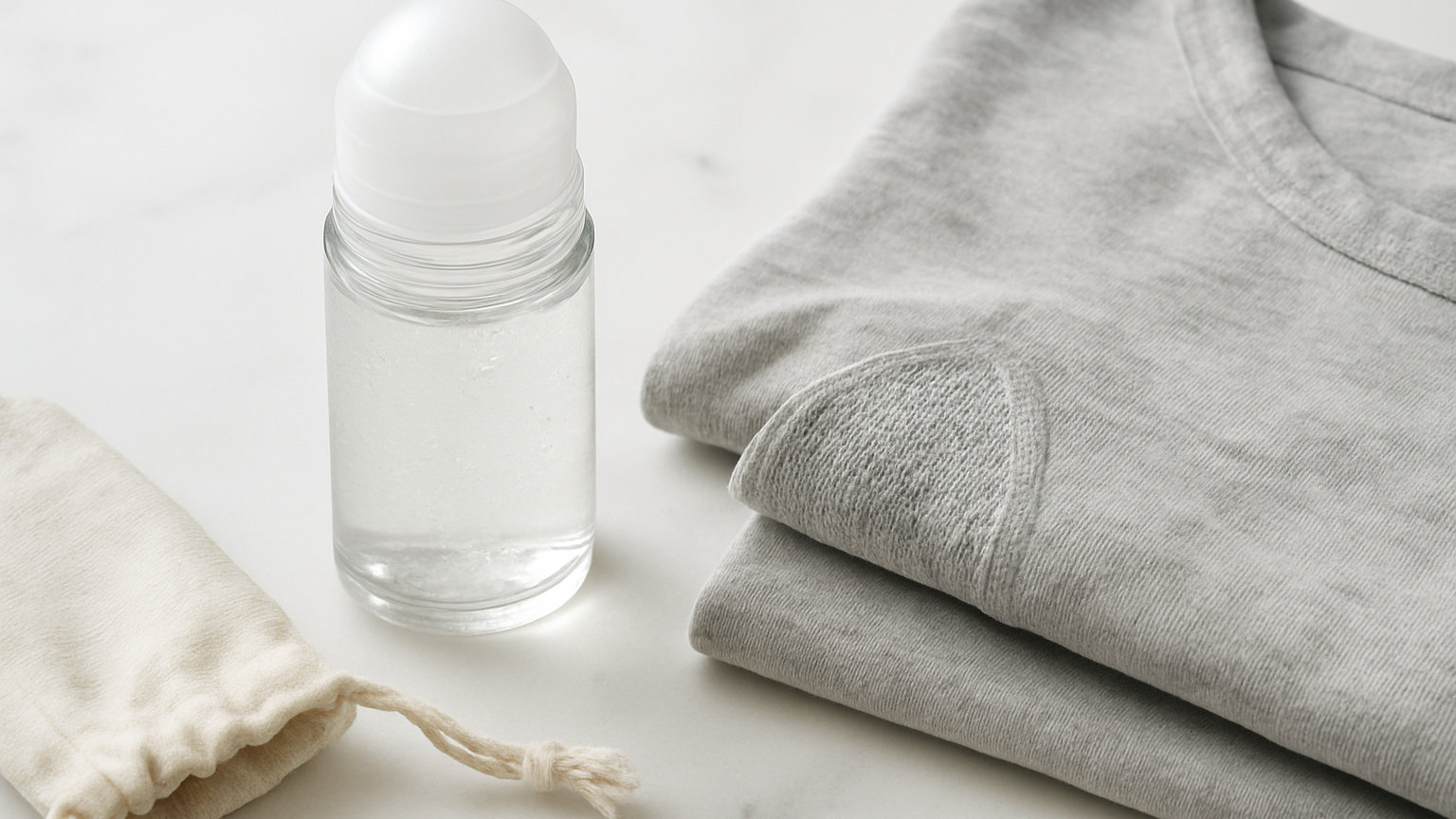
Sweating at work is a common source of genuine distress, and most of what helps is practical rather than medical. Fabric, timing and preparation account for more than the product does.
What should you change first?
Apply antiperspirant at night to completely dry skin rather than in the morning after a shower.
Sweat glands are least active overnight, which lets the aluminium salts form plugs properly. Applied to damp skin in the morning, much of it washes away before it can act.
The plugs persist for a day or two, so you are still protected and can shower normally. This single change resolves the problem for a substantial number of people.
Which fabrics show sweat least?
Patterned fabrics, which break up any mark. Dark colours other than mid-tones.
Black and white show sweat least. Grey, light blue and pastels show it most, and grey marl is the worst combination available.
Thicker fabrics absorb without the mark reaching the surface. Linen and heavier cottons perform better than thin synthetics.
Merino wool is worth knowing about: it wicks, resists odour considerably better than polyester, and does not show marks readily.
What about layering?
A cotton undershirt absorbs sweat before it reaches the outer layer, and is the most reliable solution for shirts.
It sounds warmer and frequently is not, since it keeps the outer shirt dry against the skin.
Underarm shields, either disposable or sewn-in, are a targeted version of the same idea and are effective for anyone whose sweating is confined to the underarms.
Sweat-proof undershirts with built-in barrier panels exist and work well, though they are considerably more expensive.
What should you keep at your desk?
A spare shirt, which removes the underlying anxiety more than anything else on this list.
Deodorant wipes or a travel-size roll-on for topping up. A small towel or facial tissues.
A small deodorising spray for shoes if feet are the issue, and spare socks.
Having these available matters partly because they work and partly because knowing they are there reduces the anticipatory anxiety that itself increases sweating.
How do you handle a presentation or interview?
Apply antiperspirant the night before and the night before that, which builds better protection than a single application.
Wear a patterned or dark shirt and an undershirt. Avoid a jacket you will need to remove.
Arrive early enough to cool down, since rushing raises core temperature and sweating continues for a while afterwards.
Avoid caffeine beforehand, which increases sympathetic activity, and avoid spicy food.
Cold water on the wrists and the back of the neck lowers perceived temperature quickly.
What about the anxiety loop?
Sweating causes anxiety about sweating, which increases sympathetic activity, which increases sweating. It is a genuine and well-recognised loop rather than a matter of overthinking.
Practical preparation breaks it more effectively than trying not to think about it, since the anxiety is largely about being caught unprepared.
For anyone where this is significantly affecting work or social life, it is worth treating rather than managing. That is a reasonable thing to raise with a GP.
What about hands and feet?
Sweaty palms make handshakes and keyboards difficult. A quick wipe on a handkerchief before a handshake is unremarkable and effective.
Aluminium chloride can be applied to palms, though it irritates more there. Iontophoresis is the effective treatment for palms and soles specifically.
For feet: leather rather than synthetic shoes, alternating pairs so each dries fully, changing socks midday, and antiperspirant applied to the soles at night.
When is it worth seeing a GP?
If it affects your work, your clothing choices or your willingness to attend meetings, which is sufficient reason on its own.
If over-the-counter antiperspirant applied correctly at night has not helped.
Prescription-strength aluminium chloride, iontophoresis and botulinum toxin injections all exist, and the last is effective for underarms for four to six months at a time.
What about the commute?
A crowded train or a brisk walk in a coat raises core temperature, and sweating continues for a while after you stop, which is why people arrive at their desk warmer than they left home.
Carrying the coat rather than wearing it, leaving a few minutes earlier so the walk is slower, and changing into a fresh shirt on arrival all help more than any product does at that point.
Keeping the work shirt in a bag and putting it on once you have cooled down is the most effective version of this, and it is a routine plenty of cyclists already follow.


