
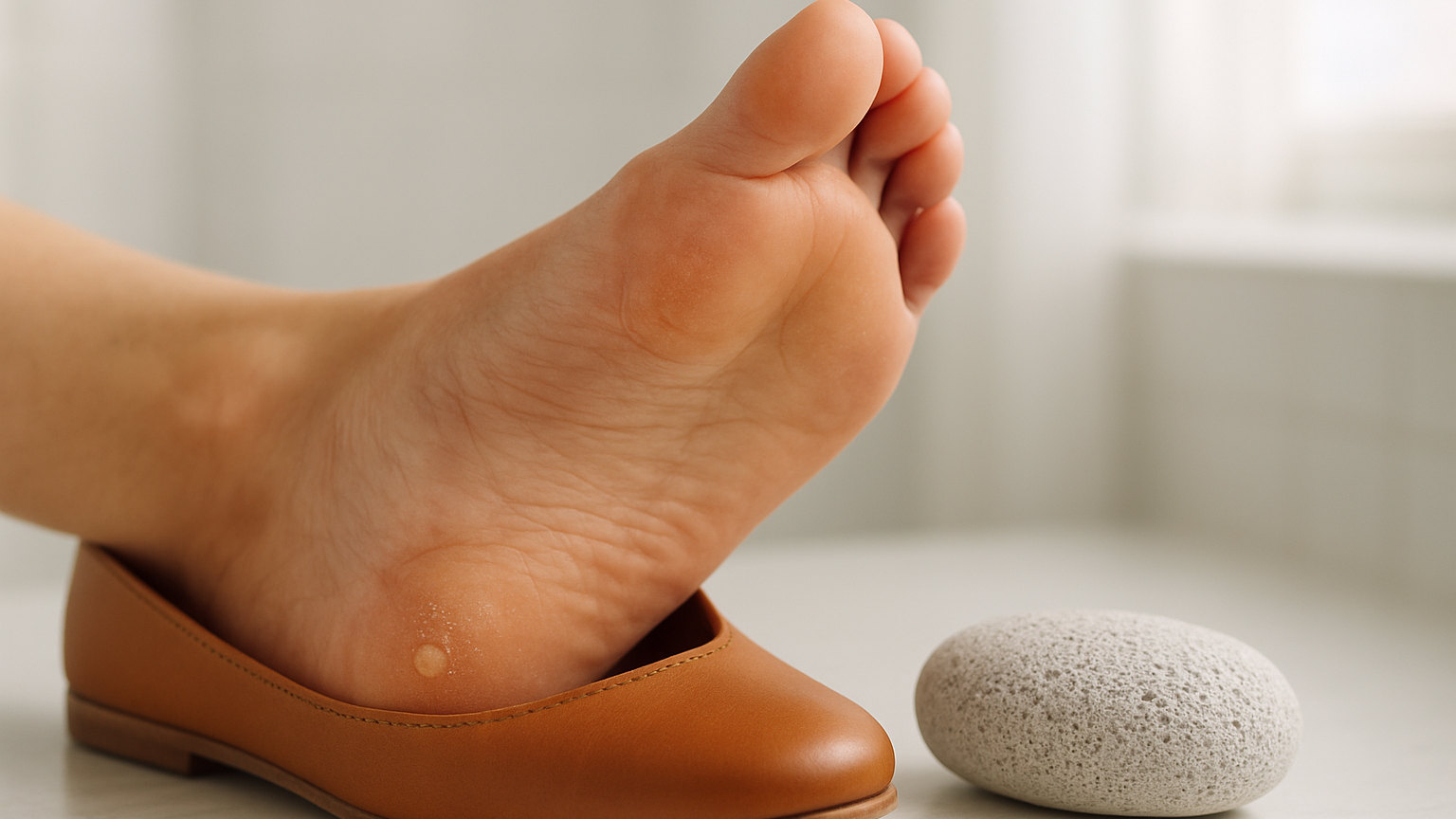
Corns and calluses are the skin doing its job. Under repeated pressure or friction it thickens to protect the tissue beneath. That is why removing one without addressing the pressure simply produces another within weeks.
What is the difference?
A callus is a broad, diffuse area of thickened skin, usually on the sole, heel or ball of the foot. It is generally painless and has no defined border.
A corn is smaller, more defined, and has a central core of harder keratin pressing inward. That core is what causes the sharp localised pain.
Hard corns appear on the tops and tips of toes and on the ball of the foot. Soft corns appear between the toes, where moisture keeps them soft and white, most often between the fourth and fifth toes.
Seed corns are tiny and appear in clusters on the sole, often painless.
What causes them?
Pressure and friction, and the source is almost always footwear or foot shape.
Shoes that are too tight, too loose, too narrow across the toes or have thin soles.
High heels, which concentrate pressure on the ball of the foot.
Foot deformities such as bunions, hammer toes and prominent metatarsal heads, which create high-pressure points.
Gait abnormalities, which load one part of the foot more than another.
Going barefoot regularly on hard surfaces.
How do you tell a corn from a verruca?
Worth distinguishing, since the treatments differ.
A corn has a smooth central core and the skin lines run over it uninterrupted.
A verruca interrupts the skin lines, frequently contains small black dots, and hurts more when squeezed from the sides than pressed downward.
If you are unsure, a pharmacist or podiatrist can tell you in seconds.
How do you treat them safely?
Soften first: a high-urea cream, at twenty-five per cent or above, applied daily. Salicylic acid preparations also soften keratin.
File gently on dry skin with a foot file, little and often. Removing a lot at once stimulates further thickening.
Relieve the pressure, which is the part that actually resolves it. Padding, a change of footwear, or a silicone toe sleeve.
For soft corns between the toes, keeping the area dry matters most: toe separators, thorough drying, and wider shoes.
What about medicated corn plasters?
They contain salicylic acid, which softens keratin effectively and does not distinguish between the corn and the healthy skin around it.
Applied slightly off-centre, they burn the surrounding skin, which is a common cause of ulceration.
They are not recommended for anyone with diabetes, poor circulation, neuropathy or fragile skin, where a chemical burn on the foot can become a serious wound.
Non-medicated padding achieves the pressure relief without the risk and is the safer choice for most people.
What should you never do?
Cut a corn or callus with a blade, razor or credo shaver at home. This causes serious injuries, and the core of a corn extends deeper than it appears.
Attempt to dig out the core, which introduces infection.
Remove all the hard skin, since some thickening is protective and the area will be tender and vulnerable without it.
Ignore recurrence, which is a signal about pressure rather than about how well you removed the last one.
What can a podiatrist do?
Debride the corn or callus properly with a sterile blade, which is safe in trained hands and provides immediate relief.
Assess the pressure distribution and gait, and provide padding or custom orthotics to redistribute load.
Advise on footwear specifically for your foot shape.
For recurrent corns over a bony prominence, refer for consideration of surgery to address the underlying deformity.
One appointment frequently resolves what months of home filing does not.
When should you see someone?
Anyone with diabetes, peripheral arterial disease or neuropathy should not self-treat corns and calluses at all.
Any corn or callus that is painful, inflamed, discharging or ulcerated.
Recurrent corns in the same place, which indicate a mechanical problem that will keep producing them.
And any hard lump you are not certain about, since not everything on a foot is a corn.


