
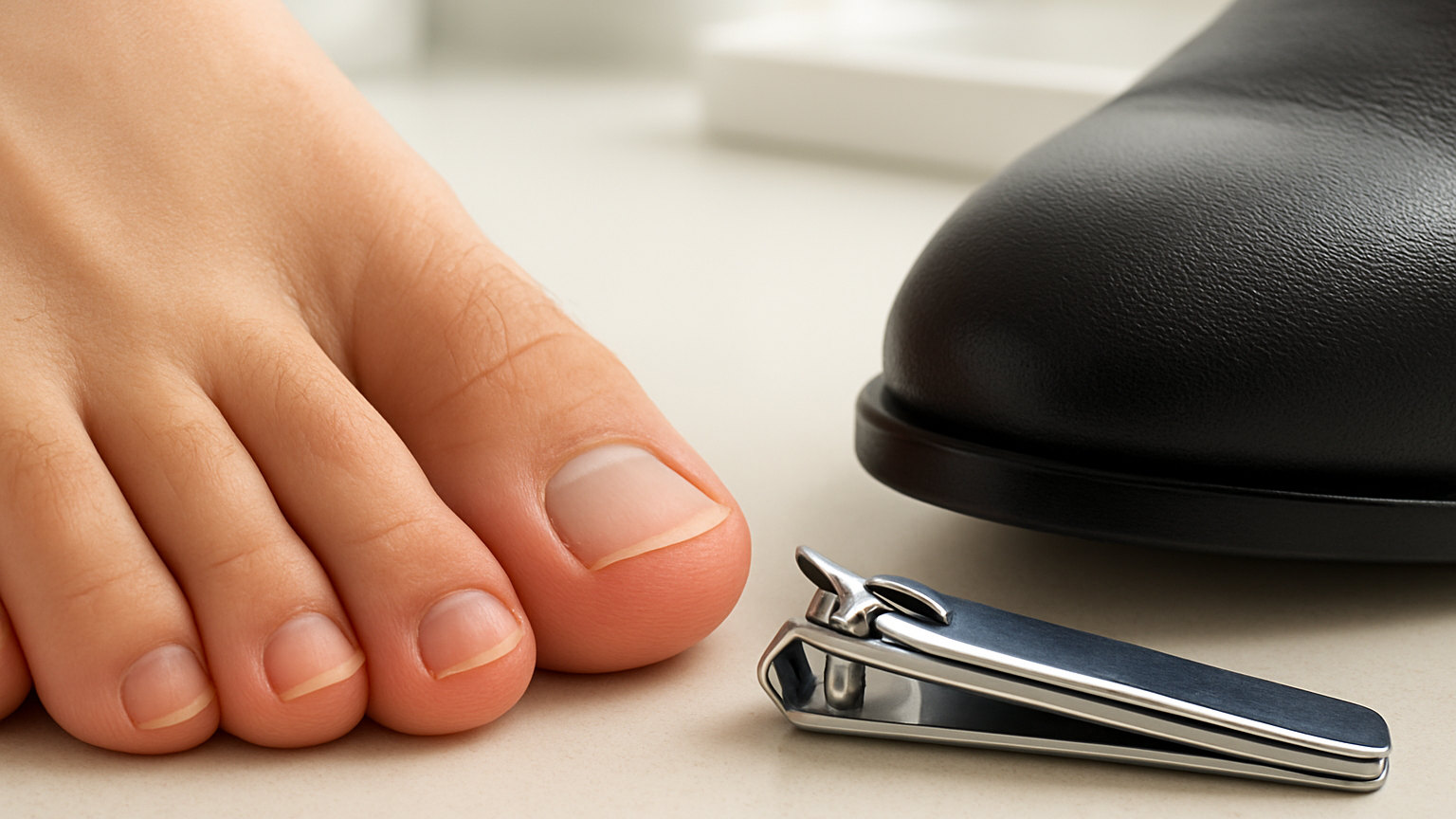
An ingrown toenail is a nail edge growing into the skin beside it. It is usually caused by how the nail was cut and what the toe is being pressed into, and it becomes considerably worse when people try to dig the corner out.
What causes them?
Cutting the nail rounded at the corners rather than straight across, which is the single commonest cause. A rounded corner allows the surrounding skin to fold over the nail as it grows forward.
Cutting the nail too short, which has the same effect.
Tight or narrow footwear, which presses the skin against the nail edge. High heels concentrate that pressure.
Injury to the toe, including repetitive trauma from running or from shoes that are slightly too short.
Naturally curved or fan-shaped nails, which are inherited and predispose regardless of technique.
Sweaty feet, since softened skin is more easily penetrated by the nail edge.
What are the stages?
Early: the side of the toe is tender and slightly red, with no discharge. This stage responds well to self-care.
Middle: increasing pain, swelling, redness and sometimes clear or yellow discharge as the skin becomes inflamed and infected.
Late: pus, significant swelling, and overgrowth of soft tissue at the nail fold, which is called hypergranulation and appears as a red fleshy lump.
The earlier you address it, the more likely it is to resolve without a procedure.
What should you do early?
Soak the foot in warm salty water for ten to fifteen minutes, two or three times a day, which softens the skin and reduces inflammation.
Dry thoroughly afterwards, particularly between the toes.
Wear open or wide shoes, and avoid anything pressing on the toe.
Some people find gently placing a small piece of clean cotton wool or dental floss under the nail corner after soaking helps lift it away from the skin. Do this only if it is not painful, and stop if it is.
Take painkillers if needed and keep the area clean and dry.
What should you not do?
Dig at the corner or attempt bathroom surgery, which is the commonest way a sore toe becomes an infected one.
Cut a V shape in the middle of the nail, which is a widely repeated folk remedy with no basis. Nails do not grow inward from the centre and cutting a notch achieves nothing.
Cut the nail shorter to relieve it, which usually makes it worse by removing the edge that would have grown out past the skin.
Ignore spreading redness or pus, which needs treating rather than soaking.
How do you prevent them?
Cut nails straight across, level with the end of the toe, and file any sharp corner smooth rather than cutting it away.
Do not cut them too short. The nail should still be visible at the end of the toe.
Cut after a bath, when the nail is softer and less likely to split.
Wear shoes with enough room in the toe box, and check length: there should be a thumb's width beyond the longest toe.
Keep feet dry and change socks daily.
What can a podiatrist do?
Remove the offending spike of nail, which frequently provides immediate relief and is done with local anaesthetic if needed.
Treat any infection and reduce hypergranulation tissue.
For recurrent cases, a partial nail avulsion with phenolisation, where a strip of nail is removed and the nail bed treated so that portion does not regrow. It is done under local anaesthetic, takes around half an hour, and has a high success rate.
The nail afterwards is slightly narrower and looks essentially normal.
When should you see someone?
Pus, spreading redness, warmth or a fever, which indicate infection needing treatment.
Pain severe enough to affect walking or sleep.
Any ingrown toenail that recurs, since a procedure resolves permanently what soaking manages temporarily.
And anyone with diabetes, peripheral arterial disease or neuropathy should see a podiatrist or GP at the first sign rather than self-treating at all, since a small infection on a foot with reduced sensation and healing can become serious quickly.


