
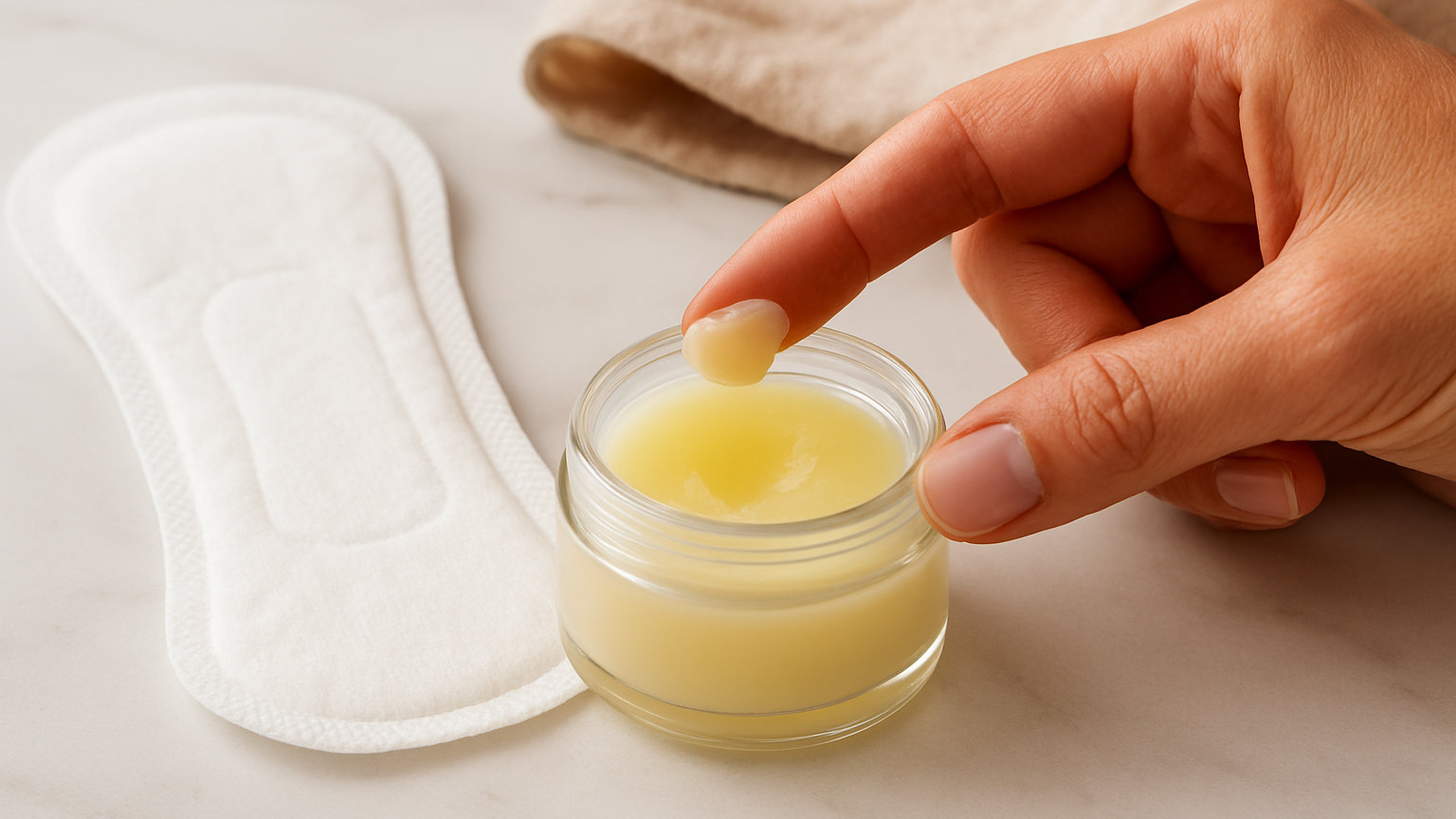
Menstrual products sit against thin, warm, occluded skin for hours at a time. A meaningful proportion of the irritation people attribute to their period is caused by the product rather than by menstruation.
What causes irritation from pads?
Occlusion and friction, primarily. A pad traps heat and moisture against the skin and rubs with every movement.
Fragrance in scented pads, which is a common cause of contact dermatitis in this area.
Adhesive and the plastic backing layer, which prevent air circulation.
Leaving the same pad in place too long, which increases both moisture and friction.
The result is redness, soreness, itching and sometimes chafing at the edges where the pad meets the thigh.
How do you reduce it?
Change more often than seems necessary, ideally every four hours or sooner on heavier days.
Choose unfragranced products, and cotton-topped rather than plastic-topped ones if you react.
Apply a plain barrier balm or an unfragranced emollient to the skin before putting on a pad, particularly where chafing occurs.
Wear loose cotton underwear rather than tight synthetic.
Switch products for a cycle or two to test whether the product is the cause, which is the most direct way to find out.
What about tampons?
They avoid the external occlusion entirely, which suits anyone whose problem is pad rash.
They can cause dryness and irritation internally if used on light days or with an absorbency higher than needed, since they absorb natural moisture along with blood.
Use the lowest absorbency that works, change every four to eight hours, and never leave one in longer than eight.
Difficulty inserting or removing one, or pain, is worth mentioning to a GP rather than persevering.
What about menstrual cups and discs?
They collect rather than absorb, so they do not dry the tissue, and they can be worn for up to twelve hours depending on the product.
They need washing with plain water or an unfragranced wash between uses and sterilising between cycles by boiling.
Insertion takes practice, and a cup that is the wrong size or sits incorrectly can cause discomfort or leaking.
They are cost-effective over time and produce far less waste, which is a genuine advantage.
Anyone with a coil should discuss cup use with their clinician, since there have been reports of displacement.
What about period underwear?
Absorbent layers built into the fabric, worn like ordinary underwear and washed afterwards.
They avoid adhesive and plastic backing, and many people find them considerably more comfortable.
They still hold moisture against the skin, so changing during the day on heavier flow matters.
Wash according to the instructions, since fabric conditioner ruins the absorbent layer.
What should you know about toxic shock syndrome?
It is very rare and serious, caused by toxins from certain bacteria, and associated with tampon use, particularly high absorbency tampons left in too long.
Symptoms come on suddenly and include a high fever, a widespread sunburn-like rash, vomiting, diarrhoea, dizziness, confusion and muscle aches.
If these occur while using a tampon, remove it and seek emergency medical help immediately, saying that you have been using a tampon.
To reduce risk: use the lowest absorbency needed, change every four to eight hours, wash hands before and after insertion, and alternate with pads where practical.
It can also occur with cups and other internal products, and with wounds and infections unrelated to periods.
Does the rest of your skin change?
Yes, and predictably. Progesterone rises after ovulation and increases sebum production, which is why breakouts commonly appear in the week before a period, typically along the jaw and chin.
Skin can also be more sensitive and reactive in the days before and during a period, so this is not the moment to start a new active or have a strong treatment.
Pain thresholds are lower around menstruation, which is worth knowing before booking waxing or threading.
When should you see a GP?
Irritation that persists after switching to unfragranced products for a cycle or two.
Pain during insertion or removal of a tampon or cup, or pain during sex.
Any unusual bleeding, bleeding between periods, or a sudden change in your cycle.
Periods heavy enough to affect daily life, which is common and treatable rather than something to endure.


