
A tan line is a boundary between skin that has been damaged by ultraviolet and skin that has not. There are only two ways to reduce the contrast: fade the dark side or colour the pale side, and one of them involves no further damage.
Why does more sun not fix them?
Because exposing the pale area also exposes the already tanned area, which continues darkening. The gap between them narrows slowly if at all.
Skin that has never been exposed also burns considerably faster than skin that has, so uncovering a strap line in strong sun frequently produces a burn on the pale strip before any tan develops.
Deliberately exposing the pale area to even things out is the commonest cause of a burn in an otherwise careful person.
How do you fade the tan side?
Gentle exfoliation, since tanned cells shed over time and removing them speeds it.
An exfoliating mitt with a body scrub two or three times a week, focused on the darker area rather than the whole body.
Lactic or glycolic acid body lotion, which speeds cell turnover chemically without friction.
Moisturising well, since well-hydrated skin sheds more evenly and looks less contrasty.
A natural tan fades over two to four weeks regardless, so patience does most of the work.
How do you colour the pale side?
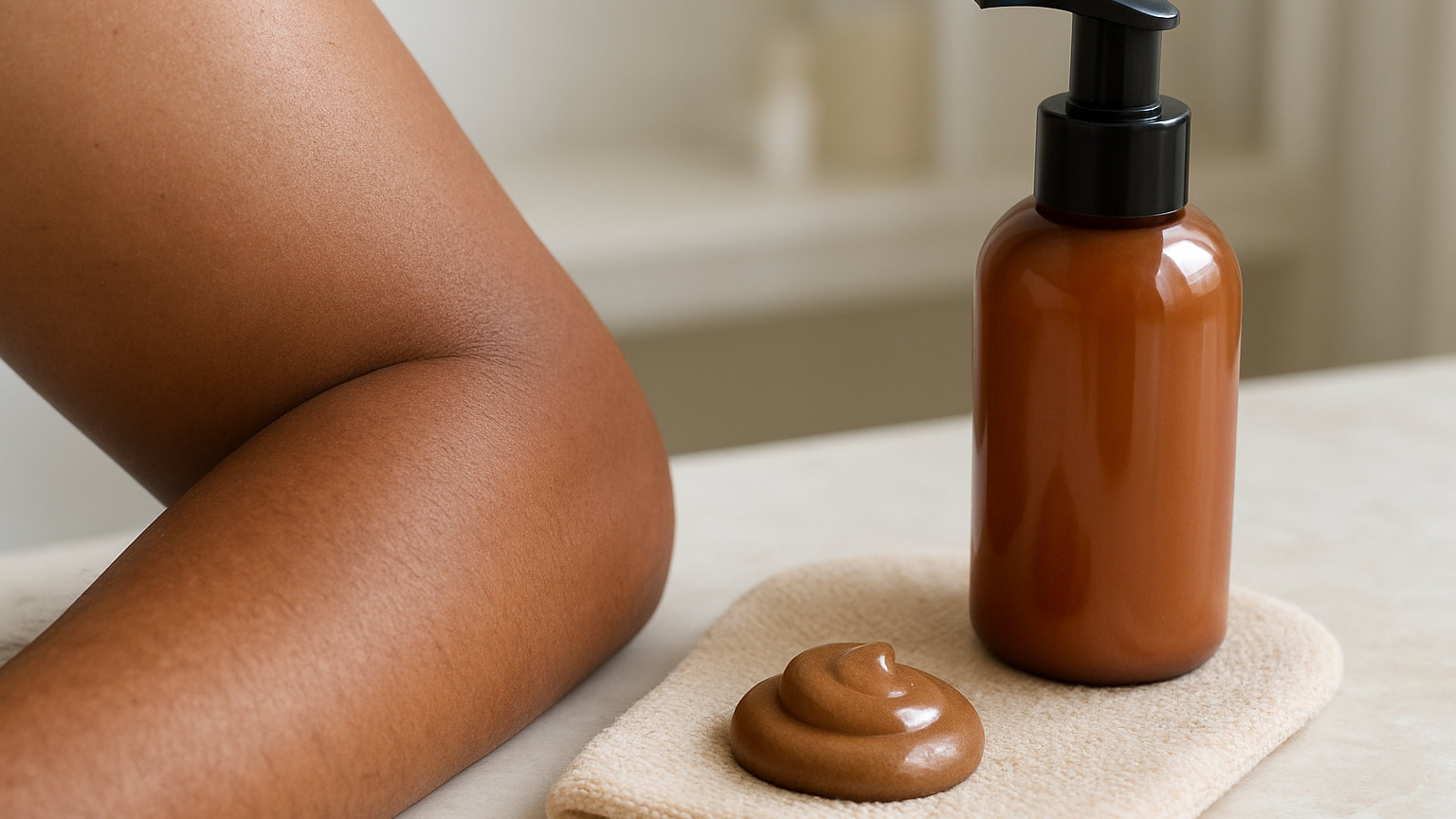
Fake tan, applied to the pale strip and blended outward over the boundary.
Use a gradual tanner rather than a full-strength product, building over two or three applications so you can stop at the right depth.
Apply with a mitt in sweeping motions across the line rather than up to it, feathering the edges so there is no second boundary.
Do a small test area first, since fake tan develops differently on skin that has been sun-exposed compared with skin that has not.
Does fake tan work over an existing tan?
Yes, and the developed result will be deeper than on untanned skin, since you are adding colour to colour.
Sun-exposed skin is often drier and more textured, which means it can grab colour unevenly. Exfoliating and moisturising first matters more than usual.
Choose a shade close to your current tanned colour rather than a dark one, and build gradually.
What about strap marks on the shoulders?
These are the hardest to blend because the lines are sharp and in a visible place.
Fake tan applied to the pale strips with a small mitt or a makeup sponge gives the most control.
A tinted body makeup or a wash-off body bronzer covers them for a single occasion and washes off, which is the simplest answer for an event.
Varying strap positions during future exposure prevents the sharp line forming in the first place.
How do you avoid them?
Sunscreen properly applied everywhere, which produces a gentler gradient rather than a sharp line.
Varying what you wear across a holiday: different strap positions, different necklines, and time in the shade.
Reapplying sunscreen to areas that shift, such as under straps and around waistbands, which move during the day and expose new skin.
Accepting a lighter overall tan, since the contrast is what makes lines visible rather than the tan itself.
What about the face and hands?
Faces and hands are exposed year-round, so they are frequently darker than the body at the start of summer and lighter by the end.
A facial self-tan product used lightly evens this, and a shade lighter than your body product is usually right.
Hands are the commonest giveaway on a fake tan and the commonest mismatch on a natural one, so blending the wrists deliberately is worth the extra minute.
Is there anything faster?
Wash-off body makeup and tinted body lotions cover a line for a day and come off in the shower. Useful for a single event.
Beyond that, the mechanisms are slow by nature. Fading takes weeks and fake tan takes hours to develop, so anything for an occasion needs planning two or three days ahead rather than the morning of.


