
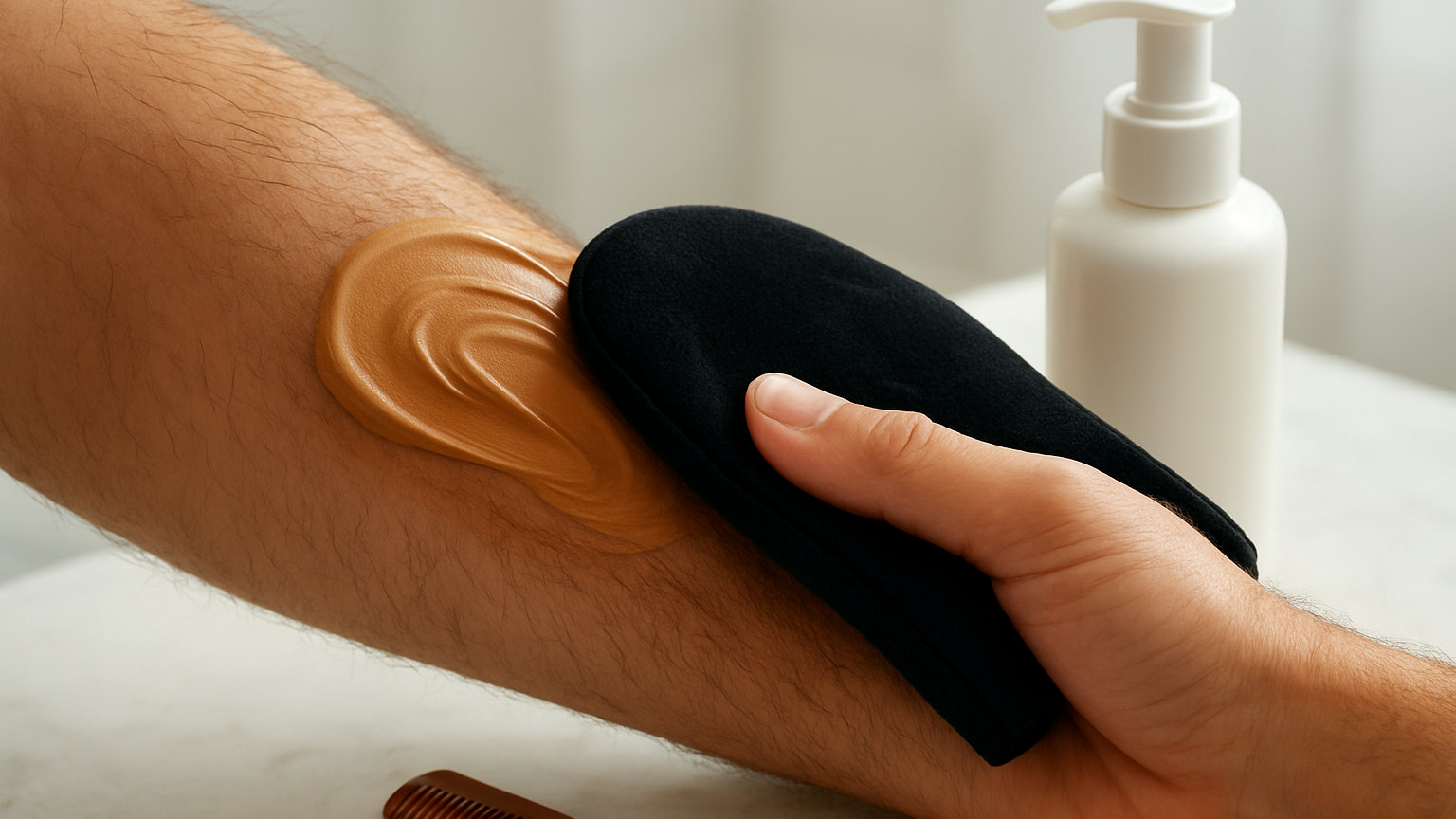
Self-tan chemistry does not distinguish between users. The practical differences for men are body hair, slightly thicker and oilier skin, and usually a preference for something that reads as being outdoors rather than as being tanned.
Does body hair affect it?
Yes, in two ways. Hair blocks product from reaching the skin evenly, so denser areas take less colour and can look patchy.
Hair also holds product, which can leave visible darker residue at the roots and on the hair itself.
The practical answer is to apply less and work it in more thoroughly, using the mitt in short overlapping strokes rather than long sweeps, and to go over hairy areas a second time with what remains on the mitt.
Trimming body hair before tanning gives a more even result if you were going to trim anyway.
Does skin thickness matter?
Male skin is on average around twenty per cent thicker and produces more sebum, which affects how the product sits.
Oilier skin can resist the product slightly, so ensuring the skin is clean and free of moisturiser matters more.
Thicker skin on the elbows, knees and hands grabs colour in the same way it does on anyone, so the same barrier-cream approach applies.
Which products suit?
Gradual tanners, for almost anyone starting out. Low concentration means mistakes are invisible, there is no development period to sit through, and colour builds slowly enough to stop where you want it.
Tanning water or a clear mousse, which leave no guide colour on clothing and are harder to streak, though missed patches are invisible until development.
Drops added to your usual moisturiser, which give the most control over strength and are the easiest option for the face.
Full-strength mousses are worth avoiding until you know how your skin responds, since the commonest complaint is a result that is obviously applied.
How do you keep it subtle?
Go one or two shades lighter than seems right, and build over several applications rather than one.
Focus on evening out tone rather than adding depth. The aim that usually looks best is a slightly healthier version of your own colour rather than a visible tan.
Pay particular attention to the hands, wrists and neck, since a mismatch there is what makes any tan obvious.
Green or neutral-based products for fair skin, which counteract orange.
What about the face?
Use a facial product or tanning drops rather than body mousse, which is heavier and more likely to congest.
Moisturise the eyebrows, hairline, beard line and sides of the nose first, since all grab colour.
For anyone with a beard, blend carefully at the edges and avoid working product into the beard itself, which will hold colour visibly.
Continue onto the ears and down the neck so there is no boundary.
What about the back?
The reach problem is the same as with sunscreen, and the solutions are the same: a long-handled applicator, a spray formulation, or asking someone.
The middle of the back is the commonest missed area, and a pale patch there is conspicuous without a shirt.
A back applicator with a mitt attachment is inexpensive and solves it.
What about sport and sweating?
Sweating during development produces runs, so leave at least the stated development time before exercising.
Afterwards, heavy sweating and frequent showering both accelerate fading, so anyone training most days will get less wear from an application.
Gym clothing rubs colour off at the shoulders and thighs particularly. Maintaining with a gradual tanner every few days works better than reapplying fully.
Is it worth it?
For anyone who wants colour, it is the only route that does not involve ultraviolet damage, and the safety difference is not marginal.
The main reason men abandon it is a first attempt with a full-strength product that looked obvious. Starting with a gradual tanner avoids that almost entirely, and most people who use one regularly are not identifiable as using anything.


