
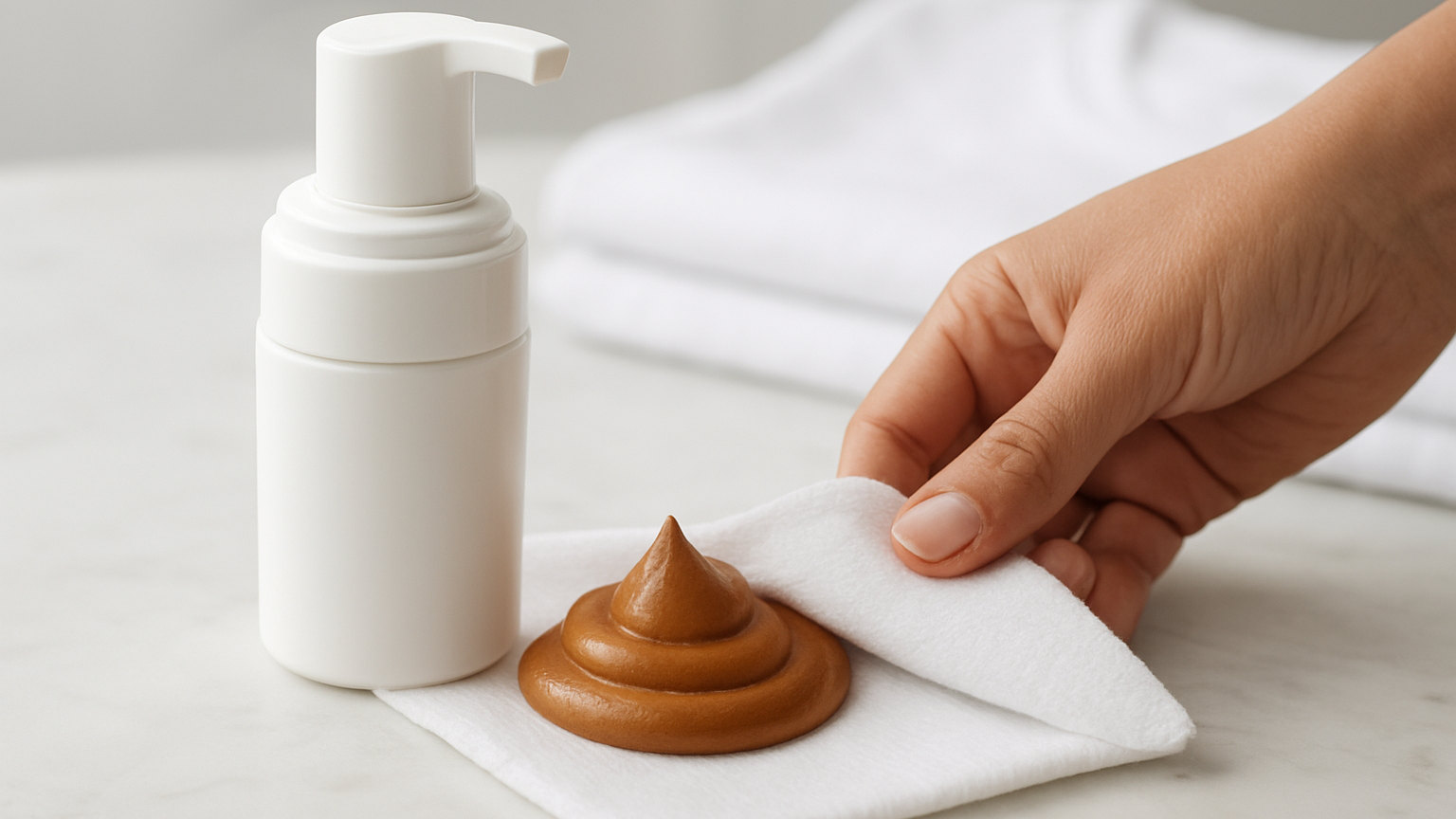
The brown mark on a pillowcase after tanning is almost always the guide colour, which is a temporary cosmetic dye added so you can see where you have applied. The DHA reaction itself happens in your skin and does not transfer.
Why does it stain at all?
Guide colour is designed to wash off skin, and it transfers readily onto anything it touches during development.
Some formulations also contain oils, which carry the colour into fabric and make it harder to lift.
Once the guide colour has been rinsed off in the first shower, the developed tan does not transfer at all, which is why staining is confined to the first night.
How do you prevent it?
Let the tan dry fully before dressing, which takes ten to twenty minutes for a mousse and longer for a lotion. Most transfer happens because people dress too soon.
Wear loose dark cotton, ideally something you do not mind marking. Old pyjamas and old bedding are the standard approach.
Avoid tight waistbands, bra straps and anything that presses, since these both stain and leave pressure marks on the tan.
A dark towel afterwards rather than a white one.
If applying at night, an old dark sheet over the bed is easier than treating a mattress protector.
Which fabrics are worst?
Anything white or pale, obviously, and silk and satin in particular, which absorb readily and cannot take aggressive treatment.
Synthetics hold the oily component more stubbornly than cotton.
Towels are frequently written off unnecessarily, since most guide colour comes out with a hot wash and an oxygen-based stain remover.
Leather and suede are the genuine problem, since neither can be washed conventionally.
How do you remove it from washables?
Act promptly rather than letting it dry in and sit for a week.
Rinse in cold water first, which lifts the surface colour without setting it.
Pre-treat with a stain remover or a solution of washing-up liquid and warm water, since the oil component responds to detergent.
Soak in an oxygen bleach solution, which is safe for colours, for a few hours or overnight.
Then wash at the highest temperature the fabric allows. Check before drying, since heat sets any remaining mark permanently.
What about white cotton specifically?
An oxygen bleach soak followed by a sixty-degree wash removes most of it.
Chlorine bleach can be used on pure white cotton and frequently is not necessary, and it damages fibres over time.
For stubborn marks on white towels or bedding, a second soak is usually more effective than a stronger product.
What about carpets and upholstery?
Blot rather than rub, which spreads it.
A solution of warm water and a small amount of washing-up liquid, applied with a cloth and blotted repeatedly, lifts most fresh marks.
A carpet stain remover for anything dried in. Test on a hidden area first.
Avoid soaking, which drives the colour into the backing.
What about baths and showers?
The orange ring in the bath after rinsing off guide colour is normal and easier to remove immediately than the next day.
A general bathroom cleaner or a cream cleanser handles it. Bicarbonate of soda works on enamel.
Rinse the shower tray or bath immediately after the first rinse-off, which takes ten seconds and prevents the problem entirely.
Grouting and silicone sealant stain more persistently, so rinsing promptly matters more in a shower than a bath.
Are clear tans worth it for this?
Tanning waters and clear mousses contain no guide colour, so they do not stain fabric at all.
The trade is that you cannot see where you have applied, which makes missed patches likely until you have a reliable technique.
For anyone whose main objection to fake tan is the bedding, a clear formulation applied carefully in good light is a reasonable answer.
Does the developed tan ever transfer?
Not in any meaningful way once the guide colour has been rinsed off, since the colour is inside the skin cells rather than sitting on the surface.
What can still transfer is anything you apply over it. Oily moisturisers and body oils lift a small amount of surface colour and can leave a faint tint on light fabric, which is one more reason to use a cream rather than an oil while a tan is on.
Heavy sweating in pale clothing occasionally produces a slight mark for the first day or two, and it washes out easily.


