
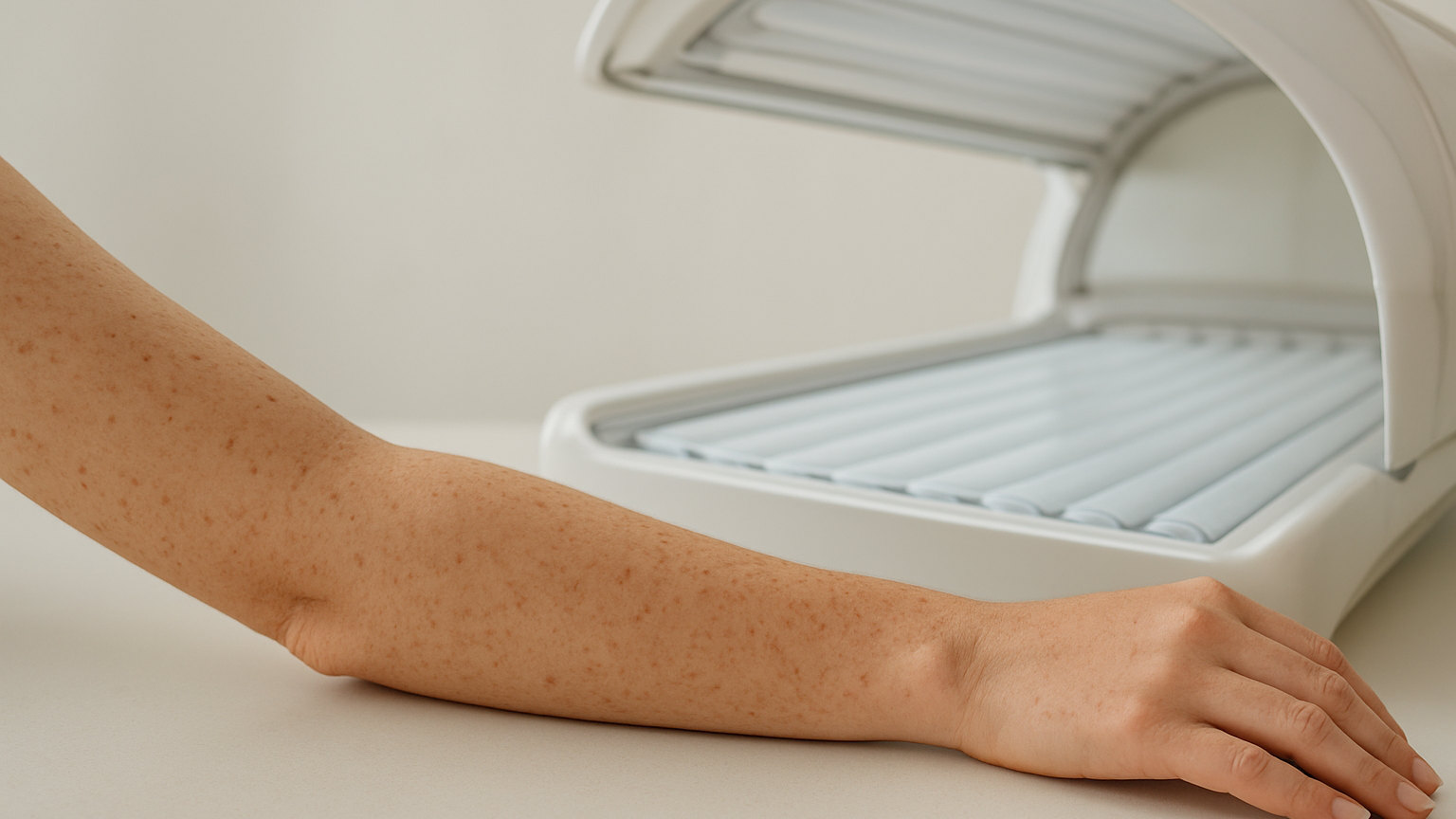
Ultraviolet-emitting tanning devices are classified by the International Agency for Research on Cancer as Group 1 carcinogens, the highest category, alongside tobacco smoking and asbestos. That classification is the starting point for everything else here.
What do they emit?
Predominantly ultraviolet A, at intensities that can be several times stronger than midday Mediterranean summer sun, alongside a smaller proportion of ultraviolet B.
Ultraviolet A penetrates deeply into the dermis, generating free radicals that damage DNA indirectly and degrading the collagen and elastin that keep skin firm.
It is the main driver of photoageing, which is why sunbed users frequently develop leathery texture, deep lines and pigmentation earlier than their age would suggest.
How large is the cancer risk?
Substantial and well documented. Use before the age of thirty-five is associated with a significantly increased risk of melanoma, and the risk rises with the number of sessions.
Melanoma is among the most common cancers in young adults in the UK, and sunbed use is a recognised contributor.
Squamous cell and basal cell carcinoma risks are also increased.
The risk is cumulative and does not reset, so a period of heavy use in the twenties continues to matter decades later.
What does the law say in the UK?
It is illegal for anyone under eighteen to use a sunbed on commercial premises. Businesses must prevent under-eighteens from using them and cannot allow them into the room where a sunbed is located.
Coin-operated unsupervised salons have been a particular concern, since they make age checks and safety advice difficult to enforce.
Operators are required to provide safety information and protective eyewear. Salons that do not are not complying.
Does the vitamin D argument hold?
No, and it is worth understanding why rather than simply dismissing it.
Vitamin D synthesis requires ultraviolet B. Sunbeds emit predominantly ultraviolet A, which contributes almost nothing to vitamin D production while delivering the deep-penetrating damage.
So a sunbed provides the risk without the supposed benefit.
Public health guidance in the UK is that most people should consider a daily vitamin D supplement through autumn and winter. That is a straightforward and free alternative.
What about tanning to prepare for a holiday?
A sunbed base tan provides an estimated sun protection factor of around three, against a minimum recommended SPF of thirty.
Building it means deliberately damaging skin in advance so it burns slightly less later, and the damage accumulated is real and additive.
Studies have found no meaningful protective benefit from pre-holiday tanning.
Are they used medically?
Narrowband ultraviolet B phototherapy is used under dermatological supervision for conditions including psoriasis, eczema and vitiligo.
It is a different technology, using a specific narrow wavelength, delivered in controlled doses with cumulative exposure tracked and the risk balanced against the condition being treated.
Commercial sunbeds are not equivalent and should not be used as a substitute, which is a distinction some salons blur.
Why do some people find it hard to stop?
Ultraviolet exposure triggers endorphin release, and research has found that a proportion of frequent sunbed users meet criteria resembling substance dependence.
The term tanning dependence appears in the literature, and studies have found that frequent users can distinguish an active bed from a sham one, suggesting a genuine physiological reward.
That is worth knowing for anyone who has tried to cut down and found it harder than expected, and it is a reasonable thing to raise with a GP.
What should you do if you have used them?
Stop, since the risk relates to cumulative exposure and stopping prevents further accumulation.
Check your skin regularly, and ask someone to check your back. Look for anything new, changing, asymmetrical, irregularly edged, multi-coloured, larger than six millimetres, or that itches, bleeds or does not heal.
See a GP about anything meeting those descriptions rather than watching it for months.
And use fake tan instead if you want the colour, which achieves it with no ultraviolet exposure at all.


