
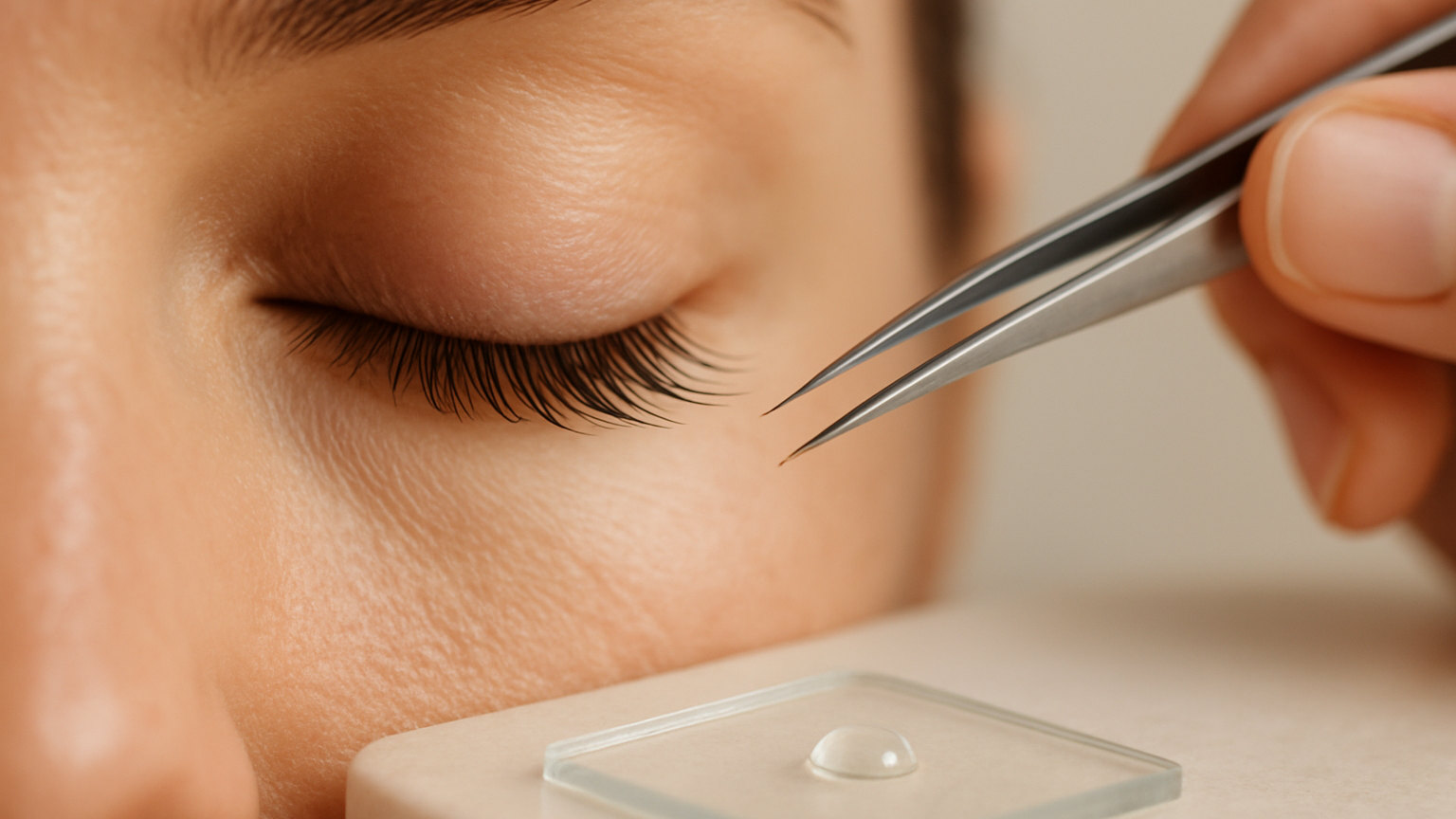
Eyelash extensions are individual synthetic lashes glued to your own, one at a time. Applied well they are safe for most people. Applied badly they damage the natural lash, and the difference is almost entirely down to the technician.
What is the adhesive?
Cyanoacrylate, the same family of compounds as superglue, in a formulation designed for the purpose.
It is applied to the extension rather than to the skin, and the extension is attached to a single natural lash roughly a millimetre from the lid.
Cyanoacrylate releases formaldehyde as it cures, in small quantities. Products described as formaldehyde-free contain none as an added ingredient, and trace amounts are still produced by the curing process.
What are the main risks?
Allergic reaction to the adhesive, which produces swollen, itchy, red eyelids and can be severe. It can develop suddenly after several uneventful sets, since sensitisation builds with exposure.
Traction alopecia of the lashes, caused by extensions that are too long or too heavy for the natural lash, or by lashes glued together in clumps so that one falling out pulls others with it.
Blepharitis and infection, since extensions make the lash line harder to clean and debris accumulates at the base.
Corneal injury from tweezers or adhesive during application, which is uncommon and serious.
Why do natural lashes fall out?
Some shedding is normal: you lose a few lashes daily and each extension goes with the lash it is attached to.
Damage happens when the extension is heavier or longer than the natural lash can support, which puts constant tension on the follicle. Over repeated sets that causes lashes to grow back finer and sparser, and eventually not at all.
The rule of thumb is that an extension should be no more than two to three millimetres longer than the natural lash and appropriate to its thickness. A technician offering dramatic length on fine lashes is offering damage.
How do you choose a technician?
Ask about training, insurance and how long they have been working. Ask what weight and length they will use and why.
Insist on a patch test at least twenty-four to forty-eight hours before a first set, which involves applying a few extensions and waiting. Any salon that skips this is not one to use.
A full set should take around two hours, since each lash is applied individually. An appointment finishing in forty minutes means lashes have been clustered rather than isolated, which is the main cause of damage.
What does aftercare involve?
Keep them dry for the first twenty-four to forty-eight hours while the adhesive fully cures.
After that, clean them daily with a dedicated lash cleanser or a gentle oil-free foaming cleanser and a soft brush. This is the step most people skip and it is what prevents blepharitis.
Avoid oil-based products around the eyes, which dissolve the adhesive. Avoid waterproof mascara, which cannot be removed without disturbing them.
Do not pick, pull or rub. Brush them gently with a clean spoolie daily.
How often do they need infilling?
Every two to three weeks, as natural lashes shed and are replaced.
Continuous wear without breaks is where cumulative damage shows. Many technicians recommend a break of several weeks every six to twelve months to let the natural lashes recover.
What should you do if you react?
Have them removed professionally rather than pulling them out, which takes natural lashes with them. Removal uses a solvent that dissolves the adhesive.
Seek medical advice for significant swelling, pain, vision changes or discharge, which suggest infection or a severe reaction rather than irritation.
Once sensitised to cyanoacrylate, the allergy is generally permanent, and subsequent exposures tend to be worse.
Are there alternatives?
A lash lift, which curls the natural lashes without adding anything and carries a different and smaller set of risks.
Strip or cluster lashes applied at home, which are removed daily and cause no follicle tension if taken off carefully.
Mascara, which remains the lowest-risk option and has improved considerably.


