
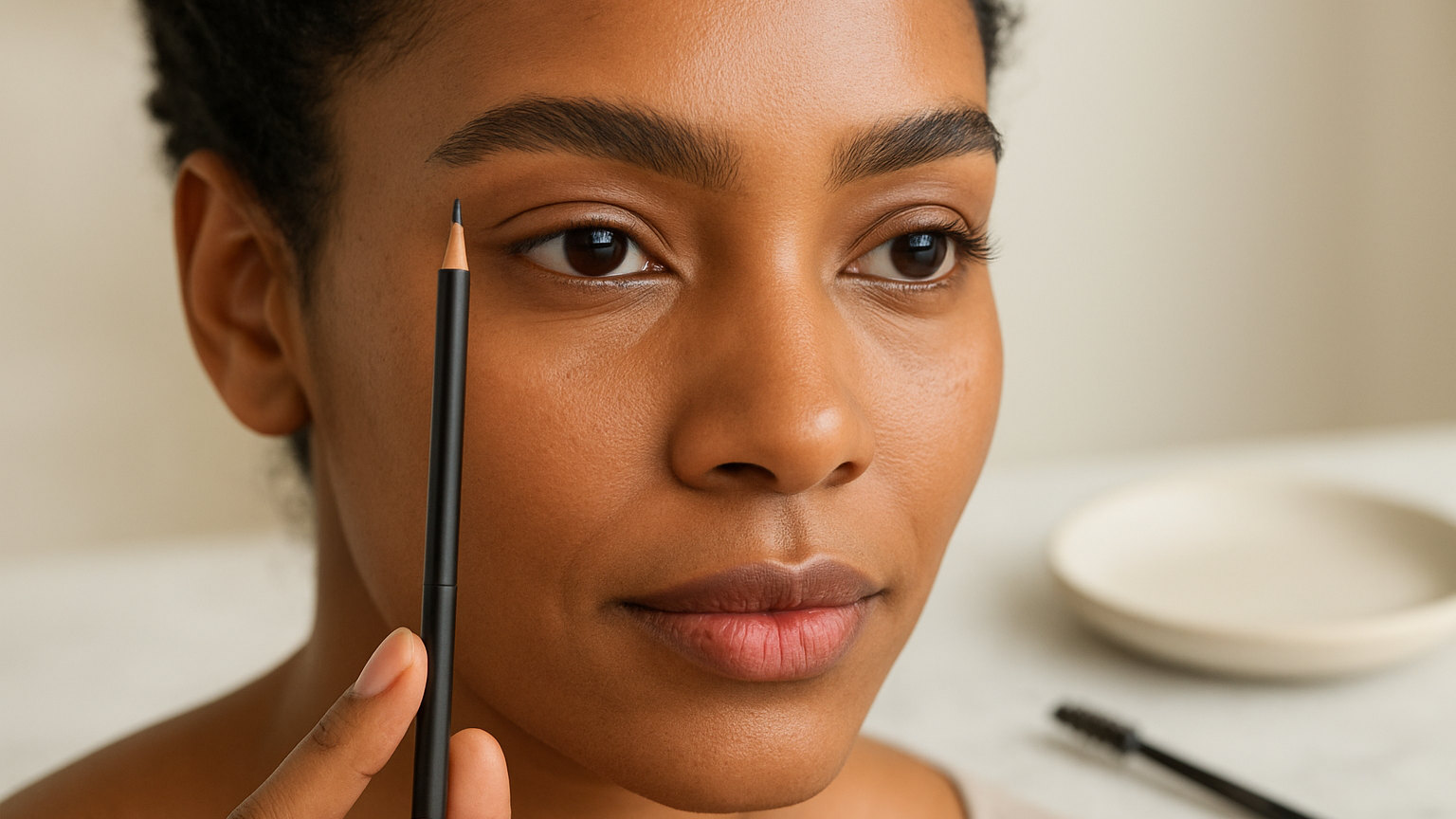
Brow shaping goes wrong in two ways: taking too much off, and taking it from the wrong place. Three measurement points prevent both, and they take half a minute to find.
Where should the brow start?
Hold a pencil vertically against the side of your nose, running straight up. Where it crosses the brow is where the brow should begin.
Hair inside that line, between the brows, can be removed. Removing hair outside it, further along the brow, makes the eyes look further apart and is difficult to correct.
Starting brows too far apart is one of the most common shaping errors and one of the slowest to grow out.
Where should the arch sit?
Angle the pencil from the side of the nose through the outer edge of the iris, looking straight ahead. Where it crosses the brow is the natural highest point.
Some people prefer it slightly further out, toward the outer edge of the eye, which gives a softer arch. Further in than the iris looks surprised.
The arch should be a gradual curve rather than a peak, and it is created by removing hair from underneath rather than from above.
Where should the brow end?
Angle the pencil from the side of the nose to the outer corner of the eye. Where it crosses is where the brow should end.
A brow ending short of that makes the eye look smaller. Extending beyond it, particularly downward, drags the eye down. The tail should not finish lower than the start.
Should you remove hair from above?
Sparingly, and this is where a great deal of damage is done.
The top line of the brow defines its thickness, and removing from above thins it permanently if repeated over years. Stray hairs well above the natural line can go; the line itself should mostly be left.
Shaping from underneath achieves the arch without reducing thickness, which is what most professional shaping does.
Which method should you use?
Tweezing for individual hairs and maintenance, which gives the most control. Pluck in the direction of growth to reduce breakage and ingrown hairs.
Threading for the initial shape, which is more precise than waxing and gentler on the skin.
Waxing, which is fast and removes more than intended if the wax spreads. Avoid it if you use retinoids or acids on your face.
A brow razor for fine hairs and tidying, which is gentler than it sounds and does not make hair grow back thicker.
How do you avoid over-plucking?
Work in good natural light, not magnifying light, which makes every hair look like it needs removing.
Step back from the mirror every few hairs and look at both brows together. Almost all over-plucking happens up close.
Brush the brows upward with a spoolie and trim only what protrudes above the top line, rather than plucking it.
Remove five or six hairs, then stop and reassess. And do not attempt to make brows match exactly, since they are siblings rather than twins and forcing symmetry costs thickness.
What if you take too much off?
Stop entirely and let it grow for at least three months, which is a full cycle. Resist tidying in the meantime, since that is how a small mistake becomes permanent.
Fill gaps with a pencil or powder in the meantime, using short strokes in the direction of growth.
Brow serums with peptides or, on prescription, bimatoprost can improve growth in follicles that still exist. Nothing revives a follicle destroyed by decades of plucking.
How often should you shape them?
Every two to four weeks for maintenance, and less if you are growing them out.
Having the shape set professionally once, then maintaining strays yourself between visits, produces a better result than doing the whole thing yourself and is considerably cheaper than going every fortnight.
Does brow shape depend on your face?
Less than the charts suggest, and one principle holds: a brow that follows your natural bone structure suits you better than one imposed on it.
The ridge above the eye already describes an arch, and shaping to it produces a result that looks like your face rather than a template. Softer, straighter brows generally suit rounder faces; a defined arch suits longer ones. Beyond that, the natural shape is the best starting point available, which is why the most common regret in this area is having changed it too much.


