
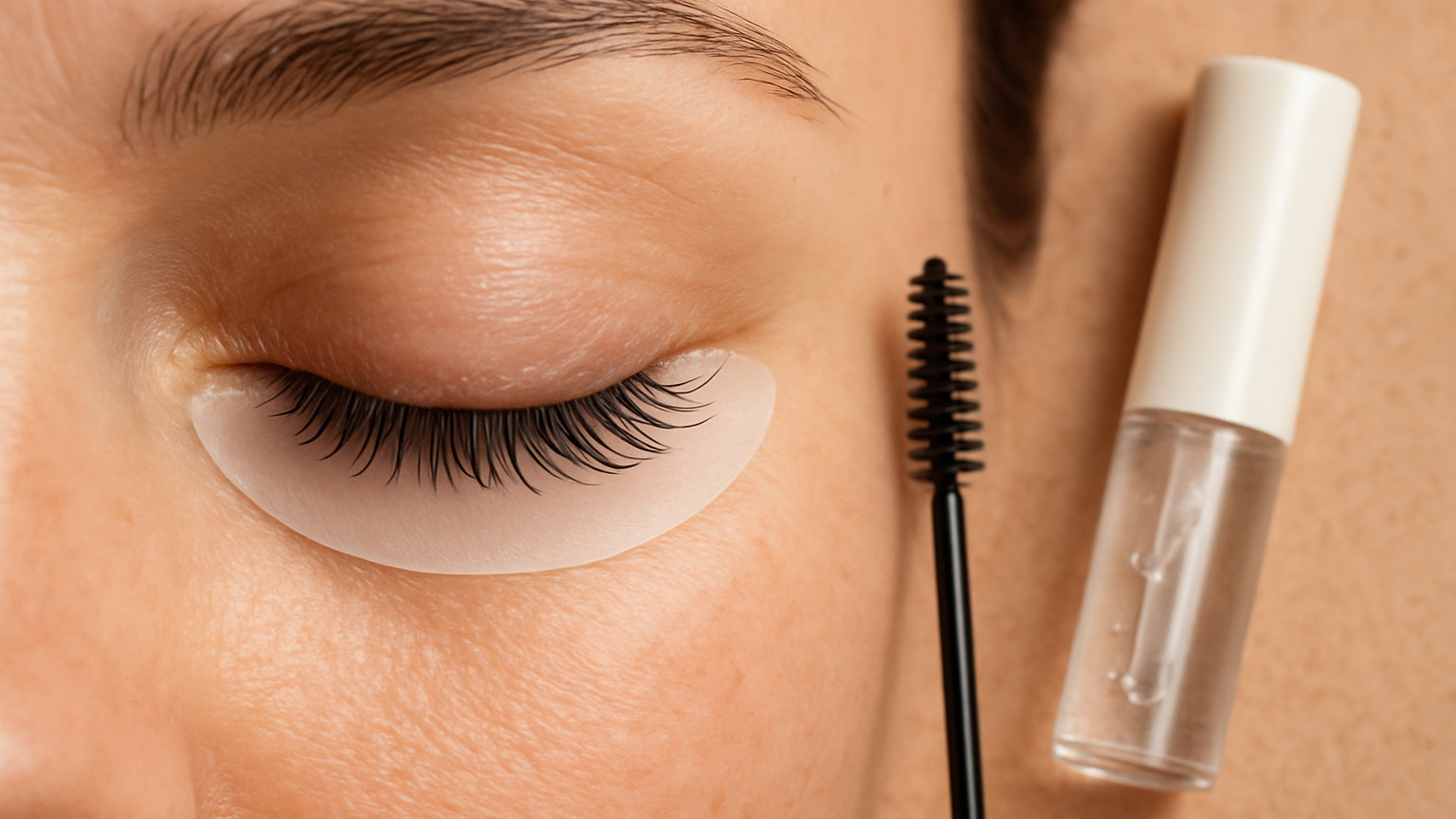
A lash lift perms the natural lashes into an upward curl, using the same chemistry as a hair perm or brow lamination. Nothing is added, which is the main reason it carries fewer risks than extensions.
How does it work?
The lashes are lifted onto a silicone shield or rod fixed to the eyelid, which sets the shape of the curl.
A perming solution, usually thioglycolate-based, breaks the disulphide bonds in each lash. A neutraliser then reforms those bonds with the lash held in its new curved position.
A nourishing serum is applied afterwards, and a tint is frequently done at the same appointment, since curled lashes look considerably better dark.
The whole process takes around forty-five minutes to an hour.
How long does it last?
Six to eight weeks, which corresponds to the lash growth cycle. The curl does not drop out; the lashes carrying it shed and are replaced by new straight ones.
Most salons will not repeat it more often than every six to eight weeks, since the chemistry is drying and repeated processing causes brittleness.
How does it compare with extensions?
Lower maintenance: no infills every two to three weeks, no daily cleaning routine beyond normal, no restrictions on oil-based products.
Lower risk: nothing is glued to the lash, so there is no weight, no tension on the follicle and no cyanoacrylate allergy.
Less dramatic: it curls and lifts what you have rather than adding length or volume. Anyone with very short or very sparse lashes will see a smaller difference.
Cheaper over a year, since the appointment frequency is roughly a third.
What are the risks?
Chemical irritation or burns, since a perming solution is being used millimetres from the eye. Redness, stinging and watering during or after are the common complaints.
Over-processing, which leaves lashes brittle, frizzy or kinked rather than smoothly curled, and can cause breakage.
Allergic reaction to the solution or the tint. Solution running into the eye, which causes significant irritation and is a technician error.
Rarely, damage to the cornea or eyelid skin.
A patch test twenty-four to forty-eight hours beforehand is essential, particularly if a tint is included.
Who should not have one?
Anyone with an eye infection, conjunctivitis, blepharitis or a stye. Anyone who has had recent eye surgery.
Anyone with very fine, damaged or already brittle lashes, where the risk of breakage outweighs the benefit.
Anyone with a known allergy to thioglycolates or hair dye. Anyone using retinoids or acids near the eye area, who should pause several days beforehand.
Pregnancy is generally advised against by salons as a precaution.
What is the aftercare?
Keep lashes dry for twenty-four to forty-eight hours: no washing over them, no steam, no swimming, no sweating heavily.
Avoid oil-based products and waterproof mascara for the first two days. Do not rub or sleep face down initially.
After that, apply a lash conditioning serum or a small amount of castor oil nightly, since the process is drying and conditioned lashes hold the curl better.
Brush with a clean spoolie daily. Mascara is fine after forty-eight hours and often unnecessary if a tint was done.
What if it goes wrong?
Over-curled lashes that point back at the eyelid usually relax within a week or two. A conditioning treatment and gentle brushing downward helps.
Brittle or broken lashes need time and conditioning, and no further processing for at least three months.
Any significant eye pain, vision change or persistent swelling needs medical attention rather than a call to the salon.
Is it worth it?
For anyone with straight lashes that point downward, genuinely yes, since it addresses the specific problem a curler solves temporarily and mascara does not.
For anyone with already curled lashes, the difference is modest. For very short lashes, extensions do more.
Choose a technician who patch tests, uses appropriately sized shields, and is willing to say your lashes are not suitable.


