
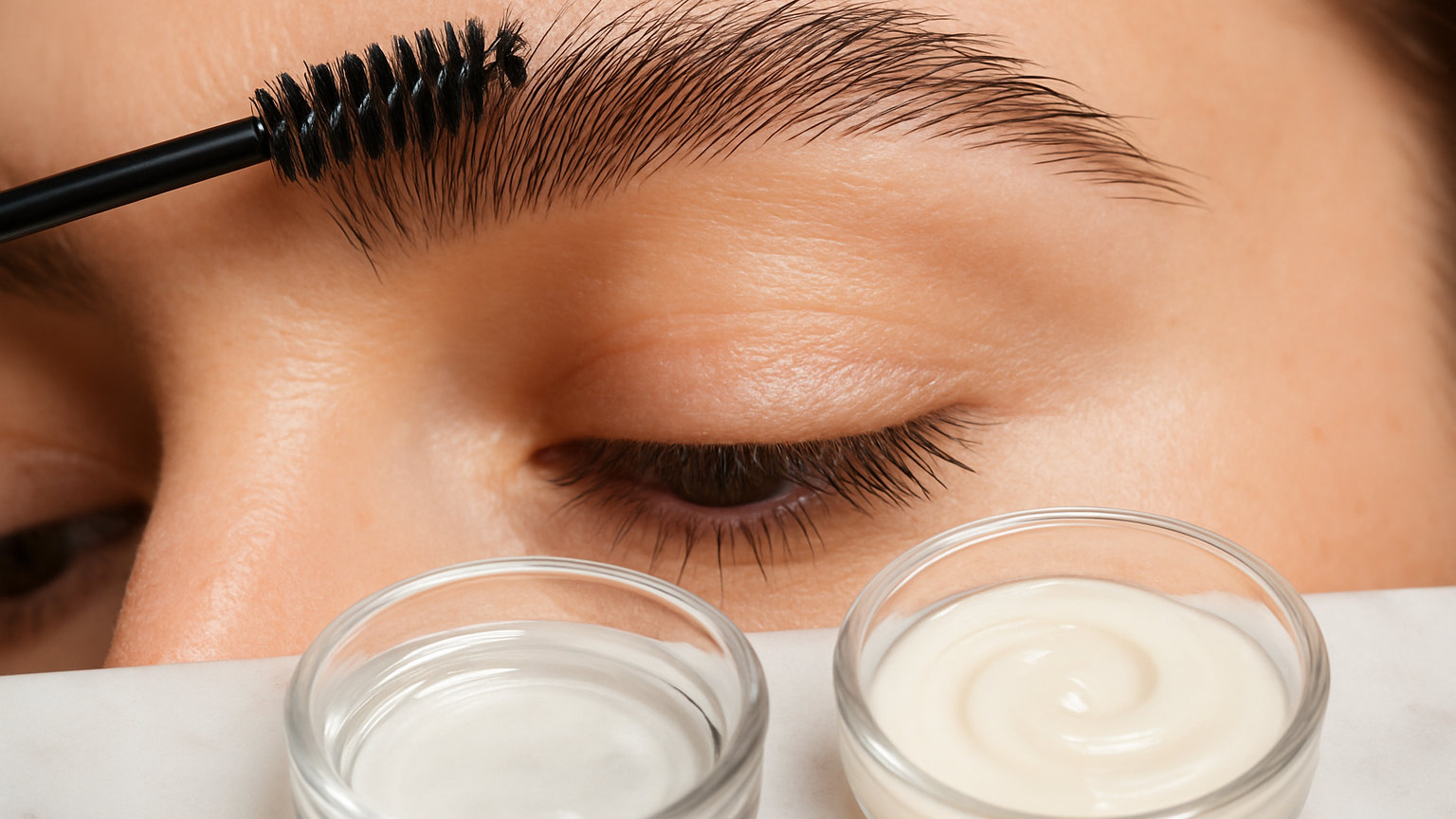
Brow lamination chemically resets the direction the brow hairs sit in, brushing them upward and holding them there. It is a perm applied to eyebrows, and it uses the same chemistry.
How does it work?
A perming solution, usually thioglycolate-based, breaks the disulphide bonds within each hair. Those are the strong bonds that determine the shape of the shaft.
The hairs are then brushed into the desired direction and held there while a neutralising solution reforms the bonds in the new position.
A conditioning treatment follows, since the process is drying. Tinting is frequently done at the same appointment.
What does it achieve?
Brows that appear fuller and more even, because hairs growing downward or sideways are redirected upward to cover gaps.
A lifted, fluffy appearance that would otherwise require daily brushing and gel. It suits unruly brows, brows with hairs growing in several directions, and brows with sparse patches that redirected hair can cover.
It does not add hair. Anyone with very sparse brows will find it redistributes what is there rather than creating fullness.
How long does it last?
Six to eight weeks, which corresponds roughly to the brow growth cycle. As new hair grows through untreated, the effect gradually fades.
Most salons will not repeat it more often than every six to eight weeks, since the chemistry is drying and repeated treatment causes brittleness and breakage.
What are the risks?
Chemical burns and irritation, since a perming solution is being applied close to the eyes. Redness, stinging and swelling are the common complaints.
Allergic reaction to the solution or to the tint applied alongside. Over-processing, which leaves brow hairs brittle, frizzy and prone to snapping.
Loss of brow hair, either through breakage or, occasionally, through the follicle being affected.
A patch test at least twenty-four to forty-eight hours before is essential, and any salon that does not offer one should be avoided.
Who should not have it?
Anyone with an allergy to thioglycolates or to hair dye ingredients. Anyone with eczema, dermatitis or broken skin around the brows.
Anyone with a recent eye infection, conjunctivitis or eye surgery. Anyone using retinoids or acids on the face, who should stop several days beforehand.
Anyone with very fine or already damaged brow hair, where the risk of breakage outweighs the benefit.
Pregnancy is generally advised against by most salons, as a precaution rather than on evidence.
What does the aftercare involve?
Keep the brows dry for twenty-four to forty-eight hours, which means no washing the face over them, no steam, no swimming and no sweating heavily.
Do not brush or touch them for the first day. Avoid makeup on the brows for forty-eight hours.
After that, apply a nourishing oil or conditioning serum daily, since the treatment is drying and brow hairs need the moisture.
Brush them into shape each morning with a spoolie.
How does it compare with alternatives?
Brow gel achieves a similar look daily with no chemistry, at the cost of two minutes each morning. For many people that is the better trade.
Microblading adds the appearance of hair where there is none, which lamination cannot do. It is semi-permanent and considerably more invasive.
Threading or waxing shapes the brow; lamination changes the direction of the hair. They address different problems and are often done together.
Is it worth it?
For unruly, coarse or downward-growing brows, genuinely yes, and it removes a daily task for two months.
For fine, sparse or already fragile brows, the risk of breakage makes it a poor bet, and the effect is smaller since there is less hair to redirect.
Go to someone experienced, insist on a patch test, and be honest about any previous reaction to hair dye or perming products, since the same chemistry is involved.
What does it cost, and how does that add up?
Typically forty to seventy pounds a session depending on location, often with a tint included. At every six to eight weeks, that is roughly three hundred to five hundred pounds a year.
Set against a brow gel costing under ten pounds and lasting several months, the comparison is stark, and it is worth making honestly. Lamination buys back a daily task and a look that gel cannot fully replicate on unruly brows, and for anyone whose brows behave with a spoolie and gel, the cost is difficult to justify.


