
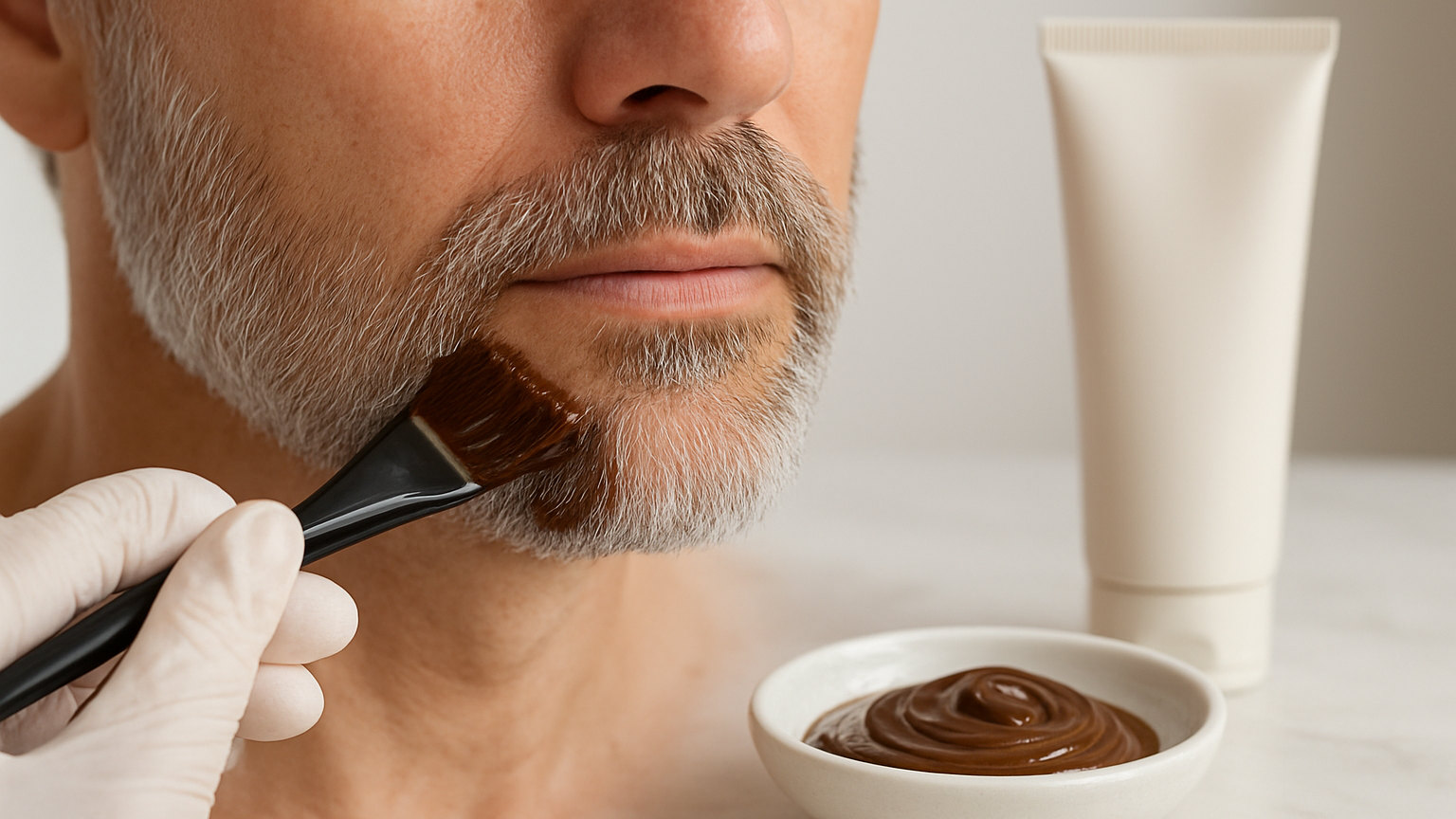
Beard dye works, and it needs more care than colouring scalp hair for two reasons: the dye sits against facial skin, and beard growth is short enough that regrowth shows within days.
Why does the patch test matter more here?
Because the same allergens are involved as in hair dye, and the reaction happens on the face.
Paraphenylenediamine and related compounds cause allergic contact dermatitis, and reactions can involve significant swelling of the face and eyelids. Sensitisation can develop suddenly after years of uneventful use.
The allergy alert test needs doing forty-eight hours before every application, including with a product used many times. Anyone who has had a black henna temporary tattoo is at particularly high risk and should be especially careful.
This is not a formality, and beard dye is applied closer to the eyes than scalp colour is.
Why does beard dye often look unnatural?
Three reasons, and all are avoidable.
Shade too dark. Beard hair takes colour more readily than expected because it is coarse and porous, and choosing a shade matching your natural colour usually produces something darker than intended. Going one shade lighter is the standard advice.
Processing too long. Beard dyes are formulated for short contact times, often five to ten minutes, and leaving them longer produces a flat opaque result.
Complete coverage of all grey. Leaving some grey at the temples and edges reads considerably more naturally than uniform colour.
How do you apply it?
To a clean, dry beard, since product and oil resist the dye. Wash it the day before rather than immediately beforehand.
Apply barrier cream or petroleum jelly along the edges of the beard on the skin, which prevents staining the surrounding face.
Use the brush or applicator provided, working from underneath outward so the colour reaches the hair rather than sitting on the surface.
Time it precisely and check a small area at the minimum recommended time. Rinse thoroughly with cool water.
How often will you need to redo it?
Every one to two weeks for full coverage, which is considerably more often than scalp colour.
Beard hair grows around a centimetre a month, and because the hair is short, a few millimetres of grey regrowth at the root is immediately visible.
This frequency is the main reason people abandon beard dye, and it is worth knowing before starting rather than after.
Are there gentler options?
Semi-permanent or progressive colours, which deposit gradually over several applications and fade rather than growing out with a line. The result is softer and the maintenance is less obvious.
Colour-depositing beard balms, which add a subtle tint and wash out. Useful for blending rather than covering.
Pure henna, which is genuinely gentle and produces a red-orange tone that suits some colouring and not others. It coats the shaft permanently and must be disclosed if you later use conventional dye, since it can react with peroxide.
Does it damage the beard?
Some. Permanent dye lifts the cuticle to deposit colour, which increases porosity and dryness, and beard hair is already coarse and dry.
Conditioning becomes more important after colouring: beard oil daily and a balm for longer growth. A gentler wash routine, since colour fades faster with frequent stripping washes.
What if the skin reacts?
Rinse thoroughly with cool water and stop using the product. An antihistamine may help itching.
Seek urgent medical help for swelling of the face, lips or eyes, or difficulty breathing, which can occur with severe reactions to hair dye.
Once sensitised, the allergy is permanent, and PPD-free alternatives exist though a proportion of people also react to the related compounds used in them.
Is it worth it?
A personal decision, and the honest points are these: the maintenance is fortnightly rather than monthly, the risk of reaction is real and manageable with testing, and a subtly blended result looks considerably better than full coverage.
A well-conditioned grey beard is also a perfectly good outcome, and the assumption that grey needs correcting is a preference rather than a rule.


