
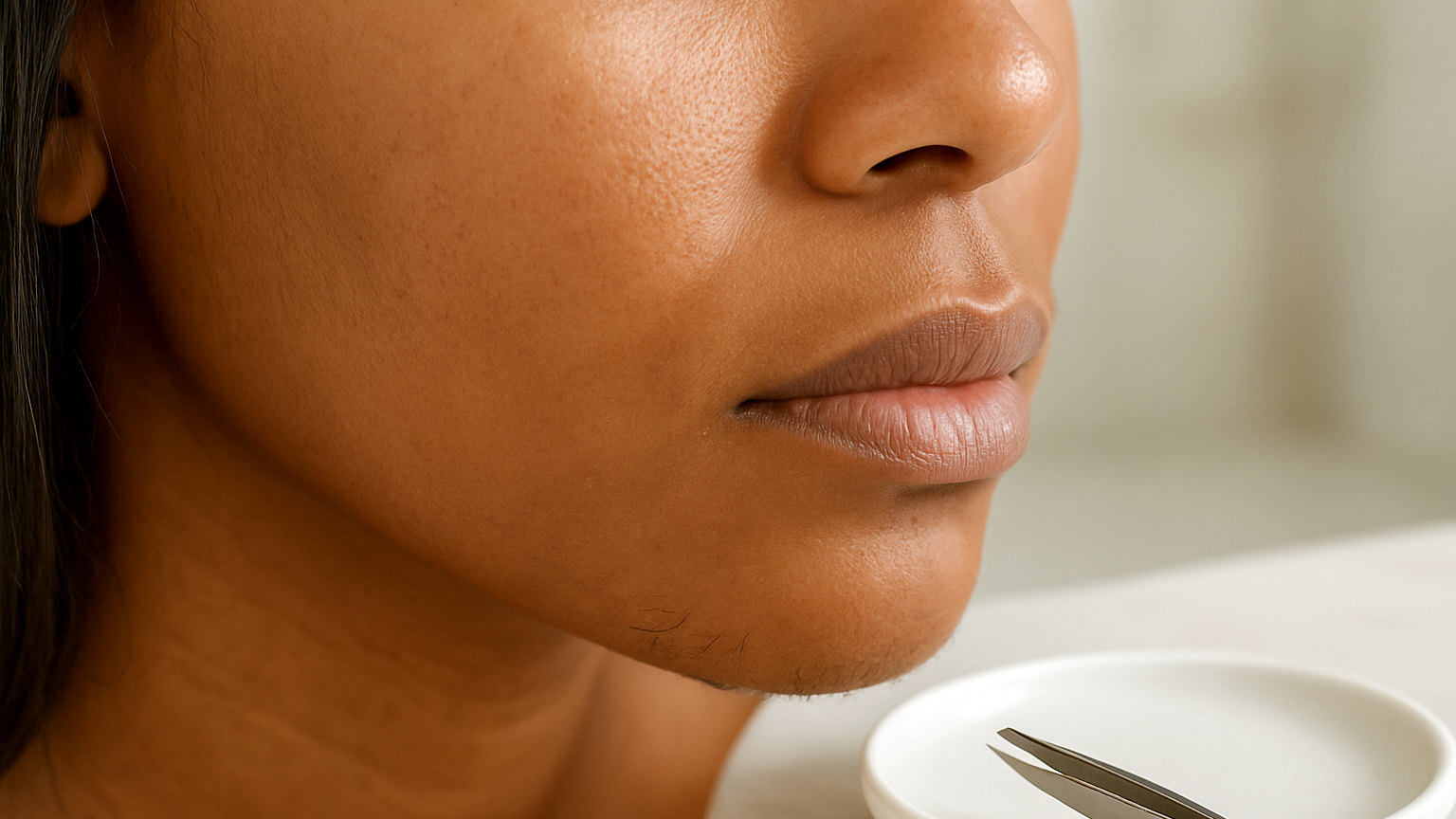
Facial hair on women is extremely common, largely normal, and surrounded by enough embarrassment that people frequently do not ask about the version that is worth investigating. The distinction is about pattern and rate of change rather than about amount.
What is normal?
Everyone has fine, pale vellus hair over most of the face. Many women also have some darker terminal hairs on the upper lip, chin or jawline, and that is within normal variation.
The amount varies considerably with ethnicity. Women of South Asian, Mediterranean and Middle Eastern heritage typically have more facial and body hair than those of East Asian or Northern European heritage, and that is genetic rather than hormonal.
Isolated dark hairs appearing on the chin, particularly with age, are common and not a cause for concern.
What is hirsutism?
Excess terminal hair growing in a male pattern: the upper lip, chin, jawline, neck, chest, upper abdomen and back.
It affects an estimated five to ten per cent of women. The distinguishing features are the male pattern of distribution, coarse dark hair rather than fine, and often a change from how things previously were.
It occurs because hair follicles are responding to androgens, either because levels are raised or because follicles are unusually sensitive to normal levels.
What causes it?
Polycystic ovary syndrome accounts for the majority, perhaps seventy to eighty per cent of cases. It typically comes with irregular periods, acne and sometimes difficulty with weight or fertility.
Idiopathic hirsutism, where hormone levels are normal and follicles are simply more sensitive, accounts for much of the rest.
Less commonly: congenital adrenal hyperplasia, Cushing's syndrome, thyroid disorders, and androgen-secreting tumours, which are rare and important to exclude.
Some medications, including certain steroids, some progestogens and minoxidil.
What happens at menopause?
Oestrogen falls considerably faster than androgens do, so the ratio between them shifts even though nothing has risen.
Follicles on the chin and upper lip respond to androgens by growing thicker and darker, while scalp follicles respond by miniaturising. That is why facial hair increasing and scalp hair thinning frequently happen together, which feels particularly unfair and is one process.
This is normal and does not usually require investigation unless it is sudden or severe.
When should you see a GP?
If it develops rapidly, over months rather than years. If it appears alongside a deepening voice, increased muscle bulk, scalp hair loss or clitoral enlargement, which together suggest significantly raised androgens and need prompt assessment.
If it comes with irregular or absent periods, acne or difficulty conceiving, which suggests PCOS.
If it begins suddenly in someone who previously had none, particularly after menopause.
And if it is distressing you, which is a sufficient reason on its own. This is a recognised medical complaint rather than a vanity issue.
What will a GP do?
Take a history, examine the pattern, and usually arrange blood tests: testosterone, and depending on the picture, other androgens, thyroid function and prolactin.
An ultrasound may be arranged if PCOS is suspected. Treatment depends on the cause, and options include combined oral contraceptives, anti-androgens such as spironolactone, and topical eflornithine, which slows facial hair growth.
Referral to endocrinology or dermatology where warranted.
What about removal?
Entirely a personal choice, and the options are the same as for any facial hair: plucking, threading, waxing, depilatory creams, shaving, and laser or electrolysis for longer-term reduction.
Shaving does not make hair grow back thicker, which is worth repeating because the belief prevents a great many women from using the simplest method available.
Electrolysis is the only method offering permanent removal and works on all hair colours. Laser is faster and works best on dark hair and lighter skin.
If there is an underlying hormonal cause, treating it slows new growth and makes any removal method considerably more effective.
How long does treatment take to work?
Longer than most people are told, which is worth knowing before concluding something has failed.
Hormonal treatments act on new growth rather than on hair already present, so existing hairs continue their cycle regardless. Six months is the usual point at which any difference becomes apparent, and twelve months for a full assessment. Removal methods handle what is already there in the meantime, and the two work well together rather than being alternatives.


