
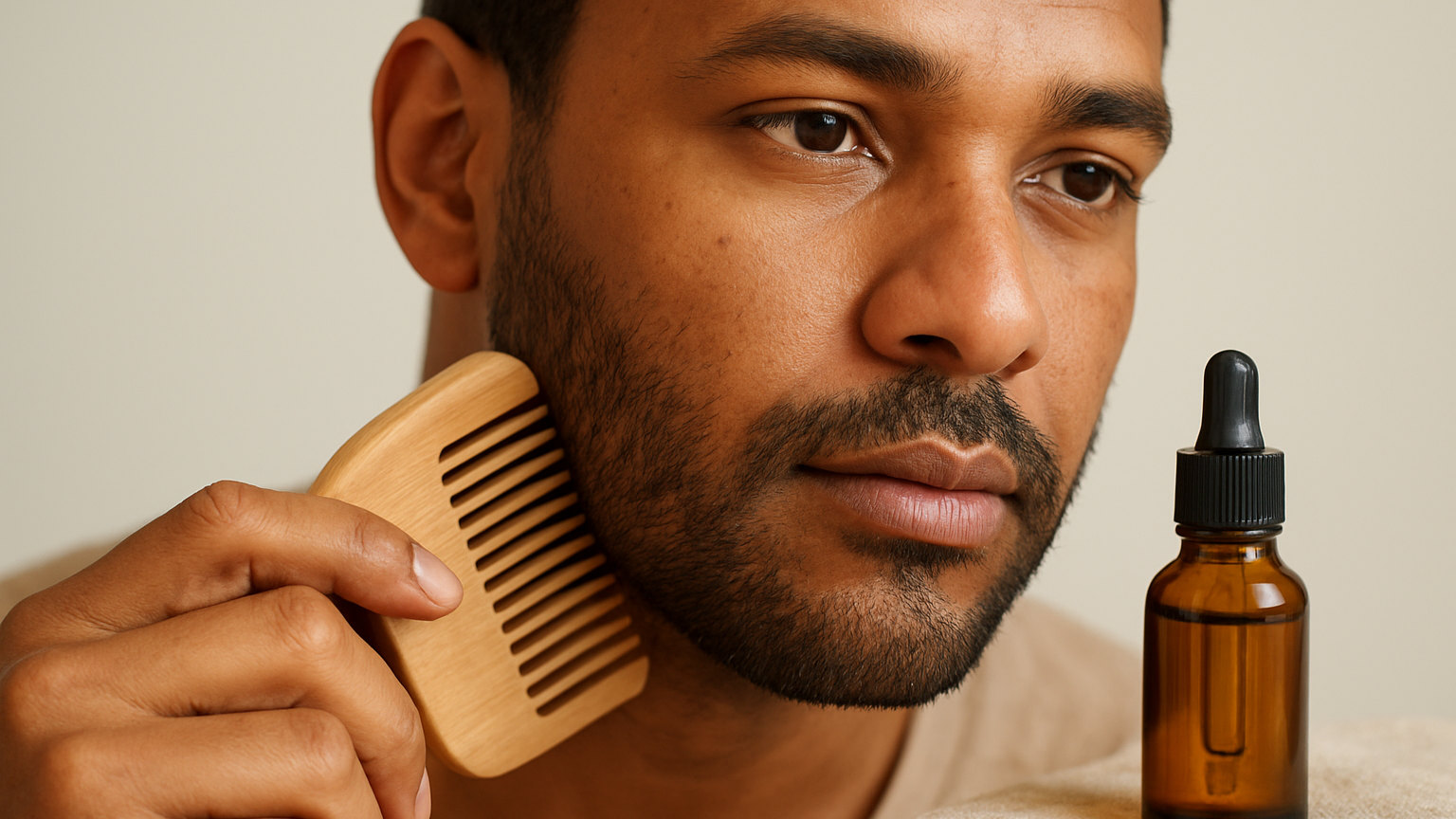
Growing a beard is mostly a matter of not shaving, and the difficulty is entirely in weeks two to four. Most people who fail to grow one give up during that period, before the beard has had a chance to show what it will actually look like.
How long does it take?
Facial hair grows at roughly a centimetre a month, similar to scalp hair. A short beard takes four to six weeks; a full beard takes three to six months.
The first month is the least representative. Growth is uneven across the face because different areas have different growth cycles, so patches that look sparse at three weeks frequently fill in by week eight.
Judging a beard before six weeks is judging an incomplete process.
What happens week by week?
Week one: stubble, generally comfortable and tidy.
Weeks two to three: the itchy stage, and the point at which most people shave it off. The itch is caused by the cut ends of hairs, which are sharp, curling back and irritating the skin as they grow through.
Weeks four to six: the itch settles as the hairs grow long enough to bend rather than poke. Patchiness becomes apparent and shape starts to emerge.
Weeks eight to twelve: filling in continues, and the beard becomes shapeable.
How do you manage the itchy stage?
Moisturise the skin underneath, which is the part people neglect because they are thinking about the hair.
Wash the face daily with a gentle cleanser, since dead skin and sebum accumulate under the growth. A beard oil or a light facial moisturiser applied to the skin rather than the hair helps considerably.
Do not scratch, which irritates the skin and can cause folliculitis. Resist trimming or tidying, which resets the process.
The itch is temporary and predictable, and knowing it lasts around a fortnight makes it considerably easier to sit through.
What actually affects growth rate?
Genetics and androgens, and almost nothing else. Beard density and pattern are inherited, and testosterone and its derivative dihydrotestosterone drive follicle response.
Age matters: beard density continues developing into the late twenties and sometimes the thirties, so a patchy beard at twenty is frequently a full one at twenty-eight.
General health matters where something is wrong. Adequate protein, iron and calories are necessary; exceeding adequate does nothing.
What does not work?
Shaving to make it grow back thicker, which cannot affect the follicle and has been repeatedly disproven.
Most beard growth supplements, which are usually biotin-based and do nothing in the absence of a deficiency. High-dose biotin also interferes with several blood tests, including the one used to diagnose a heart attack.
Beard oils and balms, which improve condition and appearance and do not stimulate growth.
Derma rolling has some limited evidence in combination with minoxidil, and considerably less on its own.
Is there anything that does?
Topical minoxidil, which is used off-label for beard growth and has some supporting evidence. It is not licensed for this purpose, it takes six to twelve months, and gains reverse if you stop.
Scalp massage principles apply weakly here. Addressing a genuine deficiency helps if one exists.
Beyond that, the honest answer is time and genetics, and a well-shaped shorter beard usually looks better than a longer one waiting to fill in.
When should you first trim it?
Not before four to six weeks, and ideally have the first shape done by a barber.
Trimming early removes the length that would have covered the sparse areas, and it is very easy to take too much off when you cannot see the whole shape.
The neckline is the exception: tidying below the jaw from around week three keeps it looking deliberate rather than neglected.
What should the routine be?
Wash daily with a gentle cleanser or a beard wash, since ordinary shampoo is too stripping for facial skin.
Moisturise the skin underneath. Add beard oil from around week three, applied to the skin rather than just the hair.
Comb or brush daily once there is length, which distributes oil and trains the direction of growth.


