
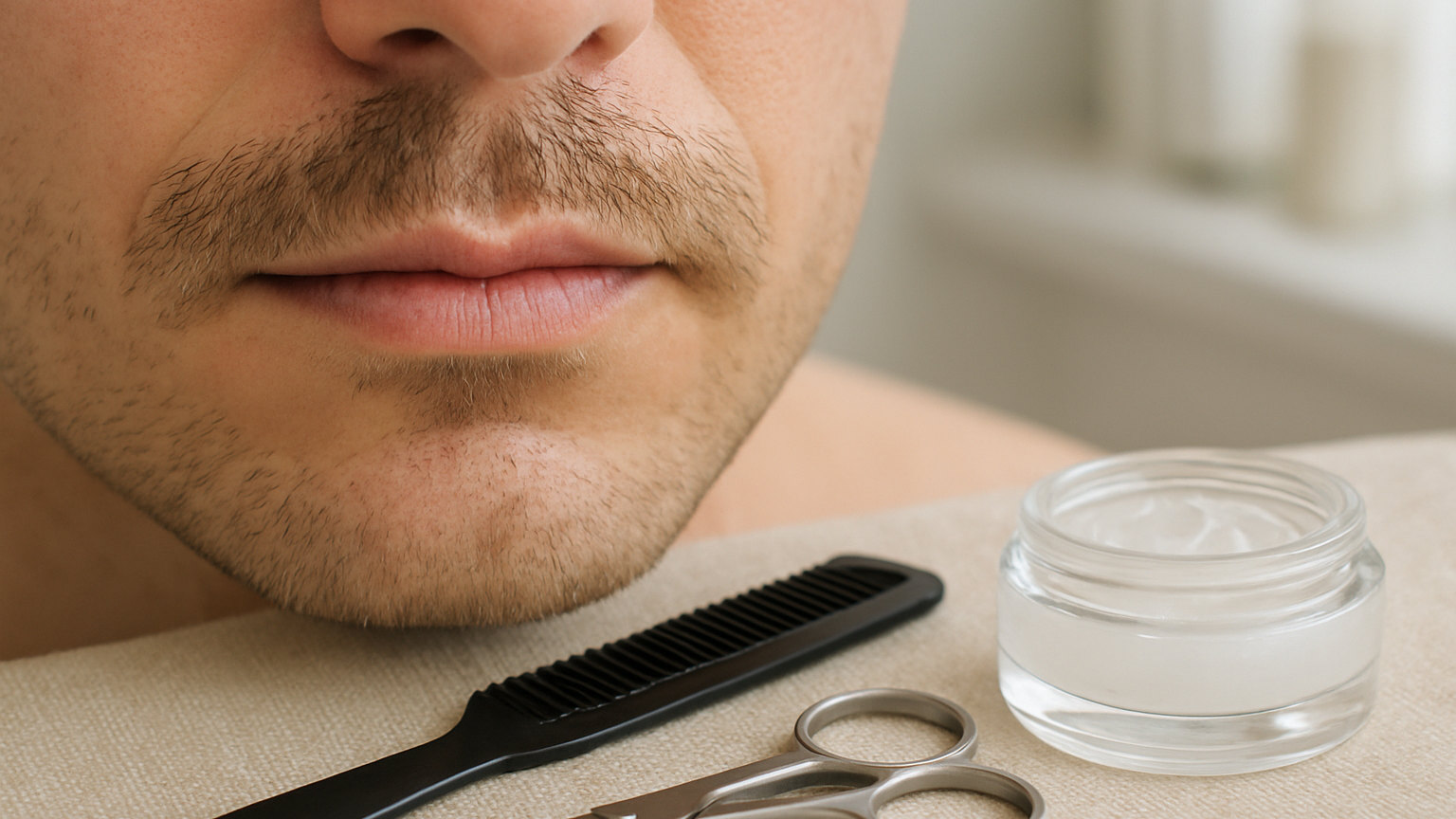
A moustache is the most conspicuous thing to grow on a face, because it sits in the middle of it and there is no surrounding beard to soften the transition. The awkward stage is correspondingly longer, and knowing that in advance helps.
How long does it take?
Two to four weeks to become clearly a moustache rather than unshaved upper lip. Six to eight weeks for a full one with enough length to shape.
A handlebar or anything requiring styling needs three to six months, since the hairs at the corners have to be long enough to train sideways.
The first fortnight is the difficult part, and shaving the rest of the face cleanly during it makes the growth read as deliberate considerably sooner.
What should you do while growing it?
Leave it alone, apart from the edges. Trimming the length early removes the growth you need.
Keep the cheeks and neck cleanly shaved, which frames it and makes the intent obvious.
Moisturise the skin underneath and the lip, both of which dry out. The upper lip gets more sun than people realise and more exposure to food and drink.
Comb it downward daily from week three, which trains the growth direction and stops hairs going in several directions at once.
How do you trim the lip line?
This is the detail that separates tidy from unkempt. Comb the moustache straight down over the lip, then trim along the top edge of the upper lip.
Scissors give considerably more control than a trimmer here. Small cuts, working from the centre outward on each side.
How much you remove depends on style: level with the lip line for a neat finish, slightly above for a more defined look, or left to overhang for a fuller traditional shape.
The area directly under the nose is best done with a small detail trimmer or the corner of a razor.
What are the main styles?
A natural or standard moustache, trimmed to the lip line and following the natural width. The most wearable and the least maintenance.
A chevron, thicker and wider, covering the top lip fully. A pencil moustache, trimmed very thin and requiring precise daily work.
A handlebar, grown long at the corners and trained upward and outward with wax. A horseshoe, extending down the sides of the mouth toward the jaw.
Width and density determine which is realistic. Sparse growth suits a shorter, neater style; dense growth carries a chevron.
What does moustache wax do?
Provides hold and shape, which no other product does. It is mostly beeswax with some oil or butter, and it is considerably firmer than beard balm.
Warm a small amount between the fingertips until it softens, then work it through from the centre outward. Shape with fingers or a small comb.
Strength varies: light waxes tame stray hairs, strong ones hold a handlebar upright all day. Start with a lighter one unless you are training a specific shape.
Remove it at the end of the day with warm water and a gentle cleanser, since wax left in place accumulates.
How do you deal with food and drink?
A shorter lip line is the practical answer if it bothers you. Beyond that, a comb and a rinse after meals deals with most of it.
Moustache combs are small and worth carrying if the moustache is long. A moustache cup, which has a guard for drinking, exists and is not entirely a novelty.
How often should you trim it?
The lip line every three to five days, since a few millimetres of growth is immediately visible in the middle of a face.
The overall length every one to two weeks, and less often if you are growing it out. Under the nose whenever it needs it.
Does it need conditioning?
Yes, and less than a beard. Moustache hair is coarse and grows over the lip, so it benefits from softening for the wearer's comfort and everyone else's.
A few drops of beard oil worked in daily, or a small amount of balm. For anything longer than a centimetre or two, conditioning genuinely improves how it sits and how it feels.


