
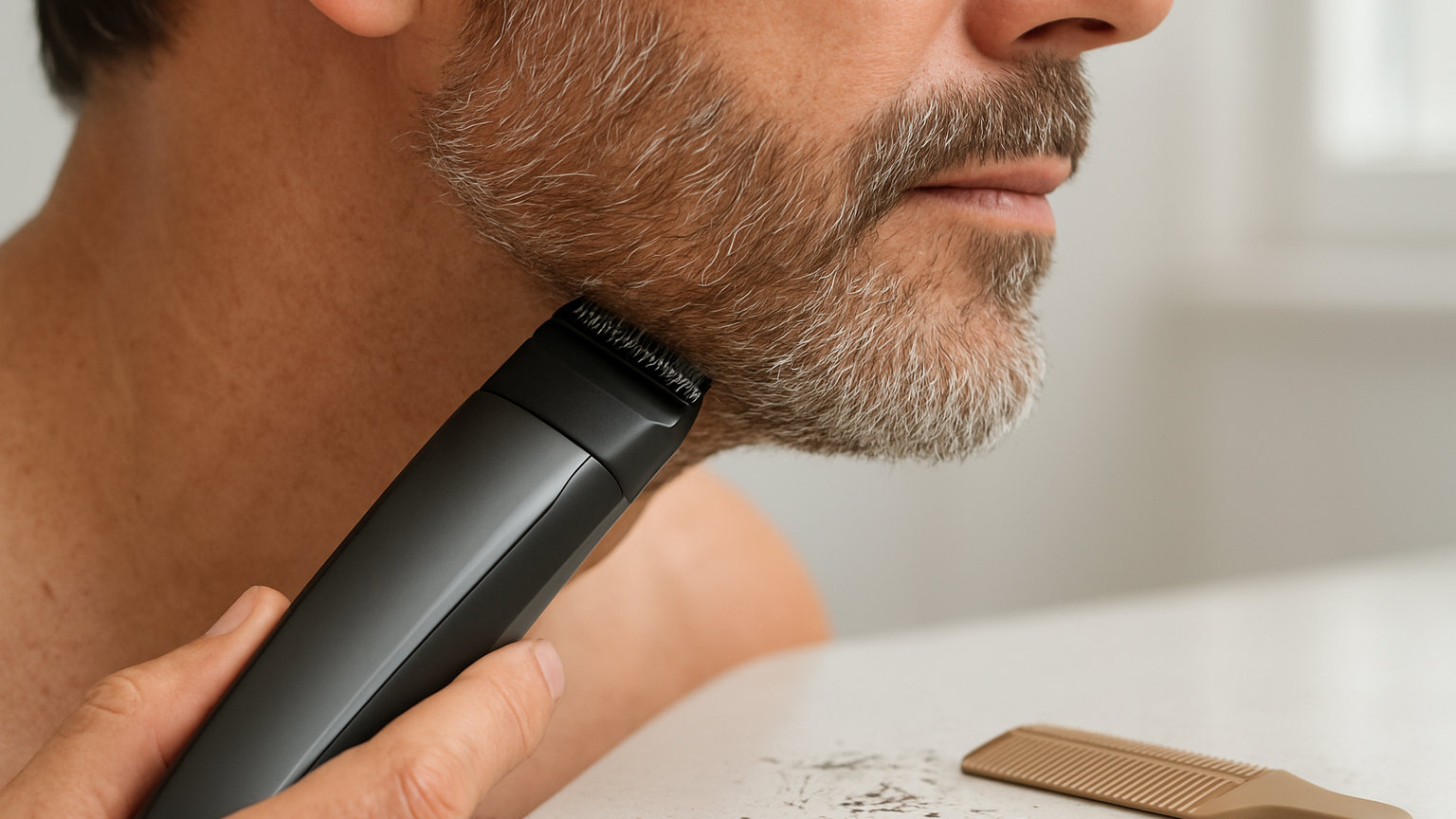
Two lines determine whether a beard looks intentional: the neckline and the cheek line. Length matters far less, and the neckline is where the majority of home trims go wrong.
Where should the neckline sit?
Not at the jaw, which is the most common error and produces a beard that looks like it is floating.
The standard guide is roughly two finger-widths above the Adam's apple, following a gentle curve up toward the back of the jaw behind each ear. Another method is to imagine a line from behind each earlobe meeting at that point on the throat.
Everything below that line comes off; everything above stays. Tilt your head up to check the line and down to shave it, since holding your head up while trimming produces a line that sits too high once you look forward.
Where should the cheek line sit?
Wherever the natural growth ends, in most cases. The safest approach is to tidy the stray hairs above the natural line rather than to create a new line lower down.
A softer, more natural cheek line suits most faces. A sharply defined line reads as deliberate and grows out obviously within a week.
If you do define it, run it from the corner of the moustache up toward the top of the ear, and keep it gently curved rather than straight.
What tools do you need?
An adjustable trimmer with guards, which does most of the work. A pair of beard scissors for stray hairs and for longer beards.
A comb, which lifts hair for even cutting. A razor or a detail trimmer for the neckline and edges.
Good light and a large mirror. A handheld mirror to check the neckline from the side.
How do you trim the length?
Start with a longer guard than you think you need. You can always take more off; you cannot put it back, and this is the single most useful rule.
Trim with the grain first for an even overall length, then against it if you want it shorter.
Work in sections and go over the whole beard at one guard length before deciding whether to go shorter.
Comb the beard downward, then trim what protrudes through the comb for longer beards, which is more controlled than working with guards alone.
How do you keep it symmetrical?
Work from the centre outward on each side rather than doing one whole side then the other.
Step back from the mirror periodically and look at the whole face rather than the area you are working on. Symmetry errors are invisible up close.
Photograph yourself, which shows asymmetry a mirror hides because the image is reversed.
Trim slightly less than you think on the second side, since the temptation to even things up is how a beard gets progressively shorter.
What about the moustache?
Comb it downward and trim along the lip line so it does not hang over. Scissors give more control than a trimmer here.
Keep it slightly longer than the beard if you want it to read as a feature, or blended if you do not.
The area directly under the nose is best done with a small detail trimmer.
How often should you trim?
Neckline and cheek line every one to two weeks, since those are what make a beard look unkempt. Length every three to four weeks.
Trimming little and often is considerably safer than a big trim every couple of months, which is when mistakes happen.
When should a barber do it?
For the first shape of a new beard, which sets a template you can maintain. After growing it out significantly. And whenever you want to change the style.
Asking a barber to define the lines and then maintaining them yourself between visits is the most practical arrangement, and considerably cheaper than a full trim every fortnight.
What if you take too much off?
Stop rather than trying to correct it, which is how a small mistake becomes a short beard. Uneven length grows back within a fortnight and evens out on its own.
If a line has been cut too high or too low, leave it and let it grow, resisting the urge to match the other side. Matching a mistake doubles it, and a barber can reshape it far more successfully at the next visit than you can that evening.


