
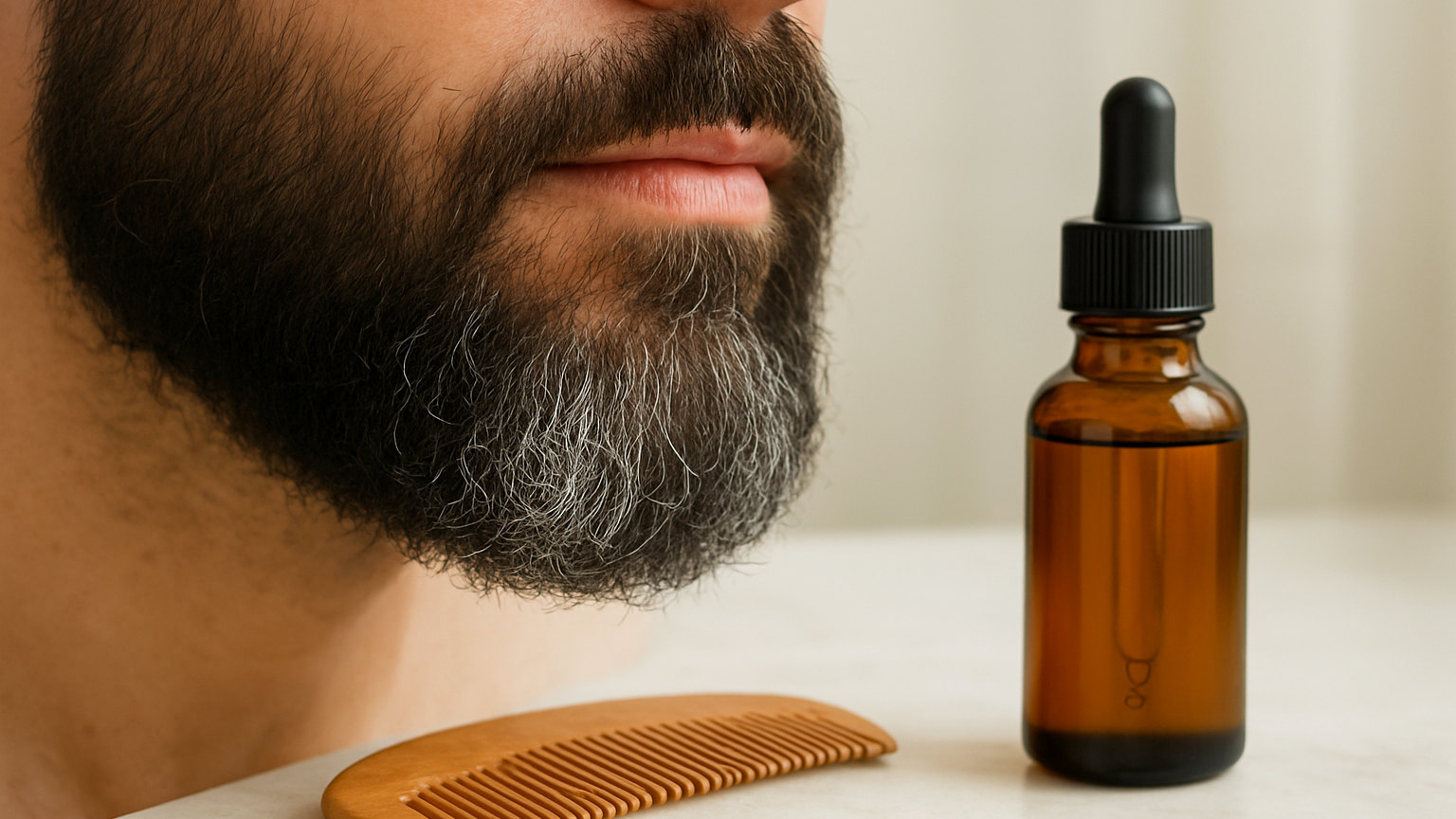
Beards frequently grey earlier than scalp hair, and often unevenly, starting with a patch on the chin or under the lower lip. The pattern is common enough to be worth explaining rather than worrying about.
Why does greying happen at all?
Melanocytes at the base of each follicle produce pigment and inject it into the growing hair. Over time those cells reduce in number and activity, and eventually stop.
Once a follicle stops producing pigment, every hair it grows afterwards is white. Grey is not a colour in itself: it is the visual mixing of white hairs among pigmented ones.
The process is largely genetic. If your parents greyed early, you probably will too, and there is little to be done about the timing.
Why does the beard go first?
The exact reason is not fully settled, and a few explanations are plausible.
Beard follicles are androgen-dependent and have a different growth cycle from scalp follicles, so they may exhaust melanocyte reserves at a different rate.
The face receives more ultraviolet exposure and more environmental damage than the covered scalp, and oxidative stress is implicated in melanocyte decline.
Beard hair is also coarser, and greying is more visible in coarse hair against skin than in a full head of hair.
Why does it start in patches?
Because each follicle operates independently and loses pigment on its own schedule. There is no coordinating signal.
The chin and the area under the lower lip are the most common starting points, and a distinct white patch there is extremely common. It usually spreads gradually over subsequent years.
A sudden, sharply defined patch of white hair appearing over days is different and can indicate alopecia areata regrowing, since regrowth after that condition often comes back white before regaining colour.
Does plucking make more grow?
No. Each follicle operates independently, and pulling a white hair communicates nothing to its neighbours.
The follicle that produced it will produce another white hair, since its melanocytes have stopped. What plucking does do is damage the follicle over time, which is a reason to cut rather than pull if a stray one bothers you.
Can greying be reversed?
Not by anything commercially available. Once melanocytes are depleted, they do not regenerate.
There is genuine research showing that stress-related greying can partially reverse in some cases, which is intriguing rather than actionable. There is also good evidence that severe vitamin B12 deficiency, thyroid disorders and some other conditions cause premature greying, and correcting those can help.
Products claiming to reverse grey are not supported by evidence. If greying is unusually early, particularly before twenty-five, a GP visit to check B12, thyroid function and iron is reasonable.
Does grey beard hair behave differently?
Yes, and this is the practical part. Grey hair is often coarser and wirier, because the same cells that produce pigment also influence the structure of the shaft.
It is drier, since it appears to be less well protected by sebum, and it has a more open cuticle, so it absorbs and loses moisture readily.
It also yellows, from sun, smoke, food and product build-up, which is particularly noticeable on a moustache.
How should you look after it?
More conditioning than pigmented beard hair needs. Beard oil daily, and a balm for coarser growth.
Wash regularly but gently, since yellowing is largely build-up. A purple-toned shampoo used occasionally counteracts yellow tones, and it should be used sparingly, since overuse leaves a lilac cast.
Sunscreen on the exposed skin, and a hat in strong sun, since ultraviolet accelerates both yellowing and further damage.
Should you dye it?
Entirely a choice. Beard dyes exist and work, and they need a patch test forty-eight hours beforehand every time, since the same allergens are involved as in hair dye.
Colouring a beard is harder to make look natural than colouring scalp hair, because the growth is short and regrowth shows within days. A softer approach, using a colour slightly lighter than your natural shade, generally reads better than matching exactly.


