
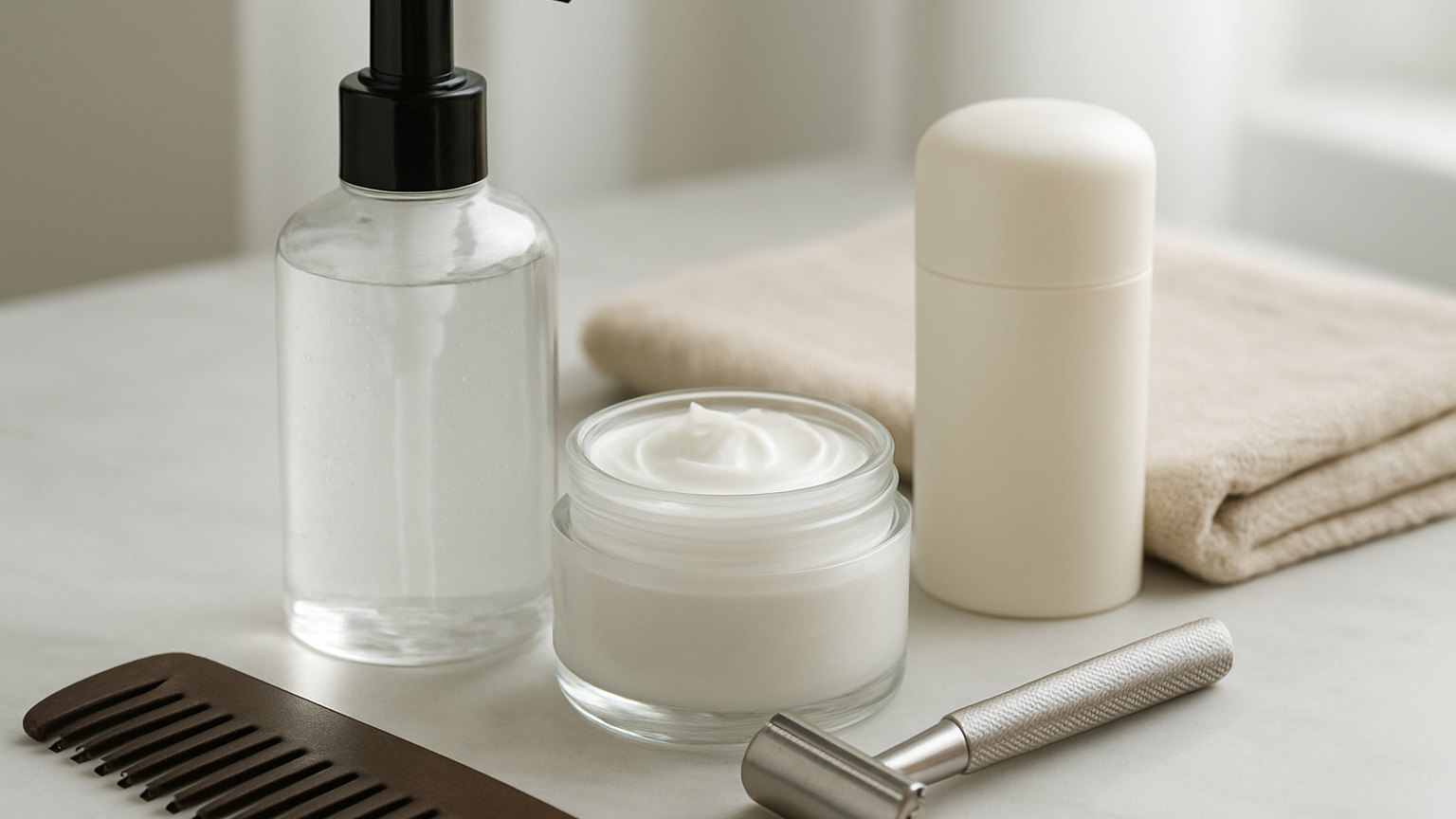
The number of grooming products sold vastly exceeds the number that do anything. A short list covers almost everything, and learning to read the claims is worth more than any specific recommendation.
What is the short list?
A gentle cleanser. A moisturiser suited to your skin. A sunscreen you will apply daily.
Fluoride toothpaste and interdental brushes or floss. A deodorant or antiperspirant.
Shampoo suited to your scalp and conditioner for the lengths. A hand cream.
Whatever you need for hair removal, if you remove hair. That is close to a complete kit for most people.
What is worth adding?
One active for a specific concern you actually have. A retinoid for ageing or congestion. Salicylic acid for oily skin. Azelaic acid or niacinamide for pigmentation and redness.
An antifungal shampoo if your scalp flakes. A urea cream if your hands or feet are rough.
One at a time, for a documented reason, is the sensible pattern. Buying four actives at once means that if something reacts you will not know which.
Which claims mean nothing?
Dermatologically tested, which means a dermatologist was involved at some point and says nothing about the result.
Hypoallergenic, which is unregulated and carries no defined standard.
Non-comedogenic, which is likewise unregulated and untested in any consistent way.
Natural, organic and chemical-free, none of which indicate safety or efficacy. Poison ivy is natural, and everything is a chemical.
Detoxifying, which describes no real process. Balancing. Anything promising to repair hair, which cannot be repaired.
Which claims mean something?
A stated concentration of an active ingredient, which allows you to compare against the strengths used in research.
SPF and UVA ratings, which are measured to a standard. Fluoride parts per million on toothpaste.
Fragrance-free, which is more meaningful than unscented, since unscented can mean a masking fragrance was added.
A period-after-opening symbol, which tells you how long it is good for once opened.
Where is spending more justified?
Sunscreen, where paying for a texture you will genuinely apply every day is money well spent, since the alternative is not applying it.
Anything treating a diagnosed condition, where the formulation genuinely differs.
Tools you use frequently: a decent razor, a hairdryer with good airflow, a toothbrush with a timer.
Where it is rarely justified: cleansers, which are on the skin for a minute; body moisturisers; shampoo; and almost anything described as luxury, where you are paying for texture and packaging.
How do you read an ingredient list?
Ingredients are listed in descending order by quantity down to one per cent, after which order is arbitrary.
The first five tell you most of what the product is. If the hero ingredient appears after the fragrance, there is very little of it.
Alcohol denat high in the list means a drying product. Fragrance or parfum near the end still means fragrance is present.
Water first is normal and not a criticism, since most products are largely water.
What about products marketed by gender?
Largely packaging, fragrance and price. The underlying formulations for cleansers, moisturisers and razors are frequently near-identical.
Male skin is on average thicker and oilier, which shifts texture preference toward lighter formulations, and that is a preference rather than a requirement.
Comparing by ingredient list and cost per millilitre rather than by aisle usually finds the same thing cheaper.
How do you avoid accumulating?
Finish something before buying its replacement. Buy small sizes when trying anything new.
Give a new product twelve weeks before judging it, which slows the rate of acquisition considerably.
And review annually, discarding anything expired, anything you cannot explain the purpose of, and anything bought for a problem that has gone.
How long do products last?
The small open-jar symbol on the packaging gives the period after opening in months, and it matters more than the expiry date on an unopened product.
Sunscreen is the one to take seriously, since degraded filters mean less protection than the label claims. Mascara should go after three months, since the wand carries bacteria into the tube each use. Anything that has changed colour, separated or smells different has gone regardless of the date.
Storing things out of a warm steamy bathroom extends most of them considerably.


