
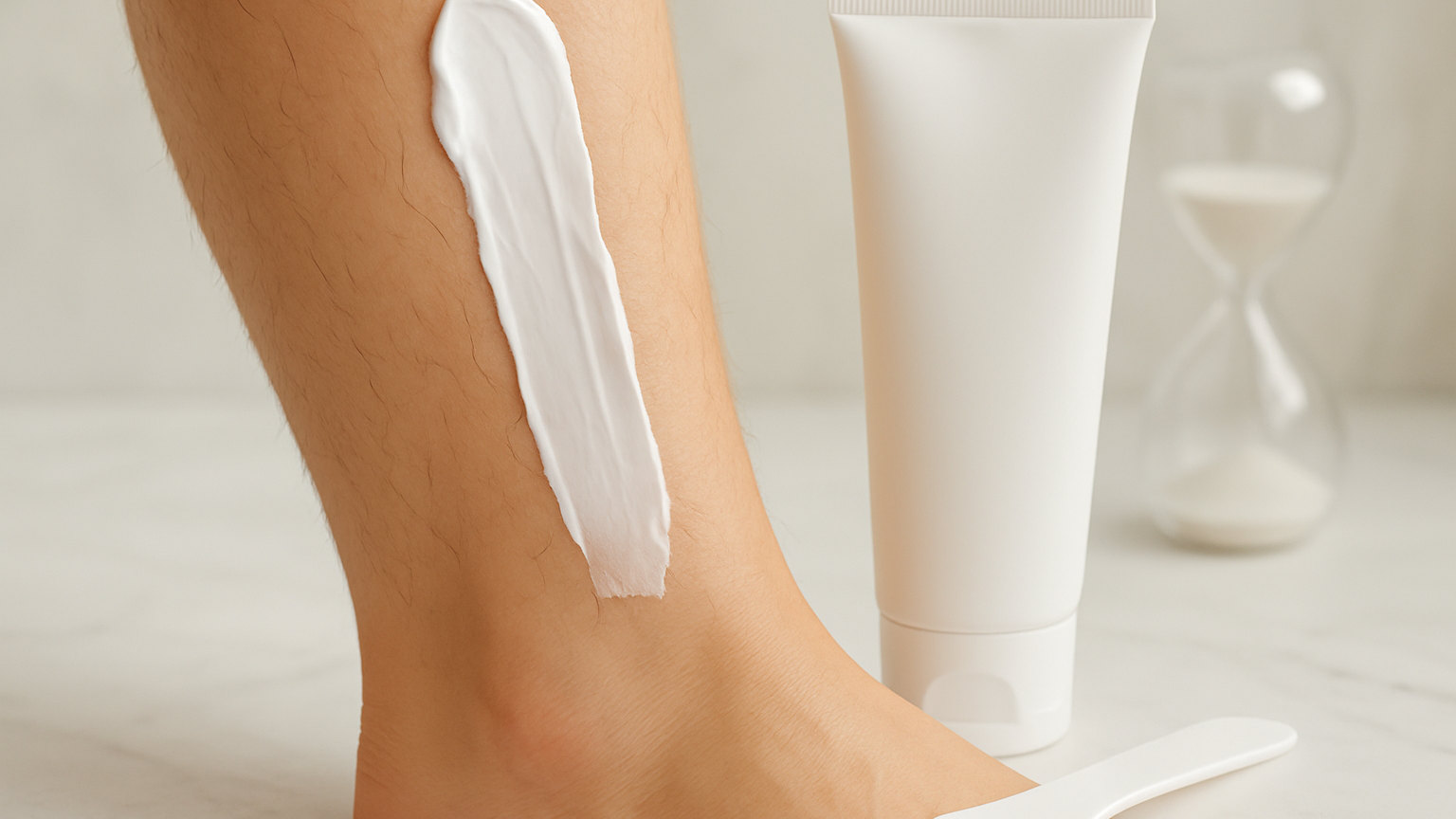
Depilatory creams dissolve the hair rather than cutting or pulling it. The chemistry that breaks down hair keratin also acts on skin keratin, which is why the timing instructions are not a suggestion.
How do they work?
The active ingredients are usually thioglycolates, such as calcium or potassium thioglycolate, in an alkaline base with a high pH.
They break the disulphide bonds holding keratin together, weakening the hair until it can be wiped away at the skin surface.
The distinctive sulphurous smell is the sulphur released as those bonds break. It is unavoidable rather than a formulation failure.
What is the risk?
Chemical burns, which are the main hazard and are entirely a function of leaving it on too long or using it on unsuitable skin.
Skin is also made of keratin, and the same reaction attacks it. The formulations are balanced so hair, which is more vulnerable, breaks down first, and the margin is a matter of minutes.
Irritant contact dermatitis is common. Allergic reactions occur and are less common.
How do you use them safely?
Patch test twenty-four hours beforehand on a small area, every time, not just the first. This is stated on every packet and skipped by most people.
Time it precisely with a timer. Never leave it longer than the maximum stated, even if hair is not coming away, since that means the product is not suited to your hair rather than that it needs longer.
Check a small area at the minimum time. Remove with the spatula provided rather than rubbing.
Rinse thoroughly with cool water and no soap for several hours afterwards.
Where should you not use them?
Anywhere the packaging does not specify. Facial creams are formulated differently from body creams and are not interchangeable.
Broken, irritated, sunburnt or recently shaved skin. Anywhere you have used retinoids, acids or exfoliants in the previous few days.
Genital skin, unless using a product specifically formulated and labelled for the bikini line, and even then following the instructions exactly.
Near the eyes, on the nose, or on moles and warts.
What if you get a burn?
Rinse immediately with cool running water for several minutes. Do not use soap, which is often also alkaline.
Apply a bland emollient or aloe. Do not apply anything acidic to neutralise it, which is a common suggestion online and can worsen the damage.
Seek medical advice for blistering, weeping, significant pain, or any burn on the face or genitals. Chemical burns can be deeper than they look initially.
How long do results last?
Three to five days, slightly longer than shaving, since the hair is dissolved marginally below the skin surface rather than cut at it.
Regrowth is softer than after shaving because the end is dissolved rather than cut bluntly, which some people find a meaningful advantage.
What are the advantages?
No blade, so no nicks and no risk of cutting yourself. Useful for anyone who bruises or bleeds easily, or who is on anticoagulants.
Fewer ingrown hairs than shaving, since the hair is not cut to a sharp point below the surface.
Reaches awkward areas such as the back of the legs without needing to see clearly. Inexpensive.
Who should avoid them?
Anyone with sensitive skin, eczema, psoriasis or a history of contact dermatitis, unless a patch test is entirely clear.
Anyone using topical retinoids, acids or benzoyl peroxide in the area, or taking oral isotretinoin.
Anyone who has reacted before, since reactions to thioglycolates tend to recur and worsen.
And anyone tempted to leave it on longer for better results, which is the single most common route to a burn.
Do they work on coarse hair?
Less well, which is the most common complaint after the smell. Thioglycolates break down keratin at a rate suited to fine and medium hair, and very coarse hair frequently needs longer than the product allows.
The temptation is to exceed the stated time, which is exactly what causes burns. Formulations labelled for coarse hair use higher concentrations and shorter times rather than the reverse. If a cream consistently leaves hair behind at the maximum time, it is the wrong method for that hair rather than a product being used incorrectly.


