
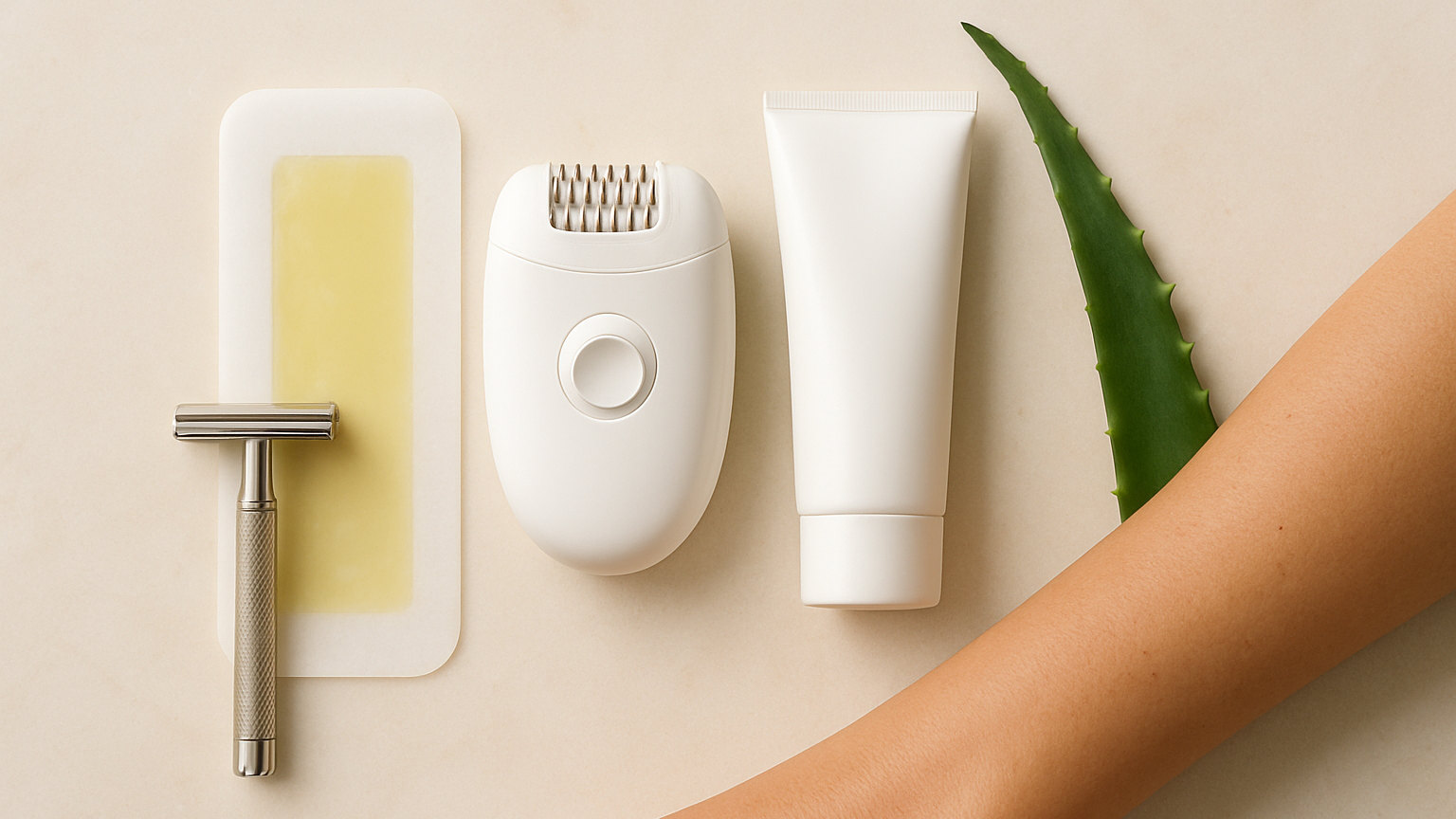
There is no best hair removal method, only trades between cost, pain, how long the result lasts, and how the skin responds. The right answer varies by body area, and most people end up using two or three.
What are the categories?
Methods that cut hair at the surface: shaving and trimming. Fast, painless, cheap, and regrowth within one to three days.
Methods that remove hair from the root: waxing, sugaring, threading, epilation and plucking. Regrowth in two to six weeks, more pain, and a risk of ingrown hairs.
Methods that dissolve hair chemically: depilatory creams. Regrowth in three to five days, no blade, and a risk of chemical irritation.
Methods that target the follicle: laser, intense pulsed light and electrolysis. Long-term reduction or permanent removal, at considerable cost.
How do they compare on cost?
Shaving is cheapest per use and adds up: cartridges over a decade run to a substantial figure, which is why safety razors appeal.
Home waxing and epilators are cheap after the initial purchase. Salon waxing runs to a monthly cost that over years exceeds laser.
Laser is expensive upfront, typically six to ten sessions per area, and cheaper than a lifetime of waxing for large areas. Electrolysis is charged by the hour and is the most expensive per area.
How do they compare on pain?
Shaving and creams: none. Threading: moderate and brief. Epilation: significant initially, reducing with regular use.
Waxing and sugaring: significant, and sugaring is generally reported as less painful since it does not adhere to skin as strongly.
Laser: a snapping sensation, tolerable for most. Electrolysis: uncomfortable and slow, since each hair is treated individually.
Which suits which area?
Legs: shaving for convenience, waxing or epilation for longer results, laser for permanence. All work well.
Underarms: shaving or laser. Waxing works and the area is sensitive.
Bikini line: waxing, sugaring or laser generally beat shaving, which causes ingrown hairs on coarse curly hair. Trimming is the lowest-risk option.
Face: threading for brows and upper lip, since it is precise. Depilatory creams formulated for facial skin. Electrolysis for permanent removal on any hair colour.
Back and chest: shaving is impractical alone, waxing is effective, laser is the most practical long-term option.
Which causes the fewest ingrown hairs?
Methods that leave the hair long or remove it entirely. Trimming causes almost none, since nothing is cut below the surface.
Laser and electrolysis eliminate the problem by removing the follicle's ability to produce hair.
Waxing and epilation cause ingrowns in some people and fewer in others, since regrowth from the root emerges finer and can struggle to break through.
Shaving against the grain on coarse curly hair is the worst combination.
Which suits sensitive skin?
Trimming and electric shavers, which do not scrape or pull.
Depilatory creams are convenient and carry a real risk of chemical burns, so a patch test twenty-four hours beforehand is not optional.
Waxing is difficult on skin taking retinoids, acids or isotretinoin, since the skin can lift with the wax. Anyone on those should say so, and isotretinoin generally requires waiting six months after finishing.
How do you decide?
Start with the area, then the tolerance for pain and cost, then how often you want to think about it.
For most people a combination works best: shaving where it is easy, waxing or laser where shaving causes problems, and trimming where removal is not necessary.
And leaving hair alone remains an option that costs nothing and carries no risk at all, which is worth saying in a category built on the assumption that it must go.
Can you switch between methods?
Mostly yes, with one important restriction. Moving from shaving to waxing requires letting the hair grow to around half a centimetre first, which is roughly two weeks, since wax needs something to grip.
Laser and electrolysis require the opposite: shaving between sessions is fine and necessary, while waxing, plucking and epilating are not, because both treatments need the hair root present in the follicle to work. Removing the root in the weeks before a session wastes the appointment, and clinics will usually tell you this and it is often missed.
Does hair grow back differently?
Only in ways that are frequently misattributed. Shaving changes nothing about the follicle, so regrowth is identical apart from the blunt cut end feeling coarser.
Root removal methods can, over years, damage some follicles enough that regrowth becomes finer and sparser, which is welcome when it is intended and unwelcome on eyebrows shaped by waxing for decades.


