
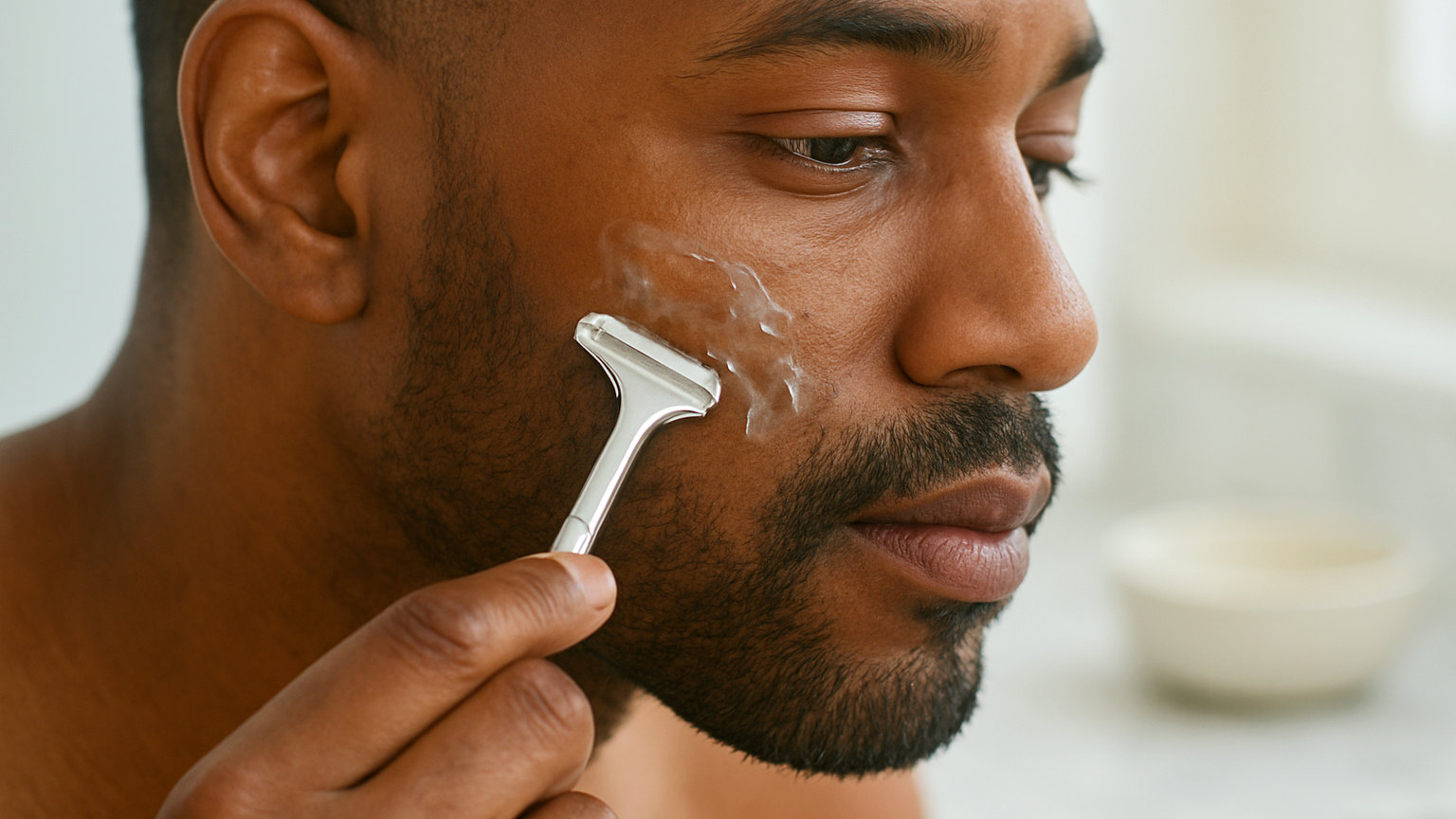
Facial skin is thinner than body skin, more visible, more prone to post-inflammatory marks and more likely to be treated with actives. All four change which removal methods are sensible.
What are the options?
Threading, which is precise, uses nothing on the skin and suits fine hair. The standard for brows and good for the upper lip.
Waxing with hard wax formulated for the face, which is faster than threading over an area and adheres to skin more.
Depilatory creams formulated specifically for facial skin, which are not the same as body creams.
Tweezing for individual hairs. Facial epilators for larger areas. Shaving and dermaplaning. Laser and electrolysis for permanent reduction or removal.
And bleaching, which lightens rather than removes and suits fine dark hair on lighter skin.
Can you shave your face?
Yes, and the belief that it makes hair grow back thicker prevents a great many women from using the simplest available method.
Shaving cuts the shaft above the skin and cannot affect the follicle. Regrowth is identical, apart from the blunt cut end feeling coarser than a tapered tip for a day or two.
Use a fresh sharp blade, a lubricant, and shave with the grain. Small facial razors designed for the purpose are easier to control than a body razor.
What is dermaplaning?
Shaving the face with a scalpel-style blade held at an angle, removing vellus hair along with the top layer of dead skin.
The exfoliation is the main appeal: skin looks smoother and makeup sits better afterwards. The hair removal lasts a few days.
Done professionally it is straightforward. Done at home with a cheap blade it carries a genuine risk of cuts and, on acne-prone skin, of spreading bacteria.
Avoid it entirely on active acne, rosacea flares, or skin using retinoids or acids, since the barrier is already thinned.
What should you avoid?
Body depilatory creams on the face, which are formulated for thicker skin and cause burns.
Waxing while using retinoids, acids or on isotretinoin, which risks lifting the skin. Stop topical actives five to seven days beforehand.
Plucking coarse chin hairs repeatedly over years, which can cause follicle damage, ingrown hairs and scarring. Individual hairs are fine; a habit of plucking a whole area is not.
Anything on active cold sores, acne lesions or broken skin.
Why do marks appear afterwards?
Post-inflammatory hyperpigmentation, which is more common and more persistent on facial skin and in deeper skin tones.
Any inflammation triggers pigment production, so repeated irritation from waxing or plucking leaves brown marks that outlast the hair by months.
Preventing it means minimising irritation, using sunscreen daily on the treated area, and treating existing marks with azelaic acid or niacinamide.
What about permanent options?
Laser works well on dark facial hair and requires care around the eyes, which are protected during treatment.
Electrolysis is the only option for grey, white, red or fair facial hair, and it is the standard method where completeness matters. Slow and permanent.
Both are worth considering for anyone whose facial hair is hormonally driven, though treating the underlying cause first makes either considerably more effective.
When is facial hair worth investigating?
If it develops rapidly over months rather than years. If it appears alongside irregular periods, acne, scalp hair thinning or a deepening voice.
If it begins suddenly after menopause. Any of these warrants a GP appointment, since polycystic ovary syndrome and other hormonal conditions are common, treatable and frequently undiagnosed.
What is the sensible routine?
Choose one method and stick with it rather than alternating, which irritates skin repeatedly. Keep the area moisturised and use sunscreen.
Do not remove hair in the days before an event, since redness and bumps need time to settle. Two or three days is usually enough.
Does bleaching work?
For fine dark hair on lighter skin, reasonably well, and it removes nothing. Facial hair bleach lightens the hair so it catches the light less, which suits an upper lip better than a chin.
It uses hydrogen peroxide with an alkaline activator and is genuinely irritating to some skin. Patch test twenty-four hours beforehand every time, keep it well away from the eyes, and do not use it on skin treated with retinoids or acids. On deeper skin tones the contrast between bleached hair and skin can be more noticeable rather than less.


