
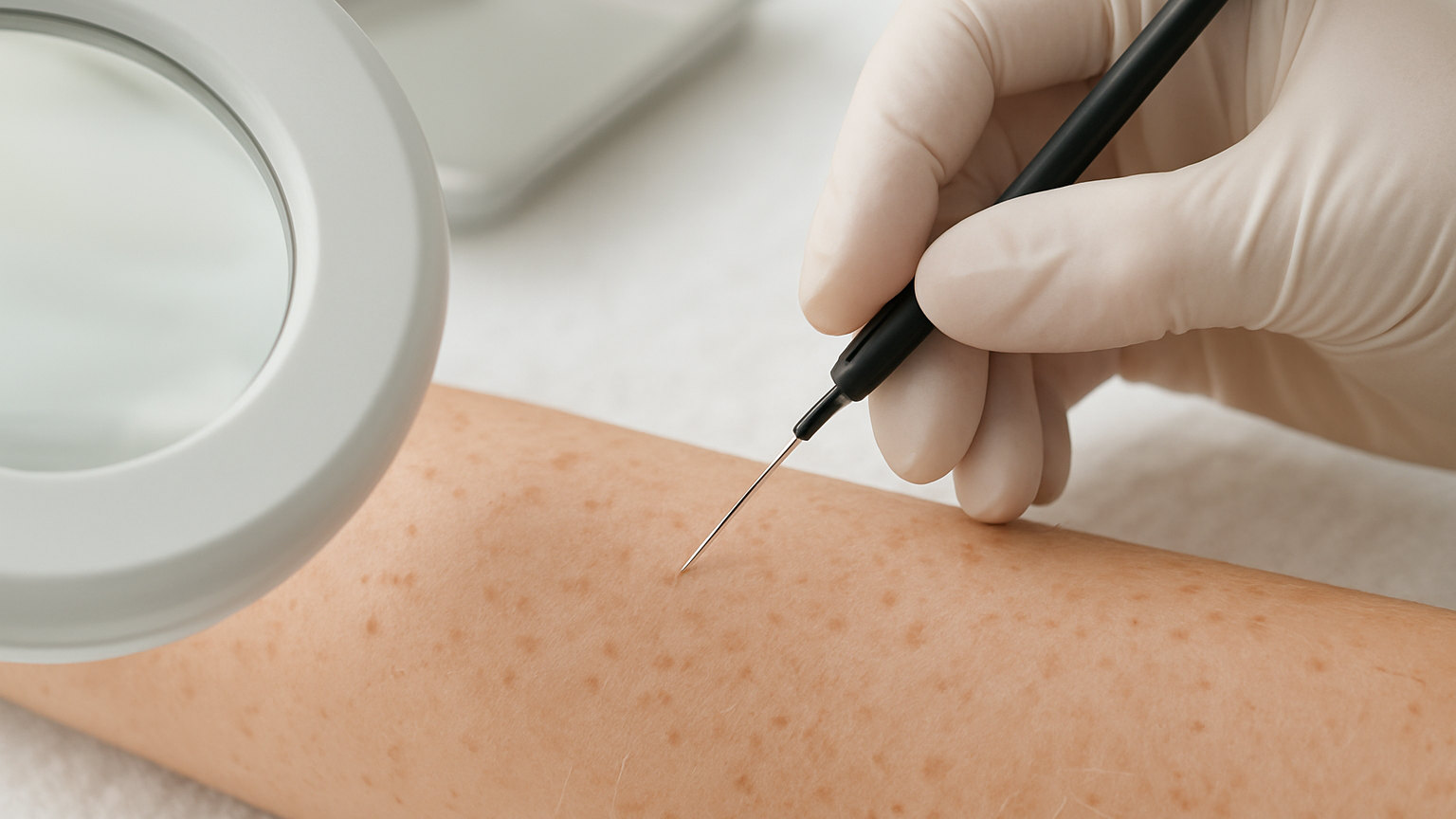
Electrolysis is the only hair removal method permitted to claim permanent removal rather than reduction, and it is the only one that works regardless of hair colour. It is also slow and expensive, which is why it is less widely used than laser.
How does it work?
A fine probe is inserted into the follicle alongside the hair, and a current is applied to destroy the cells responsible for producing hair. The hair is then lifted out with tweezers.
Each hair is treated individually, which is the reason for both its effectiveness and its slowness.
Three methods exist: galvanic, which produces a chemical reaction; thermolysis, which produces heat; and blend, which combines both and is the most commonly used.
How does it differ from laser?
Laser targets melanin in the hair, so it needs dark hair to work. Electrolysis targets the follicle directly, so hair colour is irrelevant.
That makes electrolysis the only option for white, grey, red and blonde hair, which laser cannot treat at all.
Laser treats a large area in one pass; electrolysis treats one hair at a time. A full leg course by electrolysis would be impractical, where laser handles it in twenty minutes per session.
Electrolysis is permanent for the follicles treated. Laser produces reduction that may need maintaining.
How long does it take?
Considerably longer than most people expect. Sessions are charged by time, typically fifteen minutes to an hour, and a course runs over many months.
An upper lip might take eight to eighteen months of regular sessions. Larger areas take proportionally longer and are frequently impractical.
The reason is the hair growth cycle: only follicles in the active phase can be treated effectively, so the area has to be revisited repeatedly.
What areas suit it?
Small, precise areas. The upper lip, chin, eyebrows, and stray hairs anywhere.
Areas where laser has failed or is unsuitable, particularly grey or fair hair.
It is also the standard method for permanent hair removal in gender-affirming care, where completeness matters and where hair colour varies.
Large areas such as legs and back are technically possible and rarely practical.
Does it hurt?
More than laser, and it varies by area and individual tolerance. Most people describe a sharp sting with each hair.
Topical anaesthetic cream applied beforehand helps considerably and needs applying around thirty minutes in advance.
The face, particularly the upper lip, is the most sensitive area.
What are the risks?
Redness and small welts immediately afterwards, which settle within hours to a day.
Scarring and pigment changes, which are uncommon with a skilled practitioner and a genuine risk with an unskilled one, since the technique depends on correct probe insertion and current settings.
Infection if aftercare is poor, since the follicle has been opened.
Practitioner skill matters enormously. Look for someone registered with a professional body such as the British Institute and Association of Electrolysis, and ask how long they have been practising.
What does it cost?
Charged by time, typically from around twenty to fifty pounds for a fifteen-minute session depending on location.
Over a course of a year or more for a small area, the total can exceed laser for a larger one. The value depends on whether laser is an option at all.
For grey or fair hair, it is the only option, which changes the calculation entirely.
Who is it best for?
Anyone with hair laser cannot treat. Anyone who wants genuinely permanent removal of a defined small area. Anyone who has completed laser and has scattered fair hairs remaining, which is a common and sensible combination.
Anyone with a small number of persistent hairs, such as on the chin, where a course of electrolysis resolves permanently what plucking would maintain forever.
How should you prepare and look after the area?
Unlike laser, you must not remove the hair beforehand, since the practitioner needs to see and reach each follicle. Let it grow to a few millimetres, enough to grip with tweezers.
Afterwards, keep the area clean and avoid touching it, since follicles are open. No makeup on treated facial skin for a day, no heat, no swimming and no sun for forty-eight hours. Redness and small welts settling within a day are expected; anything lasting longer is worth mentioning at the next appointment.


