
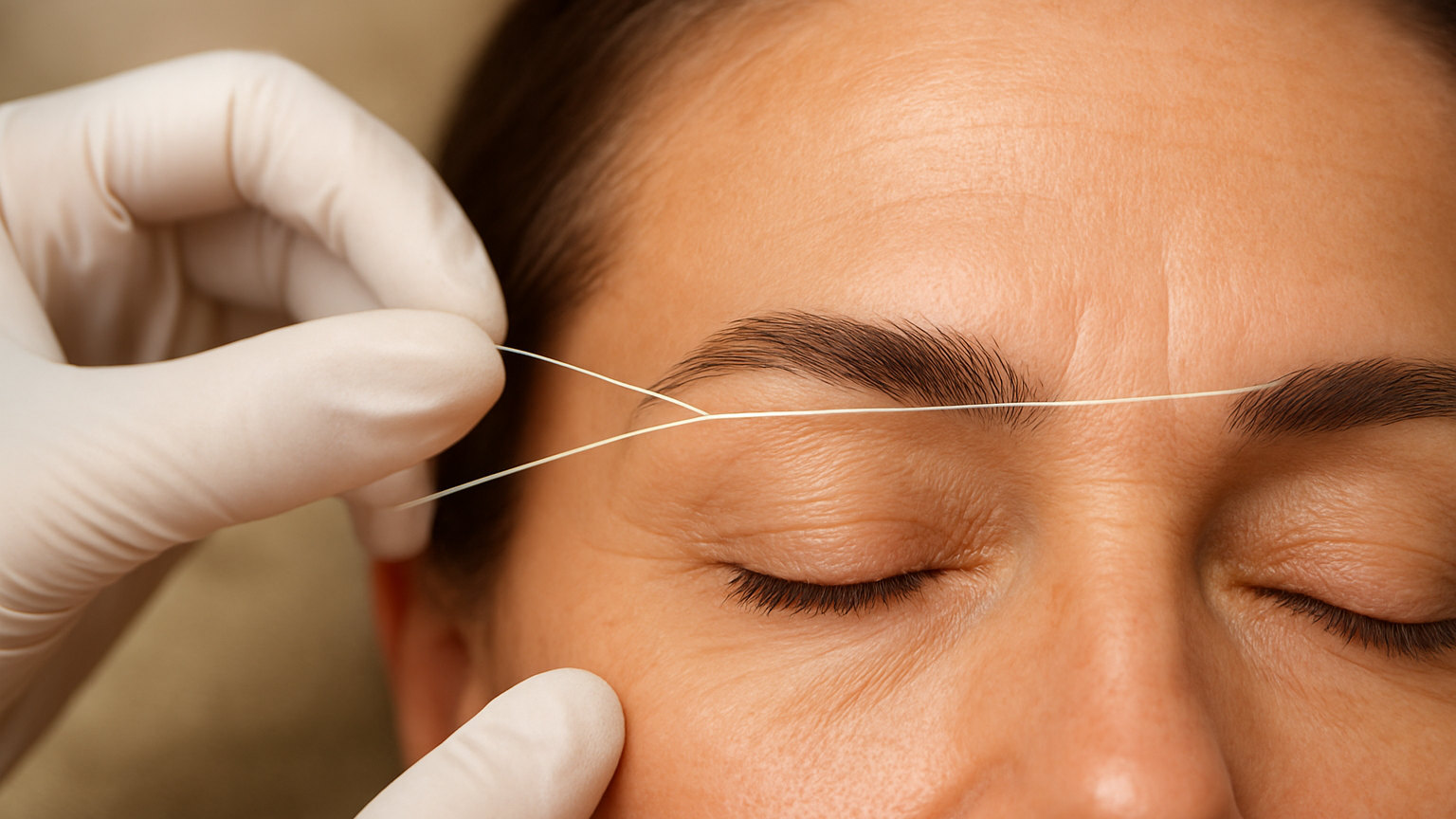
Threading uses a twisted cotton thread rolled across the skin, catching hairs in the twist and pulling them out at the root. It is ancient, precise, and the only method that removes hair without any product touching the skin.
How does it work?
A length of cotton thread is twisted into a loop and manipulated between the practitioner's hands and often mouth. As the twist is rolled across the skin, it catches hairs and lifts them out from the root.
Because the twist catches a row of hairs at once rather than a patch, it can follow a precise line, which is why it is the standard method for brow shaping in much of the world.
Nothing is applied to the skin, which makes it suitable for skin that reacts to wax or chemicals.
What is it best for?
Eyebrows, above all. The precision available is greater than waxing, since the practitioner can remove single hairs or a fine line rather than everything a strip of wax covers.
The upper lip, chin, sides of the face and between the brows. Fine facial hair generally, including vellus hair that wax struggles to grip.
It is not used for large body areas, where it would be impractically slow.
How does it compare with waxing?
More precise, since it works in lines rather than areas. Better for defining a brow shape.
Gentler on the skin, since no adhesive is pulling at the surface. That makes it suitable for anyone using retinoids or acids, where waxing risks lifting skin, though a few days without actives is still sensible.
It removes shorter hair than wax can, from around two millimetres.
It is generally slower for a given area and can be more painful for some people, since the sensation is repeated over many small pulls rather than one large one.
Does it hurt?
Moderately, and briefly. Most people describe it as sharper than waxing but shorter-lived, with the eyes watering on brow work regardless of pain tolerance.
It becomes considerably easier with repeated sessions as hair grows back finer.
Taking a painkiller half an hour beforehand helps if you find it difficult, and avoiding it in the few days before a period is worth knowing, since sensitivity is higher then.
How long do results last?
Two to five weeks, similar to waxing, since both remove hair from the root.
Brows typically need doing every three to four weeks to maintain a shape. Upper lip every three to six weeks.
Regrowth emerges with a tapered tip rather than a blunt end, so it is softer and less visible than shaved regrowth.
What are the risks?
Redness and small bumps for a few hours, which is normal. Occasional breakouts in the treated area, particularly on the face.
Ingrown hairs, which are less common than with waxing and do occur.
Hygiene is worth considering. The thread is single-use and discarded, and practitioners in some places hold one end in their mouth, which is traditional and a reasonable thing to ask about if it concerns you.
Skin lifting is very rare compared with waxing, which is the main safety advantage.
What should you do afterwards?
Avoid touching the area, which introduces bacteria to open follicles. Apply a soothing gel such as aloe if it is irritated.
Avoid makeup on the area for a few hours, and avoid heat, sun and swimming for the rest of the day.
Do not exfoliate for two days, then resume gently.
How do you get a good result?
Grow the hair for two to three weeks beforehand so there is enough to catch.
Bring a photograph or be specific about the brow shape you want, and say clearly if you want them left thick, since removing too much cannot be undone quickly. Eyebrow hair grows slowly and over-plucking over years can be permanent.
Go to someone who threads regularly rather than a salon that offers it occasionally, since the technique takes considerable practice to do well.


