
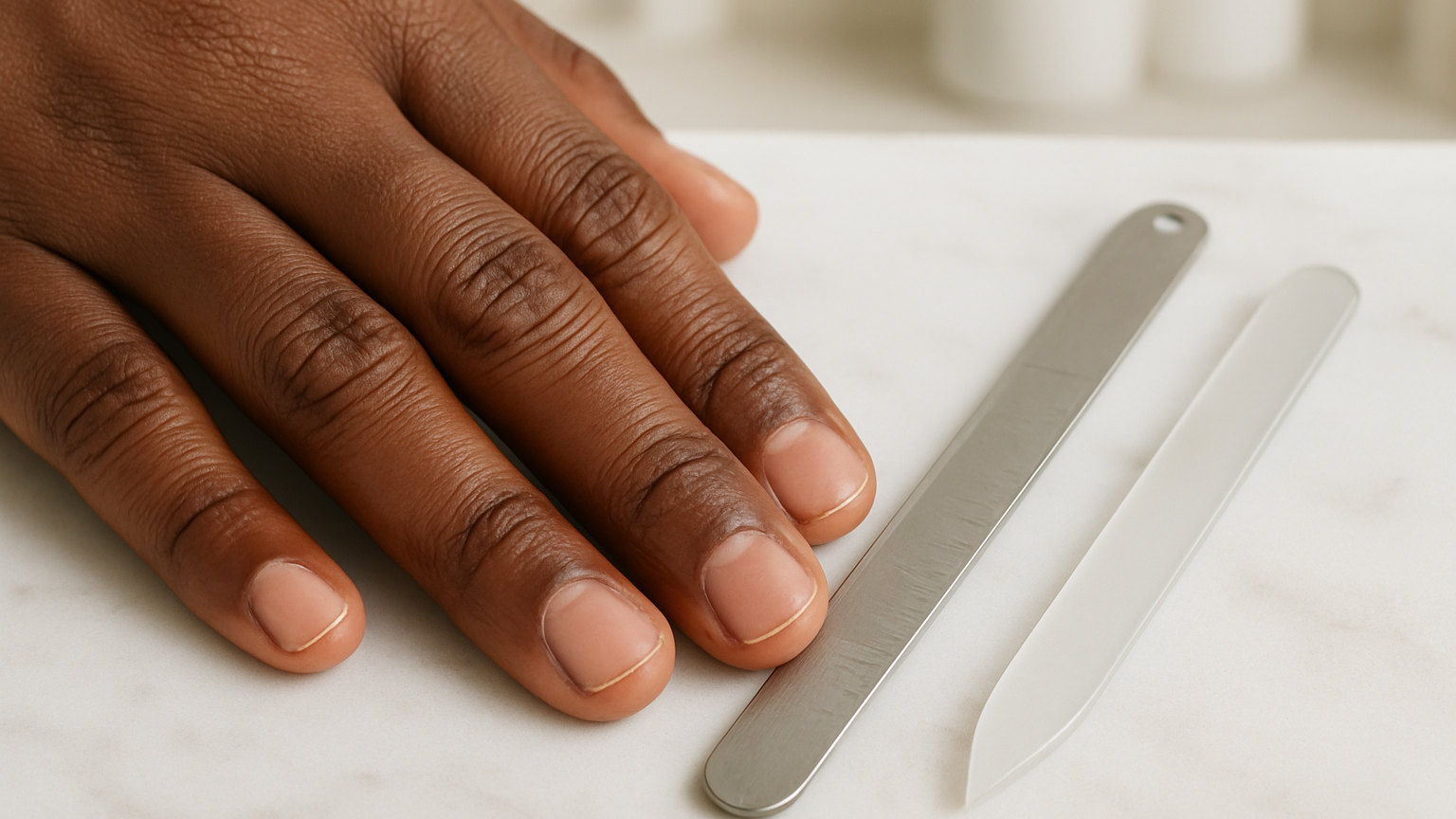
Fingernails grow around three millimetres a month and toenails around one. That is considerably slower than most people assume, and it explains why damage takes so long to disappear and why very little you apply makes a meaningful difference.
What are the actual rates?
Fingernails: roughly 3 to 3.5 millimetres a month, so a complete replacement takes around six months.
Toenails: roughly 1 to 1.5 millimetres a month, taking twelve to eighteen months for a full replacement. The big toenail is the slowest.
Those figures are useful for dating things. A mark six millimetres from the cuticle on a fingernail appeared roughly two months ago.
Why do fingernails grow faster?
Better blood supply and more use. Nails on the dominant hand grow slightly faster than the other, and the middle finger fastest of all.
Minor repeated trauma appears to stimulate growth, which is why nails on fingers used most tend to be longest.
Toes have poorer circulation and are enclosed in footwear for most of the day, which is the likeliest explanation for the difference.
What affects the rate?
Age, which slows it. Growth peaks in the twenties and declines thereafter, by a noticeable amount across decades.
Season, with modestly faster growth in summer than winter. Pregnancy, which speeds it up. Circulation, which is why cold hands and Raynaud's slow it.
Serious illness, fever, malnutrition and chemotherapy can pause growth entirely, producing the horizontal grooves known as Beau's lines.
Nail biting, oddly, is associated with slightly faster growth, again probably through repeated minor trauma.
Can you make them grow faster?
Very little, and the honest answer is the same as for hair: the useful lever is retention rather than speed.
Correcting a genuine deficiency helps if one exists, particularly iron. Biotin has some evidence for brittle nails and interferes with several blood tests at high doses, which is worth telling any doctor about.
Beyond that, nails grow at the rate your circulation and genetics allow, and no oil, serum or supplement changes it meaningfully.
What does change is how much length survives, which is a matter of avoiding splitting and breakage.
How long does damage take to grow out?
This is where the growth rate matters most.
A white spot from a knock takes two to four months to reach the free edge on a fingernail. Damage from a peeled-off gel manicure takes three to six months.
A bruise under a toenail can take a year or more. A fungal infection treated successfully still needs twelve to eighteen months for the toenail to look normal.
Judging any nail treatment before a full growth cycle has passed is judging an incomplete process, which is why nail products are so often abandoned early.
What is the matrix and why does it matter?
The matrix sits under the skin at the base of the nail, extending back beneath the cuticle. It is where new nail is produced.
Everything visible is dead tissue produced by it. Nothing applied to the nail plate changes how the nail is made, only how it behaves.
Damage to the matrix, from trauma, aggressive cuticle work or repeated infection, can cause permanent ridging or deformity, since the production itself has been altered.
This is why pushing cuticles back gently rather than cutting or forcing them matters more than any product choice.
Does the lunula mean anything?
The pale half-moon at the base of the nail is simply the visible part of the matrix, showing through because the nail there is still forming and less transparent.
Its size is anatomical and varies between people and between fingers. Claims that a small or absent lunula indicates a health problem are not supported.
How do you keep the length you grow?
Reduce water exposure, which is the largest cause of splitting. Gloves for wet work.
Moisturise the nail plate and cuticle daily. File in one direction with a fine file. Keep them at a length that suits your hands rather than the maximum you can grow.
Avoid using nails as tools, which is where most breaks come from.


