
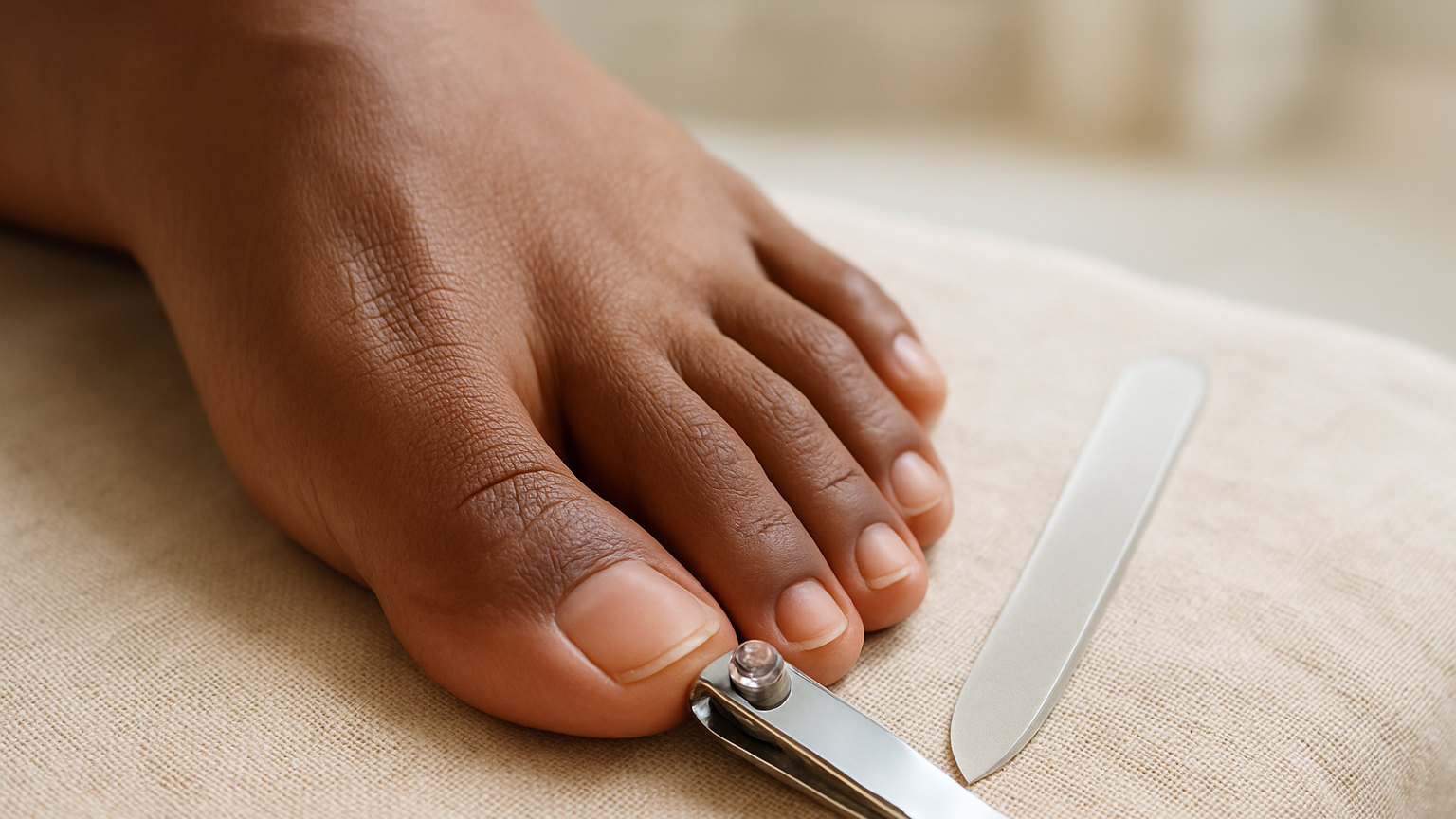
Two common problems come down to nail shape: fingernails splitting at the corners, and toenails growing into the surrounding skin. Both are largely prevented by cutting them differently, and the correct approach differs between hands and feet.
When should you cut them?
After a bath or shower, when nails have absorbed water and are more flexible. Cutting dry nails causes more splitting and crushing.
Toenails in particular benefit from softening, since they are considerably thicker.
The exception is filing, which is better done on dry nails, since wet nails are soft and tear rather than filing cleanly.
What should you use?
Nail clippers or nail scissors, kept sharp. Blunt clippers crush the nail rather than cutting it, which starts the splits.
A glass or crystal file, which seals the nail edge rather than tearing it, unlike coarse emery boards. They also last indefinitely and can be washed.
If using an emery board, a finer grit of 240 or above for natural nails. Coarser grits are for artificial nails.
Separate tools for hands and feet, to avoid transferring fungal infection.
What shape should fingernails be?
Slightly rounded, following the natural curve of the fingertip, is the strongest shape for most people.
Squared-off nails with sharp corners are more prone to catching and splitting at the corner. Very pointed shapes are the weakest of all, since the stress concentrates at a narrow point.
A soft square or oval is the practical compromise: cut straight across, then gently round the corners with a file.
Length matters too. Longer nails lever against the free edge and split more readily, which is why brittle nails do better kept short.
How should you file?
In one direction rather than back and forth, which is the rule most often ignored. Sawing separates the keratin layers at the edge and causes peeling.
Work from the outside toward the centre, on each side. Hold the file flat against the edge rather than at a steep angle.
File after cutting to smooth the edge, and file rather than cut for small adjustments, since it is gentler.
Why are toenails different?
Because rounding the corners of a toenail is what causes ingrown nails. The nail is under pressure from footwear, and a rounded corner allows the nail to grow into the skin at the side.
Cut toenails straight across, level with the end of the toe. Do not round the corners, and do not cut down the sides.
Smooth any sharp corner with a file rather than cutting it away, which is enough to prevent snagging without creating the problem.
Do not cut them too short, which allows the surrounding skin to fold over the edge.
What about cuticles?
The cuticle seals the gap between the nail plate and the skin, and it is a barrier against infection rather than a cosmetic imperfection.
Cutting it removes that seal and increases the risk of infection and inflammation. Repeated cutting or aggressive pushing can damage the matrix underneath, causing permanent ridges.
Soften with oil or after bathing, then push back gently with a soft tool. Trim only genuinely loose hangnails, and leave the rest.
What causes an ingrown toenail?
Cutting the nail too short or rounding the corners. Tight or narrow footwear. Injury to the toe. Naturally curved nails.
Early signs are tenderness at the side of the nail and redness. Soaking in warm salty water and wearing wider shoes often settles it.
Signs of infection, spreading redness, pus or significant pain need a GP or podiatrist. Do not attempt to dig out the corner, which is how minor ingrowing becomes a serious infection.
Anyone with diabetes or poor circulation should have any foot problem seen promptly rather than managed at home.
How often should you cut them?
Fingernails every one to two weeks, since they grow around three millimetres a month. Toenails every four to eight weeks, growing considerably more slowly.
Regular small trims are better than occasional large ones, which is easier on the nail and prevents the length at which splitting begins.


