
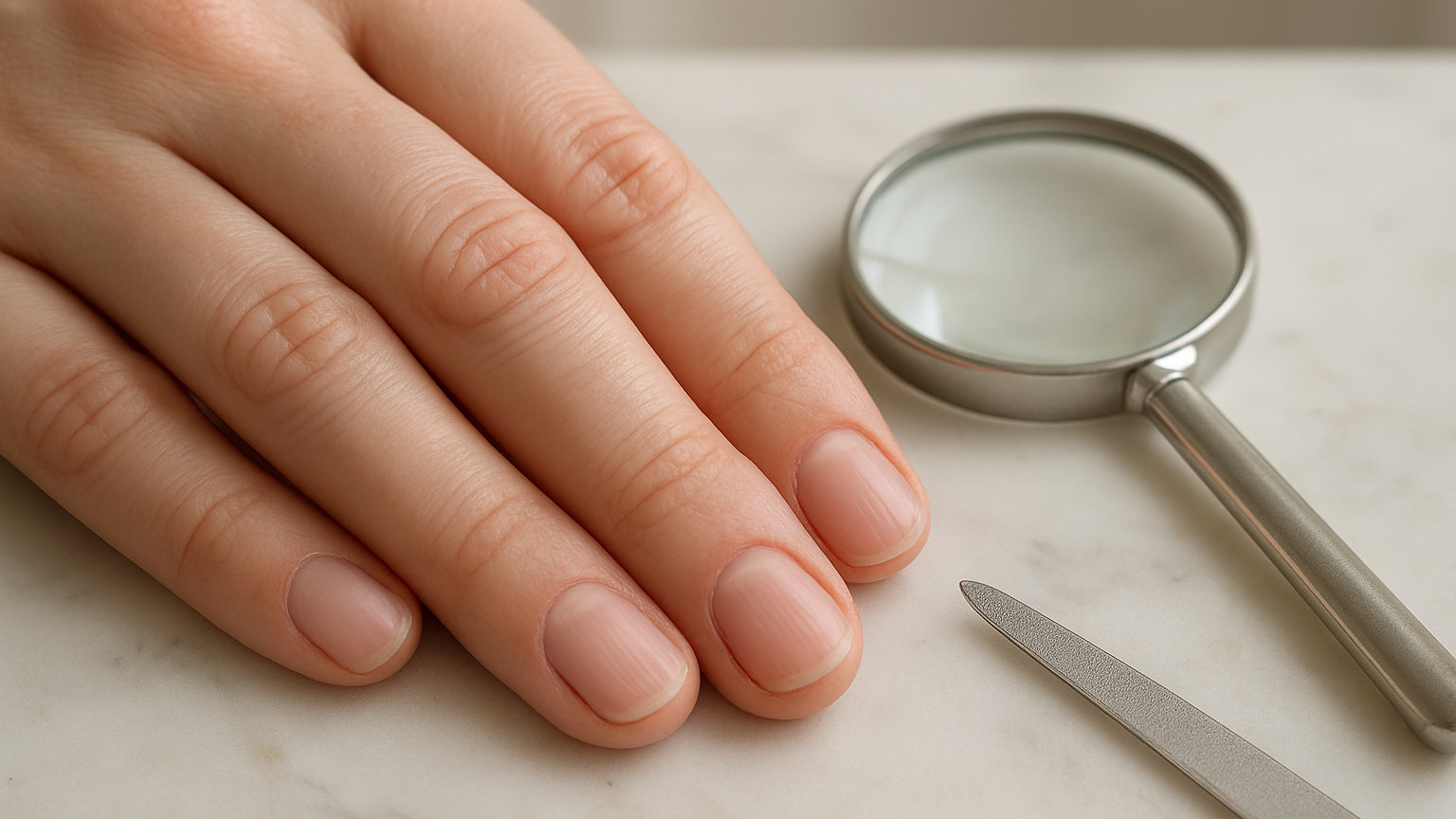
Nails carry a lot of folklore about what their markings supposedly reveal. Most of it is wrong. A useful rule cuts through most of it: changes affecting all nails suggest something systemic, and changes affecting one nail usually suggest something local.
What do vertical ridges mean?
Almost always nothing. Fine ridges running from the cuticle to the tip are the most common nail change of all and become more pronounced with age.
They are the equivalent of wrinkles: the nail matrix produces a slightly less uniform surface over time. No treatment is needed and buffing them smooth thins the nail plate, which is worth avoiding.
A single deep ridge or groove in one nail is different and may indicate a growth or cyst pressing on the matrix, which is worth showing a GP.
What about horizontal ridges?
These are more significant. Deep horizontal grooves across the nail, called Beau's lines, indicate that nail growth paused temporarily.
Causes include severe illness, high fever, chemotherapy, major surgery, malnutrition and significant physical stress. If several nails show a line at the same distance from the cuticle, something systemic happened at a datable point.
Since nails grow around three millimetres a month, you can estimate when. A groove six millimetres out corresponds to roughly two months ago.
They grow out and need no treatment. Worth mentioning to a GP if you cannot account for them.
What do white spots mean?
Not calcium deficiency, which is the most persistent myth in this area and has no basis.
They are almost always minor trauma to the matrix, from knocks, manicures or pushing cuticles back too hard. The damage shows up weeks later as the nail grows out.
They resolve on their own. Multiple white spots across all nails occasionally indicate zinc deficiency or a reaction to medication, and that is uncommon.
What about a dark line?
This is the one to take seriously. A brown or black stripe running lengthwise down a nail warrants a GP appointment.
Most are benign, particularly in people with deeper skin tones, where longitudinal melanonychia affecting several nails is common and normal.
The concerning features are a single nail affected, a line that is widening or darkening, pigment spreading onto the surrounding skin, or a line accompanied by nail splitting.
Subungual melanoma is rare and is missed regularly because people assume a dark line is a bruise. A bruise moves out with the nail over months; melanoma does not.
What causes pitting?
Small depressions across the nail surface, like pinpricks. Most commonly associated with psoriasis, where nail changes affect a substantial proportion of patients.
Also seen in alopecia areata and in eczema. Worth mentioning to a GP alongside any skin or joint symptoms, since nail psoriasis is associated with psoriatic arthritis.
What about spoon-shaped nails?
Nails that curve upward at the edges, concave enough to hold a drop of water, are koilonychia and are classically associated with iron deficiency anaemia.
Also seen in haemochromatosis and some thyroid conditions. This one genuinely warrants a blood test rather than a nail treatment.
What about clubbing?
The nail beds soften, the nails curve downward and the fingertips broaden. It develops gradually and is easy to miss in yourself.
It is associated with lung and heart conditions and some gastrointestinal diseases. New clubbing is a genuine reason to see a GP.
When should you see someone?
A dark streak in one nail, particularly if changing. Any nail lifting from its bed. A nail that has changed shape or thickness.
Persistent discolouration, particularly green, which suggests bacterial infection, or yellow-brown crumbling, which suggests fungal.
Changes affecting all nails alongside fatigue, hair loss or other symptoms. New clubbing or spooning. And any lump, swelling or persistent pain around a nail.
Do nails really show your health?
Less reliably than the internet suggests. Nails do reflect some systemic conditions, and the specific claims attached to individual markings are mostly wrong.
White spots are not calcium deficiency. Vertical ridges are not a sign of anything. Moons of a particular size mean nothing.
What genuinely matters is change: a marking that is new, spreading or affecting one nail only. Nails grow slowly enough that anything visible today began weeks ago, which makes them a slow record rather than a real-time indicator.


