
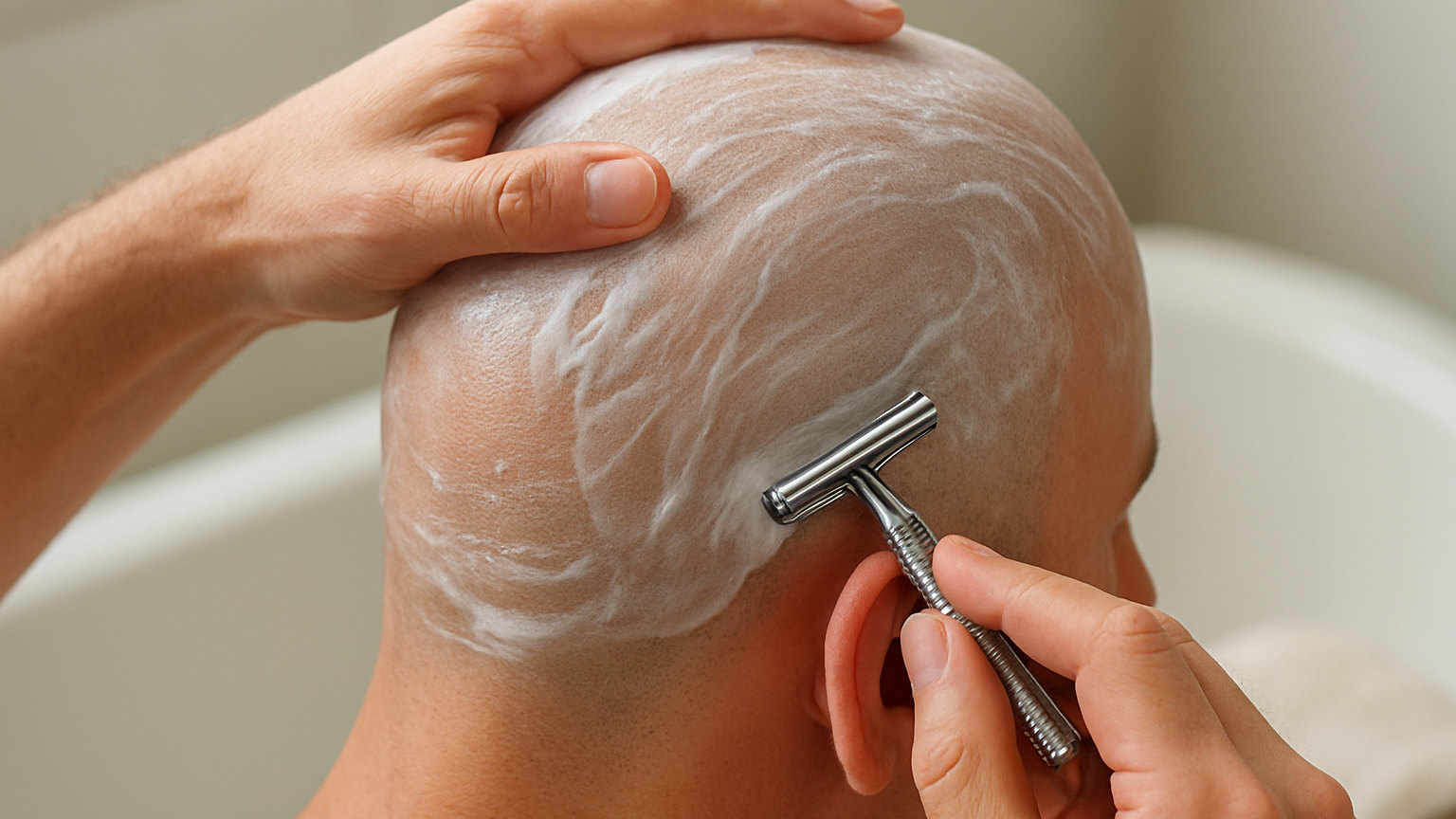
Shaving your head means working on a large curved surface you cannot fully see, with skin that is thinner than it looks and gets more sun than anywhere else. The technique differs enough from face shaving to be worth setting out.
What should you do first?
Clip the hair down to stubble with a guardless or short-guard trimmer before any blade touches it. Shaving longer hair clogs the razor immediately and causes most first-attempt problems.
Then a warm shower for several minutes. Scalp hair is coarse and softens considerably with heat and water.
Exfoliate gently once or twice a week rather than every shave, which clears dead skin and reduces ingrown hairs.
What should you use?
A cream or gel with good slip and enough visibility to see where you have been. Transparent gels help considerably on a head, since you cannot rely on feel alone.
A multi-blade cartridge or a dedicated head-shaving razor with a pivoting head, which follows the curve better than a rigid safety razor. Safety razors work well once you have learned the angle and are unforgiving at first.
Two mirrors, or a handheld mirror used against a bathroom mirror, for the back.
What is the technique?
Work in sections: top, sides, then back. Shave with the grain on the first pass, which on a scalp usually means from the crown outward and downward.
Use short strokes and light pressure, letting the razor follow the curve rather than pressing it flat against a rounded surface.
Rinse the blade constantly, since scalp hair is dense and clogs it quickly.
Use your free hand to feel for missed patches, then reapply cream to that area rather than dry shaving over it.
How do you do the back?
Mostly by feel, with a mirror to check rather than to guide. Trying to work visually with a reversed image is harder than working by touch.
Run your hand over the area between passes to find stubble. Go slowly around the occipital bone at the base of the skull, where the surface changes angle sharply and nicks are common.
The area behind the ears and along the hairline at the nape needs care, since hair grows in several directions there.
What should you do afterwards?
Rinse with cool water and pat dry. Apply an alum block if you have nicks, then a fragrance-free moisturiser or balm.
Avoid alcohol-based aftershave on a freshly shaved scalp, which stings considerably over that area.
And apply sunscreen if you are going outside. This is not optional: a shaved scalp has no protection at all, burns readily, and the scalp is a site where skin cancers are found late.
How do you avoid ingrown hairs and bumps?
Do not shave against the grain, particularly at the nape, where curly hair and close shaving produce razor bumps most readily.
Exfoliate between shaves with a salicylic acid product. Moisturise daily, since a dry scalp makes it harder for hair to break through.
Acne keloidalis nuchae, which produces firm bumps at the back of the neck that can become keloid scars, is associated with close clipping and shaving in that area, particularly with tightly curled hair. Leaving that area slightly longer is a sensible precaution, and any firm persistent bumps there warrant a GP appointment.
How often should you shave?
Every one to three days depending on growth rate and how smooth you want it.
Daily shaving of a whole scalp gives the skin no recovery time, and alternating with a trimmer on a zero guard is a reasonable compromise that looks nearly identical.
What if the scalp gets dry or flaky?
A shaved scalp is more exposed and often drier. A light fragrance-free moisturiser daily helps.
Persistent flaking with redness is more likely seborrhoeic dermatitis than dryness, and responds to an antifungal shampoo used on the scalp rather than to more moisturiser. Shaving does not cause it, and it becomes considerably more visible without hair covering it.


