
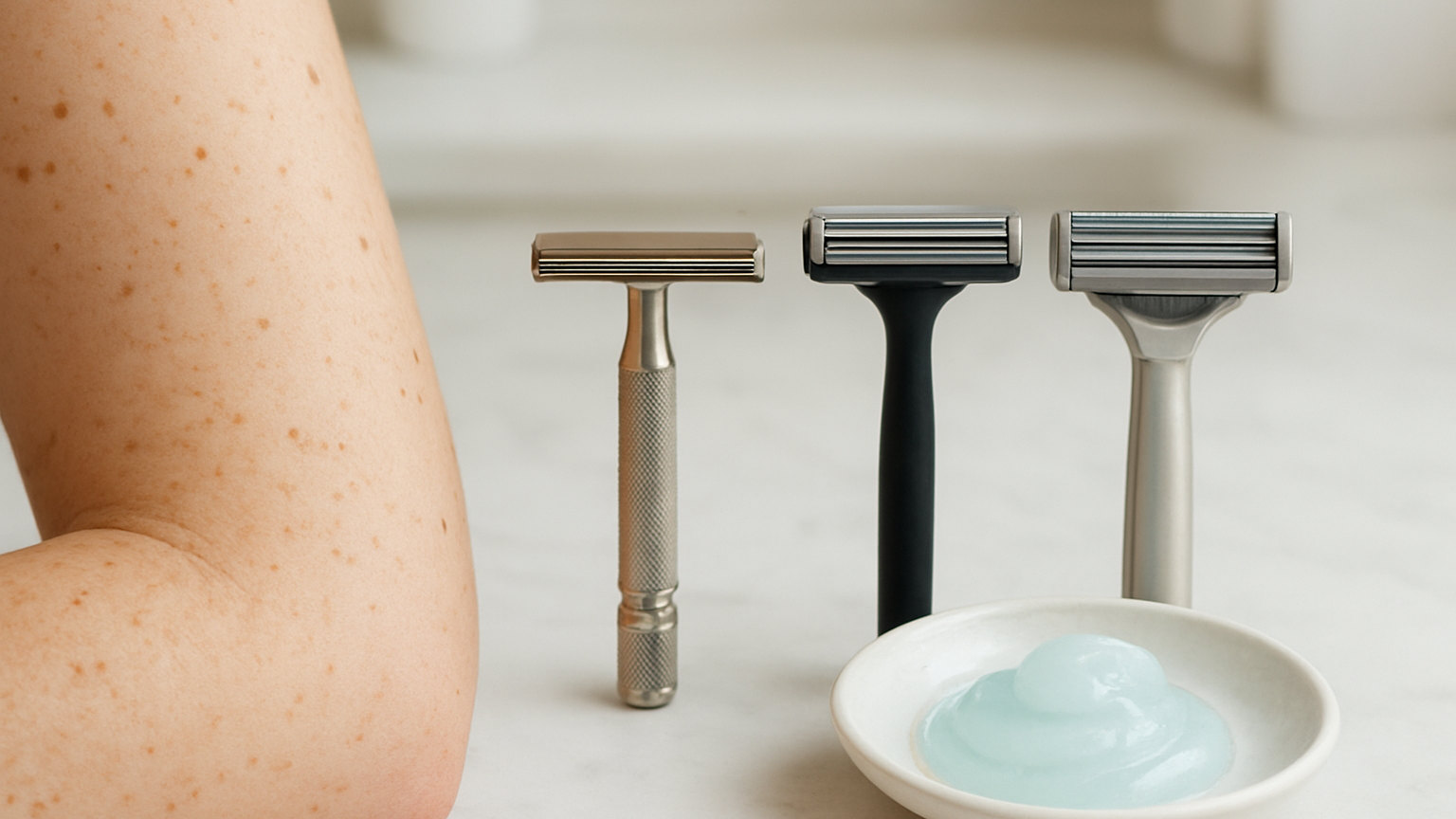
Razor marketing runs on blade count, and more blades genuinely do give a closer shave. They also cause more irritation, which makes this a question of what your skin tolerates rather than which is most advanced.
How do multi-blade cartridges work?
By hysteresis. The first blade catches the hair and pulls it slightly out of the follicle, and the following blades cut it before it retracts. The hair is therefore cut below the skin surface.
That produces a very close shave, which lasts longer. It also means every hair regrows from below the surface, which is exactly the mechanism that produces ingrown hairs.
For skin that tolerates it, cartridges are convenient and effective. For anyone prone to razor bumps, the mechanism is working against them.
What about safety razors?
A single blade held at a fixed angle, using replaceable double-edged blades. The shave is slightly less close and considerably less irritating for many people.
The blades cost pennies rather than pounds, which over a year is a substantial difference. The learning curve is real: angle and pressure matter far more than with a cartridge, and the first few shaves usually involve nicks.
They suit anyone with ingrown hairs, sensitive skin, or an objection to cartridge prices.
What about electric shavers?
They cut hair above the skin surface rather than below it, which removes the ingrown hair mechanism almost entirely.
Foil shavers use an oscillating blade behind a perforated screen and suit straight hair and daily shaving. Rotary shavers use spinning heads and cope better with coarse or curly hair and with longer stubble.
The shave is less close, which is the trade. For anyone with chronic razor burn or pseudofolliculitis, that trade is usually worth making.
What about disposables?
Convenient and generally the worst option for skin. The blades are lower quality and dull quickly, and because they are cheap people keep using them well past the point they should be replaced.
Reasonable for travel and occasional use, and a poor daily choice.
Does blade count matter for legs and body?
Less than on the face, since leg hair is generally finer and straighter and the skin is less prone to ingrown hairs.
The bikini line and underarms are the exceptions, where the hair is coarser and often curly and the skin is thin and folded. Those areas frequently do better with fewer blades and shaving with the grain.
Which suits sensitive skin?
Fewer blades, generally. A two-blade cartridge or a safety razor causes less drag and cuts less deeply than a five-blade.
Cartridges with lubricating strips help, though those strips are also a common cause of contact irritation for some people, and the fragrance in them is worth suspecting if irritation appears in a strip pattern.
An electric shaver is the gentlest option available and requires accepting a less close result.
How often should blades be replaced?
Cartridges every five to seven shaves. Safety razor blades every three to five. Disposables after two or three.
Coarse hair, thick stubble and large areas all shorten that. The signal to replace is needing more pressure, more passes, or noticing tugging.
Blade cost drives most people to stretch this, which is why safety razors appeal to anyone shaving daily: the blades are cheap enough that replacing them frequently is painless.
What matters more than the razor?
Preparation, lubrication, direction and pressure. A blunt blade in an expensive handle produces a worse shave than a fresh cheap blade used properly.
If you change one thing, change the blade more often. If you change two, add proper preparation with warm water and a real shaving cream.
Are razors marketed for women any different?
Rarely in any meaningful way. The differences are usually the handle shape, the colour and the lubricating strip, and the blades themselves are frequently identical or near-identical to the equivalent men's cartridge.
The price often is not. Comparing cartridges by blade count and cost per shave rather than by which aisle they are in usually finds the same product cheaper, and a razor does not know whose skin it is on.


