
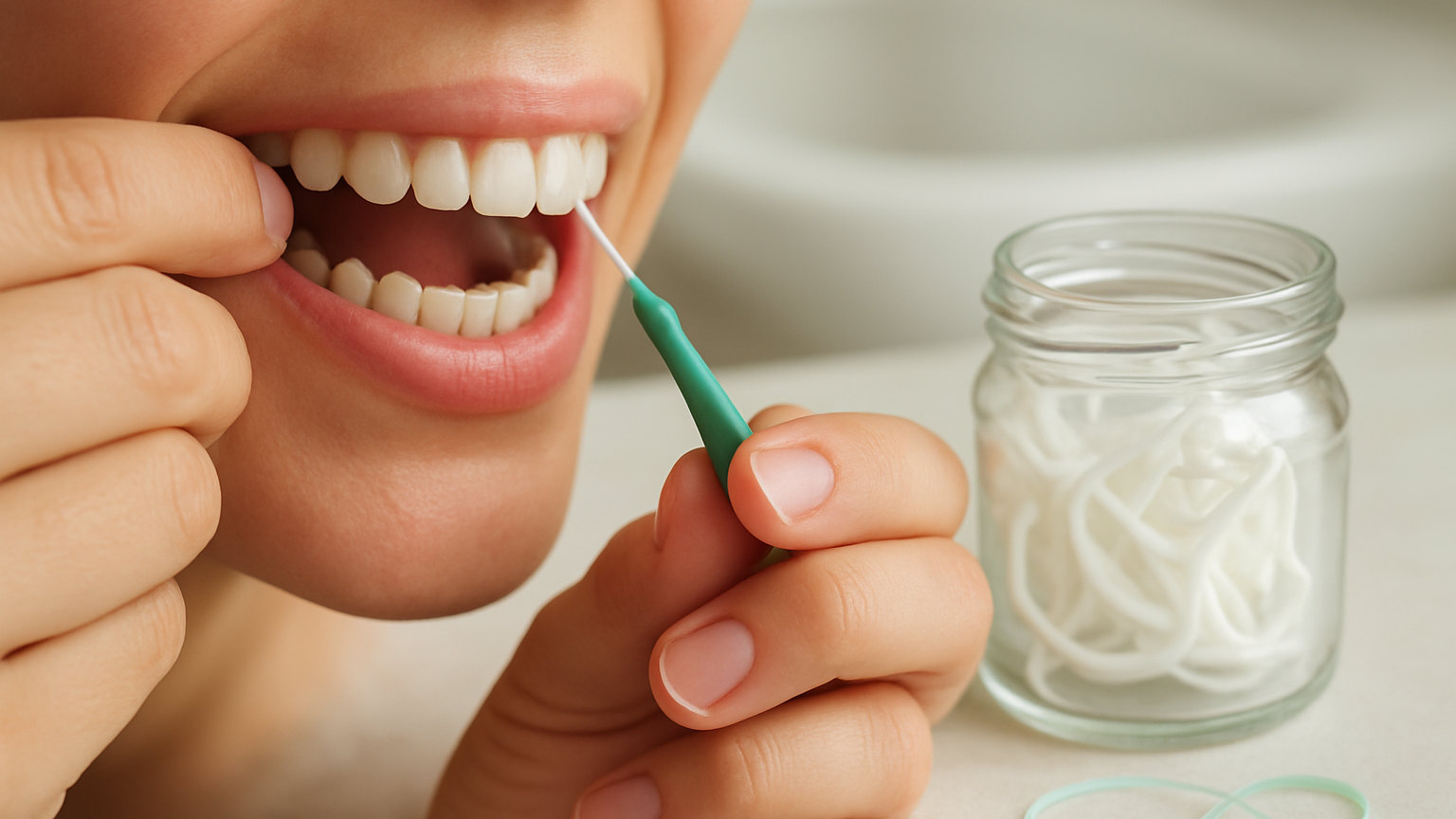
A toothbrush cleans around three fifths of each tooth surface. The remaining two fifths are the sides where teeth touch each other, and those are where the majority of decay and gum disease begin.
Why does it matter so much?
Because those surfaces are protected from the brush, from saliva flow and from the mechanical cleaning that chewing provides.
Plaque left there for a day or two hardens into calculus, which can then only be removed professionally, and it causes the gum inflammation that leads to gum disease.
Decay between teeth is also harder to detect and needs a larger filling by the time it is found, since it has usually spread by then.
Floss or interdental brushes?
Interdental brushes where the gaps allow them, which is most adult mouths. The evidence favours them over floss for plaque removal and gum health.
Floss where the gaps are too tight for even the smallest brush, which is common in younger people and in crowded teeth.
Most people need a combination, since gap sizes vary across the mouth. A dentist or hygienist will size them for you, which takes two minutes and makes a considerable difference.
How do you use interdental brushes?
Choose a size that fits snugly without forcing. Too small does nothing; too large damages the gum.
Insert gently at the gum line, straight in rather than at an angle, and move back and forth two or three times. Do not force it.
Rinse the brush and move to the next gap. Replace the brush when the bristles splay, typically after a week or two.
Some bleeding in the first week is expected if the gums are inflamed, and it should stop within two to three weeks of daily use.
How do you floss properly?
Take around forty centimetres, wind most around one middle finger and the rest around the other, gripping a short section between thumbs and forefingers.
Guide it between the teeth with a gentle sawing motion rather than snapping it down, which cuts the gum.
Curve it into a C shape against the side of one tooth and move it up and down, going slightly below the gum line. Then repeat against the neighbouring tooth.
Use a fresh section for each gap. Both sides of every gap need doing, which is the step most often skipped.
Do water flossers work?
Reasonably well, and they are better than nothing rather than better than everything.
Evidence suggests they reduce bleeding and gingivitis effectively, and they are less good than interdental brushes at physically disrupting plaque, which requires contact.
They are genuinely useful for anyone with braces, bridges, implants or limited dexterity, where conventional cleaning is difficult. As a replacement for brushes or floss in a healthy mouth, they are a step down.
How often and when?
Once daily is the recommendation. Plaque takes around twenty-four hours to become established, so daily disruption is sufficient.
Before brushing rather than after, which allows the fluoride toothpaste to reach the surfaces you have just cleaned.
Evening is generally best, since it removes the day's debris before the overnight period of reduced saliva flow.
Why do people give up?
Bleeding, which is interpreted as damage rather than as the sign of inflammation it actually is. It stops with consistent cleaning.
Difficulty, particularly with floss at the back of the mouth. Floss picks and interdental brushes with angled handles both solve this.
And not seeing an immediate result, since the benefit is preventing something rather than producing something visible.
What if you have bridges, implants or braces?
Specific tools exist and are worth asking about. Superfloss has a stiffened end for threading under bridges. Interdental brushes come with angled handles for awkward areas.
Implants need particularly careful cleaning, since the tissue around them is more vulnerable than around natural teeth.
A hygienist can demonstrate the right technique for your specific situation in one appointment, which is more useful than any general instruction.


