
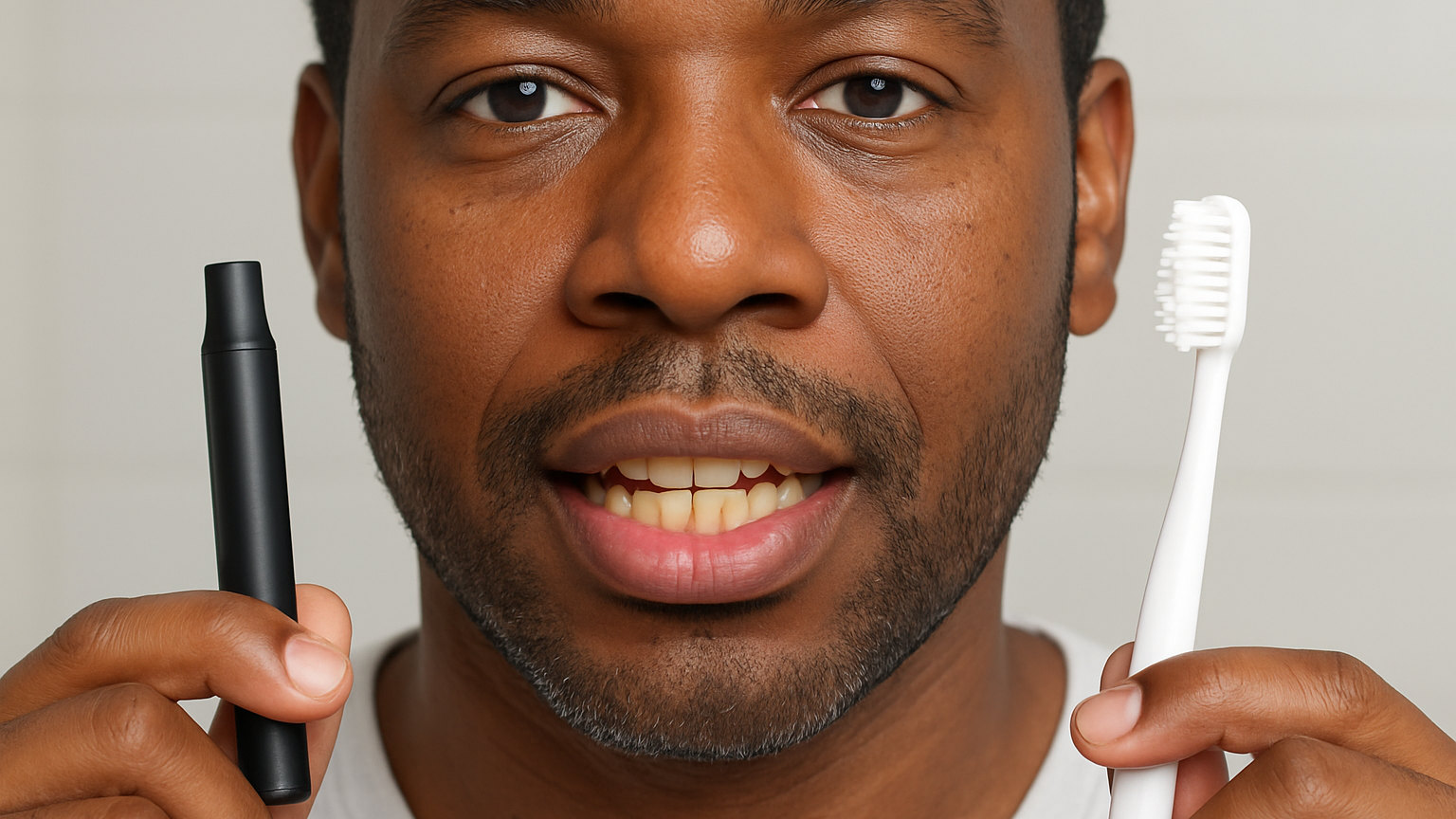
Smoking affects the mouth more than almost any other habit, and it does something particularly unhelpful: it suppresses the bleeding that would otherwise warn you that gum disease is developing.
What does smoking do to the gums?
Nicotine constricts blood vessels, reducing blood flow to the gum tissue. That impairs the immune response and slows healing.
Gum disease progresses faster and more severely in smokers, with more bone loss and more tooth loss. It is the largest modifiable risk factor for periodontal disease.
The masking effect is the dangerous part. Reduced blood flow means inflamed gums bleed less, so the earliest and most useful warning sign is absent while the disease progresses underneath.
Smokers frequently present with advanced gum disease and no bleeding at all.
What else does it cause?
Staining, which is the most visible effect and the least serious. Tar and nicotine produce heavy brown discolouration that responds to professional cleaning.
Bad breath, both directly and through dry mouth and gum disease.
Reduced sense of taste and smell, which partially recovers after quitting.
Delayed healing after extractions, which is why dry socket is considerably more common in smokers.
Higher failure rates for dental implants, to the point that some practitioners will not place them in heavy smokers.
What about oral cancer?
This is the most serious consequence. Smoking is the leading risk factor for cancers of the mouth, tongue, throat and lips, and the risk multiplies substantially when combined with alcohol.
Oral cancer rates in the UK have risen over recent decades. Outcomes depend heavily on how early it is found, which is why the oral cancer examination at a dental check-up is genuinely valuable.
Signs worth acting on: an ulcer that has not healed in three weeks, a persistent red or white patch, an unexplained lump, numbness, or difficulty swallowing. Any of these needs assessment promptly rather than watching.
What does the evidence on vaping show?
Less established than for smoking, since the products are relatively recent, and enough is emerging to be worth taking seriously.
Nicotine in vapes has the same vasoconstrictive effect, so the impact on gum blood flow and healing is likely comparable.
Studies have found associations with dry mouth, gum inflammation and changes to the oral bacterial population. Propylene glycol, a common base, is drying.
Sweetened vape liquids may contribute to decay risk, and there are reports of increased decay in some vaping populations.
The reasonable summary is that vaping appears less harmful than smoking to the mouth and is not neutral, and the long-term picture is not yet clear.
What about other tobacco products?
Chewing tobacco, snuff and paan carry a substantially increased risk of oral cancer, gum recession and decay, with the damage concentrated where the product is held.
Areca or betel nut, used with or without tobacco, is independently carcinogenic and causes oral submucous fibrosis, a condition that progressively stiffens the mouth.
These are worth naming specifically since they are sometimes assumed to be safer than smoking.
What improves after quitting?
Blood flow to the gums improves within weeks, and with it the response to treatment. Gum disease treatment works considerably better in people who have stopped.
Bleeding may initially increase, which is disconcerting and is a sign of returning circulation rather than worsening disease.
Taste and smell improve within days to weeks. Healing after dental procedures improves. Staining can be removed professionally and stops recurring.
Oral cancer risk falls over years and does not return entirely to that of someone who never smoked, which is an argument for stopping sooner rather than a reason not to.
What should smokers do differently?
See a dentist and hygienist more often, since risk is higher and warning signs are suppressed.
Clean between the teeth daily without exception. Report any ulcer, patch or lump lasting more than three weeks rather than waiting for a check-up.
And ask about stopping, since NHS stop smoking services are free and considerably more effective than willpower alone.


