
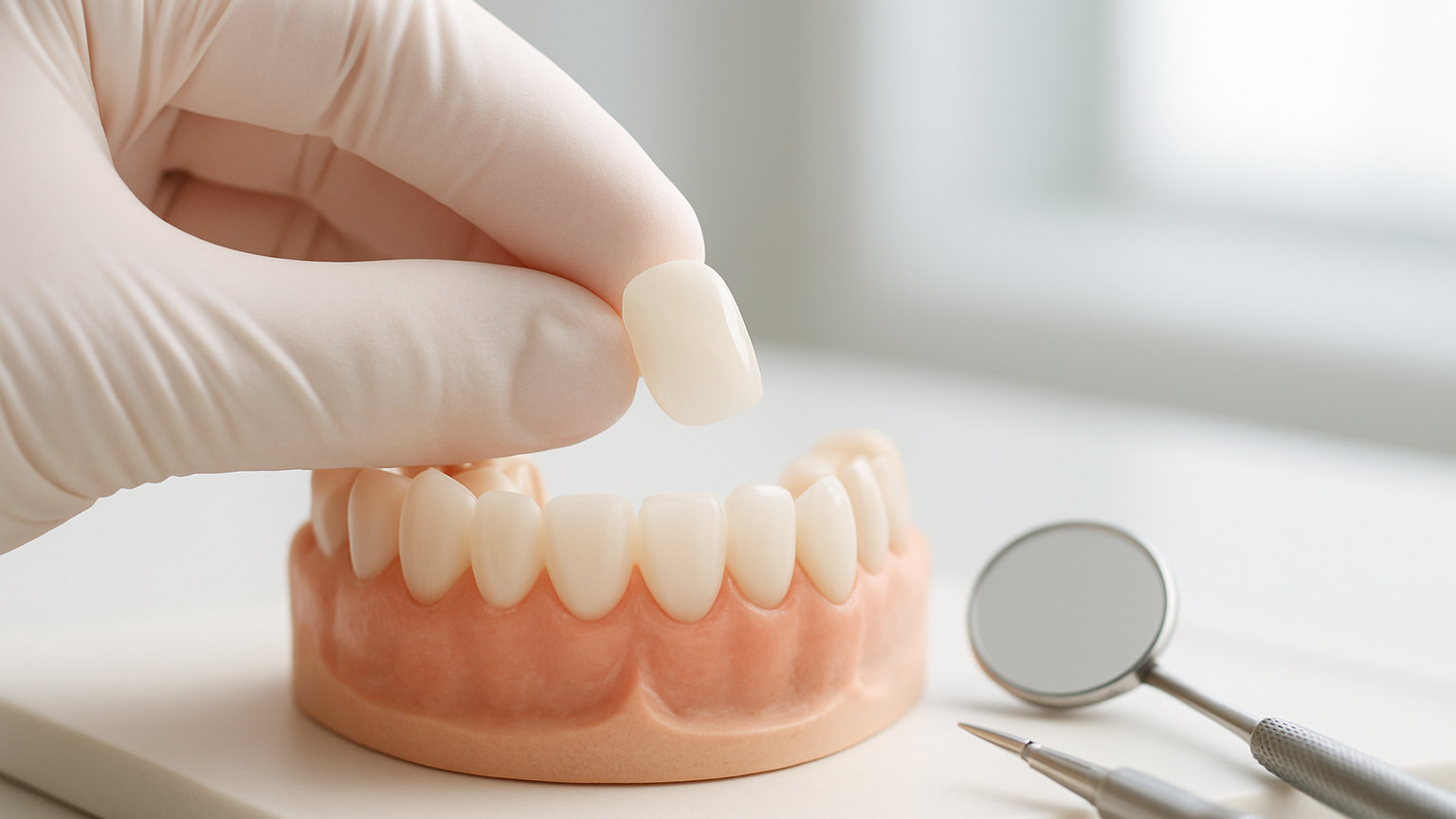
Veneers are thin shells bonded to the front of the teeth. The essential thing to understand is that preparing a tooth for one removes enamel permanently, so the decision cannot be undone.
What are the types?
Porcelain veneers, custom-made in a laboratory and bonded to a prepared tooth. Durable, natural-looking, and requiring enamel removal.
Composite veneers or composite bonding, where tooth-coloured resin is applied and shaped directly. Cheaper, reversible in some cases, less durable, and staining over time.
Minimal-prep or no-prep veneers, which are thinner and require little or no enamel removal. Suitable in a limited range of cases and frequently offered where they are not appropriate.
What does the process involve?
An assessment, since veneers are only suitable on healthy teeth and gums. Decay and gum disease must be treated first.
Preparation, where a layer of enamel is removed from the front of the tooth, typically half a millimetre or so. Impressions are taken and temporary veneers fitted.
Fitting at a second appointment two to three weeks later, where the permanent veneers are bonded.
Good practice includes a wax-up or digital preview so you can see and approve the proposed result before anything is cut.
Why does the enamel removal matter?
Because enamel does not regrow. Once a tooth is prepared, it will need a veneer or a crown on it for the rest of your life.
Veneers last roughly ten to fifteen years, so someone having them at twenty-five should expect several replacements over a lifetime, each of which may require removing more tooth structure.
Prepared teeth are also more prone to sensitivity and, if too much is removed, to nerve damage requiring root canal treatment.
What is the difference between veneers and crowns?
A veneer covers the front surface. A crown covers the entire tooth, and preparing for one removes considerably more tooth structure, often the majority of it.
This distinction is central to what is frequently sold abroad. A great deal of what is marketed as veneers, particularly in packages combining many teeth in a single trip, is actually crowns.
Crowns on healthy teeth are far more destructive and carry a much higher risk of nerve damage, and the teeth beneath cannot be restored to their original state.
What are the risks with dental tourism?
Not that overseas dentistry is inherently poor, since standards vary everywhere. The specific risks relate to how these packages are structured.
Very short timescales, with preparation and fitting compressed into a few days, which leaves no room for the gums to settle or for problems to emerge.
Aggressive preparation of healthy teeth, often crowns rather than veneers, on more teeth than clinically necessary.
No aftercare once you are home. If something fails, UK dentists are treating someone else's work without records, and NHS dentistry will not routinely fix cosmetic work.
No practical route to complaint or redress. UK regulators have no jurisdiction over treatment provided abroad.
British dental bodies have reported a significant increase in patients returning with complications including nerve damage, infections and failed restorations.
What should you ask before agreeing?
Whether these are veneers or crowns, in writing. How much tooth structure will be removed. Why this number of teeth.
What happens if one fails, who pays, and over what period. What the aftercare arrangement is. Whether a preview or wax-up is provided before preparation.
And whether anything less invasive would achieve a similar result, which is the question a good dentist raises unprompted.
What are the alternatives?
Whitening, for discolouration alone, which removes no tooth structure. Frequently sufficient and almost always worth trying first.
Composite bonding, which can close small gaps, repair chips and reshape edges with minimal or no preparation, and which can often be removed.
Orthodontics, including clear aligners, for alignment, which moves teeth rather than covering them and removes nothing.
Most people considering veneers for cosmetic reasons have at least one of these available, and working up from the least invasive is the approach least likely to be regretted.


