
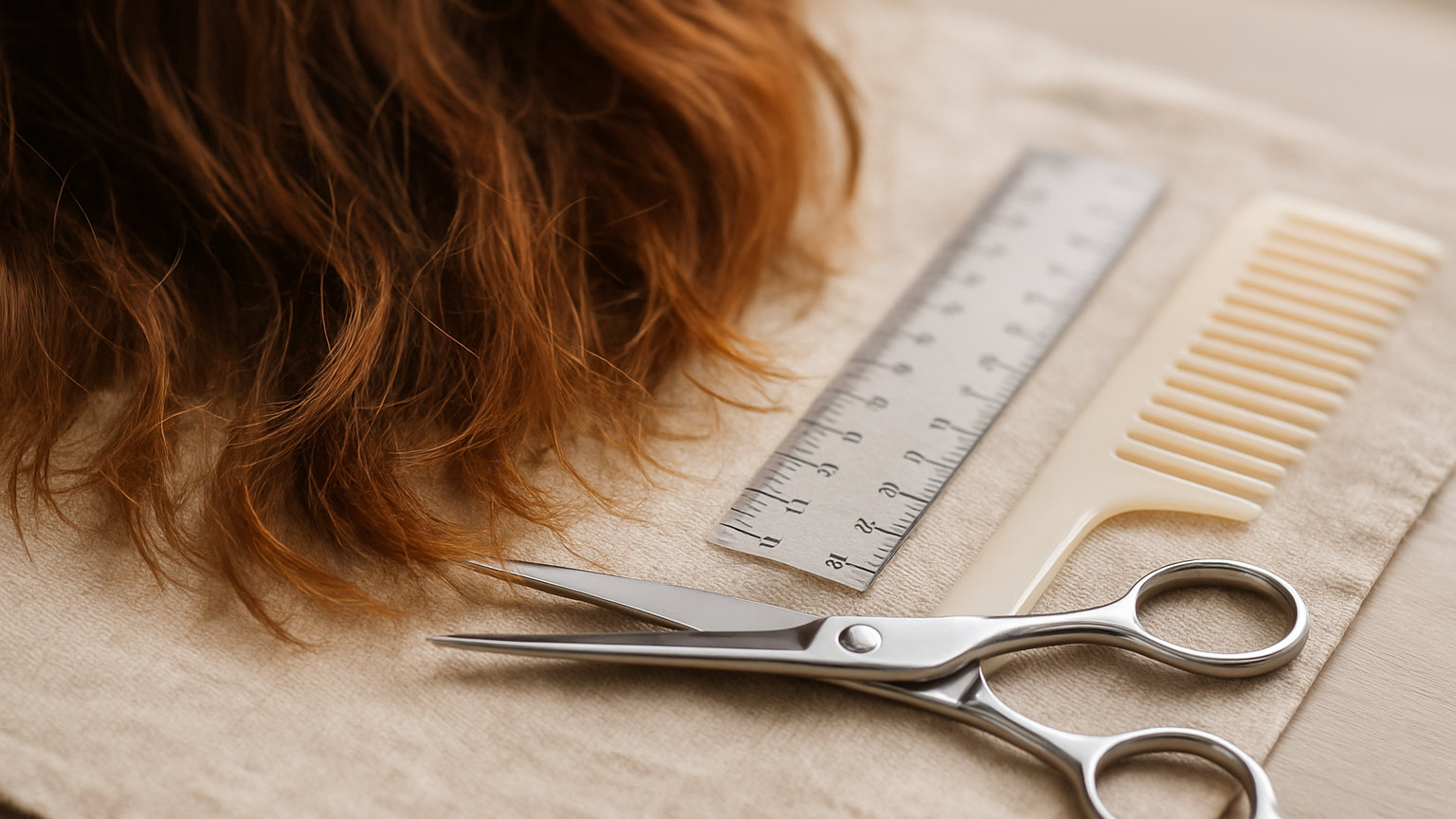
This comes down to arithmetic and preference, and both options are legitimate. What is not legitimate is the third option most people take, which is doing neither while buying products and hoping the damage resolves itself.
Why is there no third option?
Because damaged hair does not recover. Hair is dead keratin with no repair mechanism, so a damaged section stays damaged until it is cut off.
Products improve how it behaves and how it looks, which is worth having. They do not change its condition, and the damage will still be there in a year unless it has been removed.
The choice is therefore about when the damaged length comes off, not whether.
What is the case for cutting?
An immediate result. Hair looks and feels dramatically better within an hour, styling becomes easier, and the constant tangling stops.
It also stops splits travelling, which means the healthy hair below is no longer being lost to breakage from above.
And it removes a decision that otherwise recurs weekly. A good deal of the stress of damaged hair is the daily negotiation with it.
What is the case for growing out?
Length, obviously, and it matters to people for reasons that do not need justifying.
It also spreads the loss over time rather than concentrating it in one appointment, which is easier to live with if the amount to remove is substantial.
And in some cases the damage is confined to the last few inches, in which case regular small trims remove it while the hair still lengthens overall.
How does the arithmetic work?
Hair grows around a centimetre a month. If you trim half a centimetre every eight weeks, you gain roughly 1.5 centimetres over that period, so hair lengthens while damage is removed.
If the damaged section is ten centimetres, that takes around eighteen months to remove entirely at that rate, while gaining a little length overall.
Cutting it off removes ten centimetres today and you regain them in around ten months. Growing out keeps the length you have and takes longer to reach fully healthy hair.
How do you decide?
Assess how much is affected. Run a hand down a section and find where the roughness starts. If it is the last two or three centimetres, growing out is straightforward. If it is half the length, cutting is usually the better answer.
Apply the wet stretch test. If hair is gummy and stretches without recovering, it is failing structurally and will break unpredictably, and cutting is the only sensible option.
Consider whether you can commit to the handling required. Growing out damaged hair means very little heat, careful detangling and regular trims for a year or more.
What does growing out involve?
Trims every eight to twelve weeks, asking specifically for a dusting to remove only the damaged tips rather than a reshape.
Minimal heat, ideally none, for the first few months. Bond-building treatments if the damage is chemical. Weekly deep conditioning. Silk pillowcase, loose ties, careful detangling.
Realistic expectations about how it looks in the meantime, which is the part people find hardest.
Is there a middle route?
Usually the best answer. A decisive trim removing the worst, taking off perhaps a third of what is damaged, followed by regular small trims while growing.
That produces an immediate improvement without losing all the length, and it removes the sections that are actively breaking and costing you hair from above.
A stylist can identify where the hair stops being viable, which is more reliable than judging it yourself in a mirror.
What should you ask for at the appointment?
Be explicit about the aim, since trim means different things to different stylists. Say whether you are prioritising length or condition, and ask them to show you where the damage starts before cutting.
Asking for a dusting means removing only the split tips. Asking to cut back to healthy hair means something considerably more substantial. Agreeing which one you want, in those words, prevents the common experience of leaving with far more gone than expected.


