
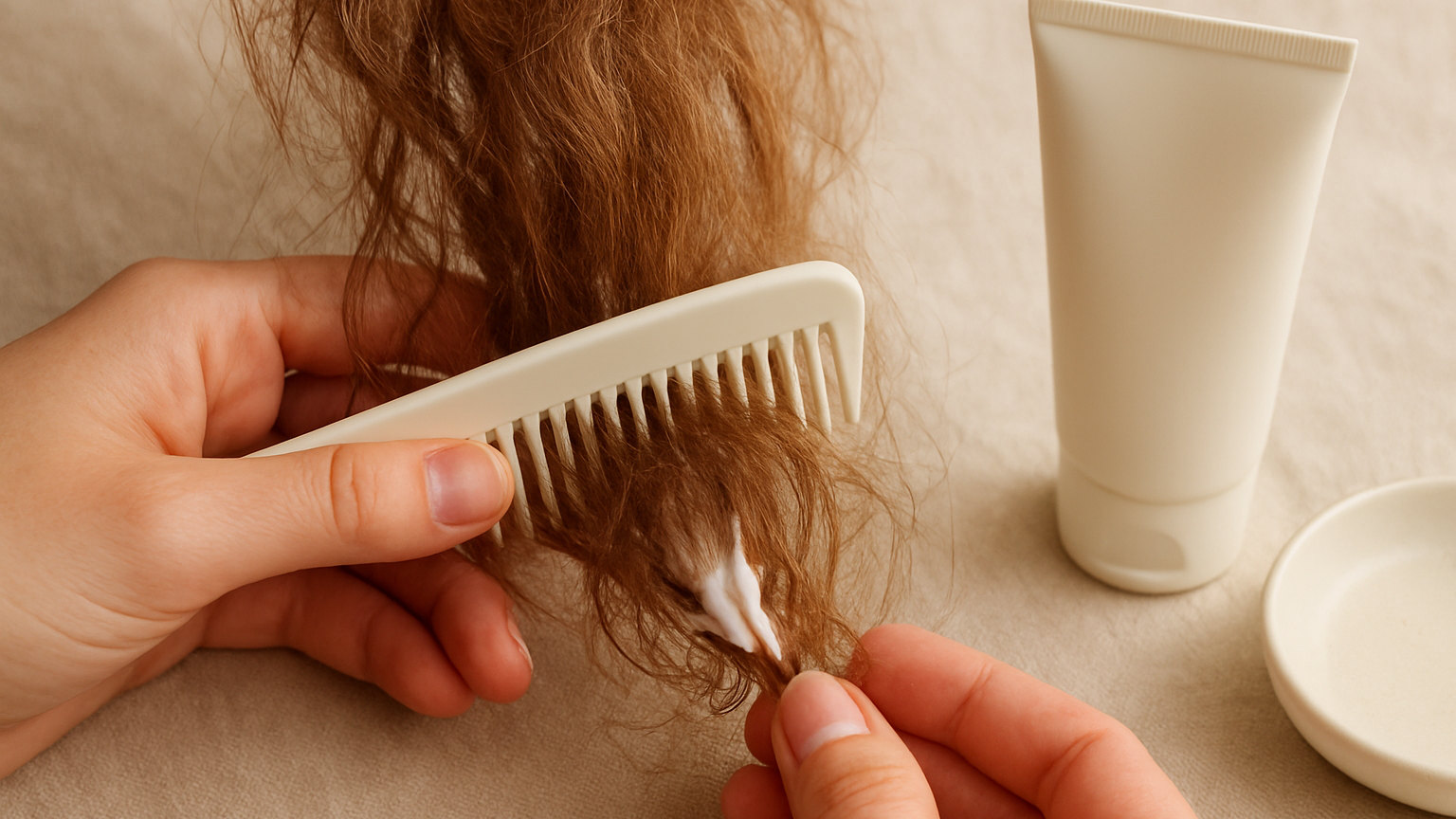
Detangling is where most breakage happens, and damaged hair sits in an unfortunate position: it tangles far more readily and tolerates the process considerably less. The technique matters more here than anywhere else in a routine.
Why does damaged hair tangle more?
Because a raised cuticle catches. Intact cuticle scales lie flat like roof tiles and slide past each other; damaged ones lift and hook onto neighbouring strands.
Damaged hair is also drier, since a raised cuticle loses moisture, and dry hair has more friction. Add split ends, which physically snag, and hair that has broken at various lengths, and the tangling compounds.
This is why detangling gets harder as damage accumulates, and why more forceful detangling makes it worse the following day.
Wet or dry?
It depends on your hair type, and the answer is not the same for everyone.
Straight and wavy hair is generally better detangled before washing, while dry, when it is strongest. Water swells the shaft, lifts the cuticle and increases elasticity, so wet hair stretches further and does not fully recover.
Curly and coily hair is the opposite. Detangling dry causes far more breakage and destroys curl formation, so it should be done wet with conditioner in.
Damaged hair of any type should never be detangled soaking wet without slip.
What provides slip?
Conditioner, a detangling spray, or a leave-in. Slip is the single most useful variable, and adding more of it is almost always better than pulling harder.
For severe tangles, apply conditioner generously and leave it for several minutes before touching the hair. The time spent waiting is repaid several times over in hair not lost.
What tools should you use?
A wide-tooth comb for wet hair and for curly hair generally, since it separates rather than dragging through.
A flexible detangling brush with widely spaced cushioned bristles for damp or dry hair. These flex rather than forcing, which is exactly what damaged hair needs.
Fingers first, always, for the worst sections. Nothing else separates hair with as much feedback about where the resistance is.
Avoid fine-tooth combs and any brush with hard bristles ending in a point.
What is the method?
Work in sections, four or more for thick hair, clipping the rest out of the way.
Start at the very ends and work upward in short passes, holding the section above where you are working so tension is taken by your hand rather than by the roots.
When you meet resistance, stop and separate it with fingers rather than pulling through. Add more slip if needed.
Never start at the roots. Combing from the top pushes every tangle downward into a single larger knot.
How do you deal with a severe knot?
Saturate it with conditioner or oil and leave it for ten minutes. Work from the outside of the knot inward with fingers, teasing strands apart rather than pulling the knot as a whole.
Then a wide-tooth comb from below the knot, working up gradually.
If a knot genuinely will not release, cutting it out is better than tearing through it, since the surrounding hair will be damaged in the attempt and you will lose more than the knot occupies.
How do you reduce tangling in the first place?
Condition every wash and use a leave-in on the lengths. Sleep on silk or satin with hair loosely plaited or in a loose bun.
Detangle before washing rather than only after. Avoid piling hair on top of the head while washing, which is one of the most reliable ways to create knots.
And remove split ends regularly, since they snag on neighbouring strands and are a significant contributor to tangling that people rarely connect.
How long should it take?
Longer than most people allow, and rushing is where breakage happens. Ten to fifteen minutes for damaged shoulder-length hair is realistic; considerably more for long or very tangled hair.
If you are detangling in under two minutes, you are pulling through knots rather than separating them. Treating it as a task with a proper amount of time set aside, rather than something squeezed in, changes the outcome more than any product does.


