
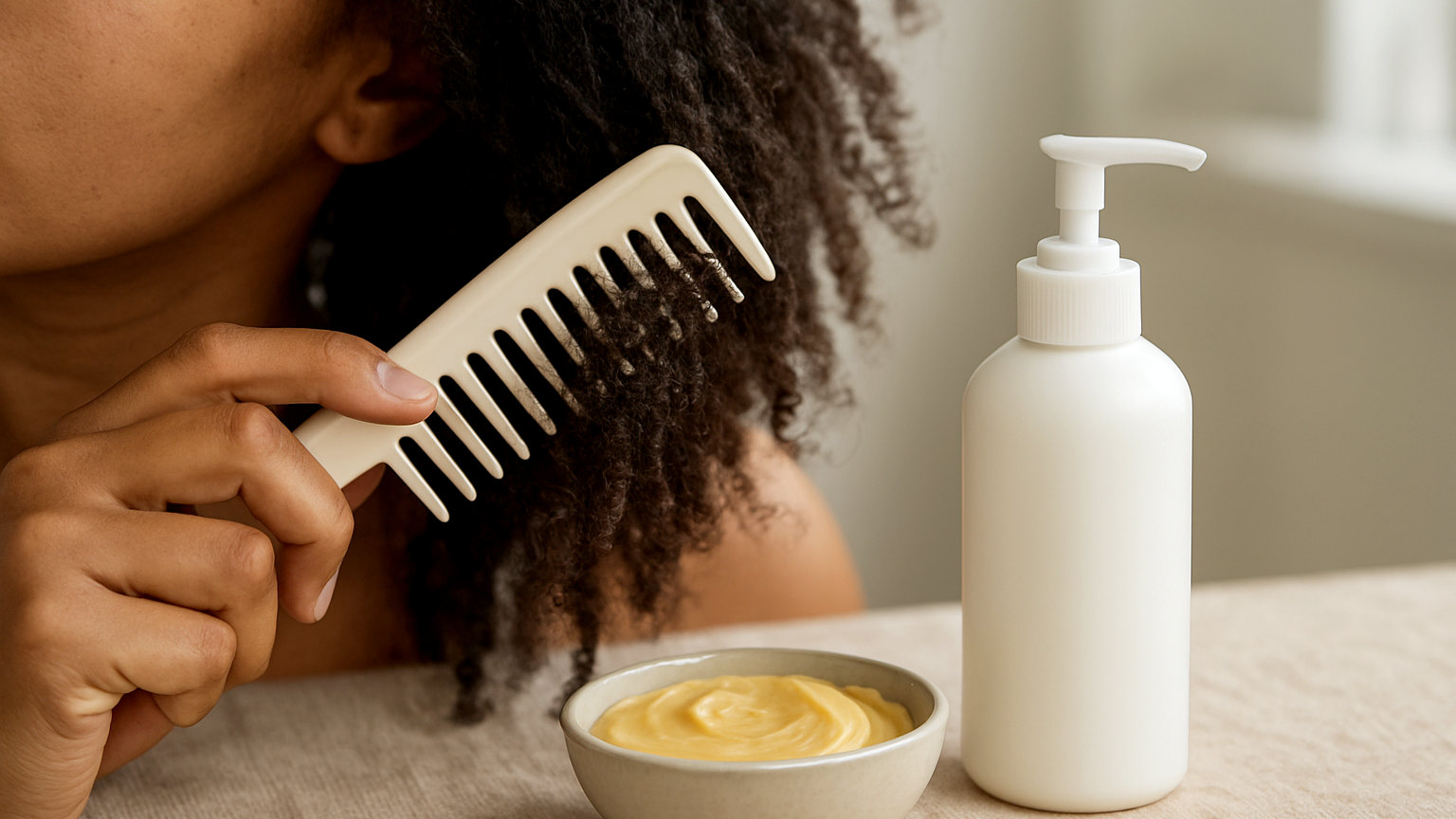
Heat damage cannot be reversed, since hair is dead keratin with no capacity to repair itself. What can be done is a good deal: managing how the hair behaves, preventing further damage, and growing it out with the least loss possible.
What does heat actually do?
Above around 150 degrees, water inside the shaft turns to steam and forces its way out, leaving small cavities and lifting the cuticle. The hair becomes more porous and rougher.
Above roughly 215 degrees, keratin itself begins to break down and the change is structural rather than superficial. Repeated exposure compounds it.
Styling damp hair is the worst case, because there is far more water to vaporise. The sizzle from straighteners on damp hair is exactly what it sounds like.
How do you know hair is heat-damaged?
Ends that feel rough and look frayed while the roots feel normal, since the ends have had years of exposure.
Loss of curl or wave that does not return after washing, which is the clearest sign. Increased breakage and short broken hairs throughout the length. Hair that no longer holds a style. White dots along the shaft, which mark where the cuticle has worn through and the hair is about to snap.
Hair that is unusually porous, soaking through quickly and drying fast.
Do curls come back?
Only if the damage is superficial. Curl pattern is determined by the shape of the follicle and by disulphide bonds within the shaft.
If those bonds have been broken by heat, the curl in that section is gone permanently and no treatment restores it. New growth from the follicle will be curly as normal.
Sections that have lost curl and do not recover after several washes with no heat are heat damaged. The only route back to uniform curl is growing it out and cutting the affected length away.
What helps in the meantime?
Bond-building treatments, which reduce breakage in hair with broken disulphide bonds and are the one category acting inside the shaft rather than on it.
Deep conditioning weekly, which improves flexibility so hair withstands handling better. Leave-in conditioner on the lengths.
A light oil or serum to seal, applied to damp ends. This does not repair anything and it makes hair behave considerably better while it grows out.
What should you stop doing?
Heat, at least for several weeks, which is the only thing that genuinely changes the trajectory. If you cannot stop, reduce the temperature substantially and the frequency.
Most people can style adequately at 150 to 180 degrees. Fine hair needs less; coarse hair may need more. The habit of using maximum heat because it is faster costs a great deal over a year.
Also stop chemical processing until the hair has recovered, since heat and bleach damage compound each other severely.
Does heat protectant work?
It reduces damage rather than preventing it. Products form a film that slows heat transfer and distributes it more evenly.
They are worth using every time, and they do not make high temperatures safe. Applying protectant and then straightening at 230 degrees is still damaging, just less so.
Apply to damp hair, dry fully, then style. Applying to soaking hair wastes it, and applying to bone-dry hair immediately before heat gives no time to form a film.
How long before hair improves?
Behaviour improves within weeks with conditioning and no further heat. Actual condition improves only as damaged length is cut off and new growth replaces it.
At a centimetre a month, replacing shoulder-length hair takes around two years. That sounds discouraging and is worth knowing, because the alternative of expecting a product to fix it leads to years of buying things that cannot.
Is it better to cut it off?
Depends on how much length is affected and how you feel about it. Cutting to the point of healthy hair gives an immediate result and loses length.
Growing it out with regular small trims takes longer and preserves length. Most people do best somewhere between: a decisive trim to remove the worst, then trims every eight to twelve weeks while growing.


