
Washing is when hair is at its weakest, and damaged hair is weakest of all. Several small adjustments to the routine make a disproportionate difference, and none of them requires buying anything.
Why is washing the vulnerable moment?
Water penetrates the shaft and causes it to swell, lifting the cuticle. Hydrogen bonds break, so hair stretches considerably further before snapping and does not fully recover.
Damaged hair absorbs water faster because the cuticle is already raised, so it swells more and more quickly. Add mechanical handling from lathering and towelling and the combination accounts for a large share of breakage.
How often should you wash it?
Less often than undamaged hair, since each wash means another cycle of swelling and drying.
For bleached or severely damaged hair, every three to four days is a reasonable target, using dry shampoo sparingly in between rather than as a routine.
That said, an oily or flaking scalp needs washing regardless. The scalp and the lengths have different requirements, and the answer is a gentle shampoo used on the scalp rather than avoiding washing entirely.
What water temperature?
Lukewarm throughout, and this is one of the highest-value changes available.
Hot water dissolves the lipids holding the cuticle together far more effectively than warm water, and it increases how much the shaft swells. A cooler final rinse encourages the cuticle to lie flatter, which improves shine modestly.
Standing under cold water is unnecessary. Simply not using hot achieves most of the benefit.
Which shampoo?
A gentle, sulfate-free or low-foaming formula, applied to the scalp only. Sodium lauryl sulfate is worth avoiding on damaged hair; sodium laureth sulfate is milder and tolerated by many.
Avoid clarifying shampoos more often than every four to six weeks, since they strip a cuticle that is already compromised. If build-up is an issue, follow immediately with a mask.
Never scrub shampoo into the lengths. The diluted lather running through as you rinse cleans them adequately, and scrubbing tangles and roughens them.
What about the technique itself?
Detangle before washing if your hair is straight or wavy, so you are not working through knots on swollen hair.
Let hair hang down rather than piling it on top of your head, which is one of the most reliable ways to create tangles.
Use fingertips rather than nails on the scalp. Rinse thoroughly, for longer than feels necessary, particularly at the back where residue accumulates.
What should conditioning look like?
Every wash, without exception, on the mid-lengths and ends, left for two to three minutes.
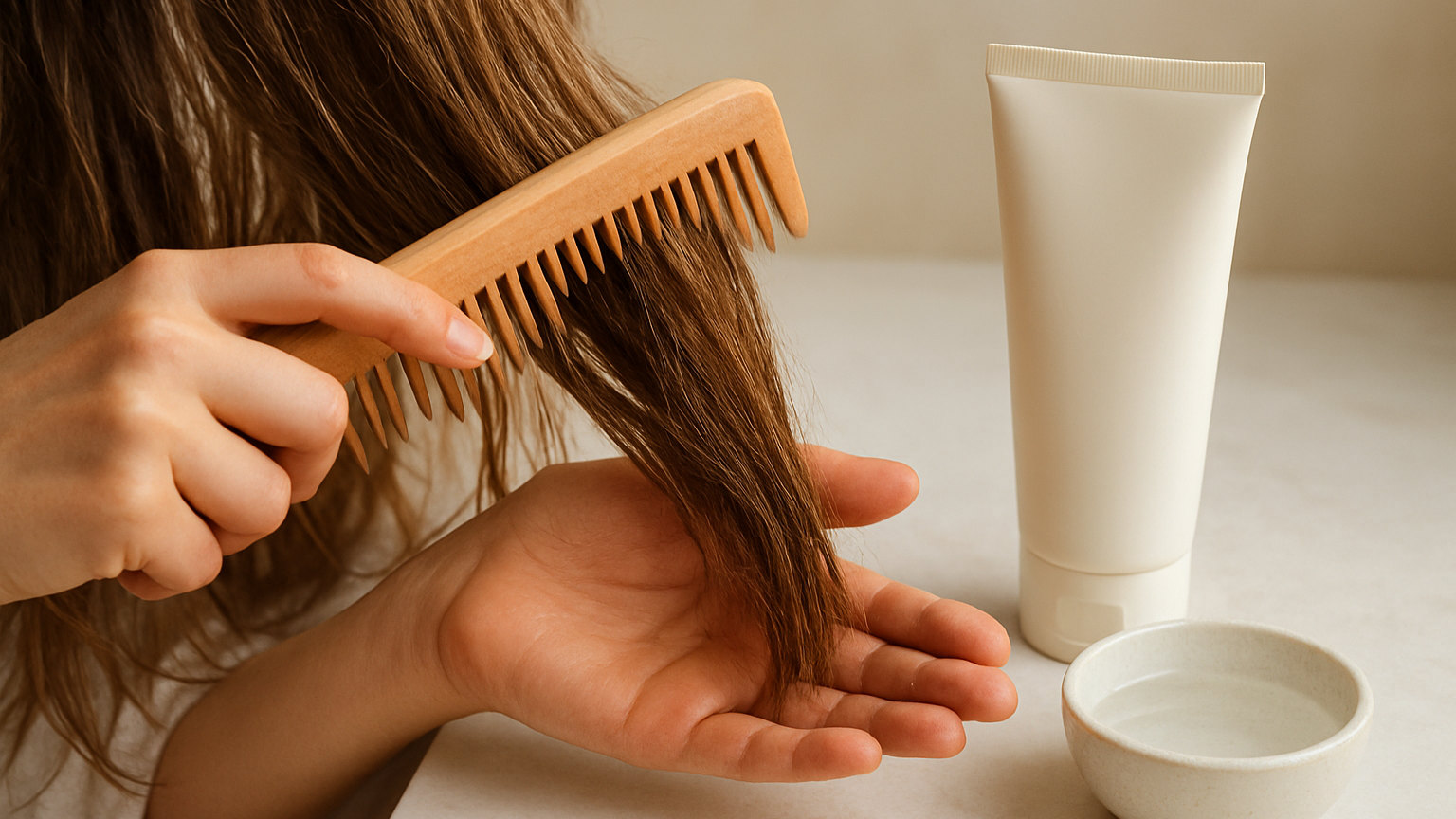
Detangle with a wide-tooth comb while the conditioner is in, which is when the hair has the most slip, then rinse. For very damaged hair, this is the only detangling that should happen while wet.
A leave-in on damp hair afterwards, and a light oil on the ends to seal.
How should you dry it?
Squeeze rather than rub, with a microfibre towel or an old cotton t-shirt. Terry towelling catches individual strands and pulls.
Do not wrap hair tightly in a towel turban for long periods, since the tension at the hairline and the friction inside both cause damage.
Let it dry to around eighty per cent naturally before any heat, and use the lowest setting that works. Never use straighteners on damp hair.
What single change matters most?
If you only alter one thing, make it how you handle hair between the shower and being dry. That window, wet and being towelled and combed, is where the majority of breakage occurs, and it costs nothing to change.
Does co-washing help?
Sometimes, and it depends on the scalp rather than the hair. Washing with conditioner alone avoids surfactants entirely, which suits very dry, curly or coily hair.
It has limited cleansing power, so it suits a dry scalp and causes build-up on an oily one. A reasonable compromise for damaged hair with a normal scalp is alternating: a gentle shampoo one wash, conditioner only the next. Anyone prone to flaking should be cautious, since conditioner left on the scalp feeds the yeast involved.


