
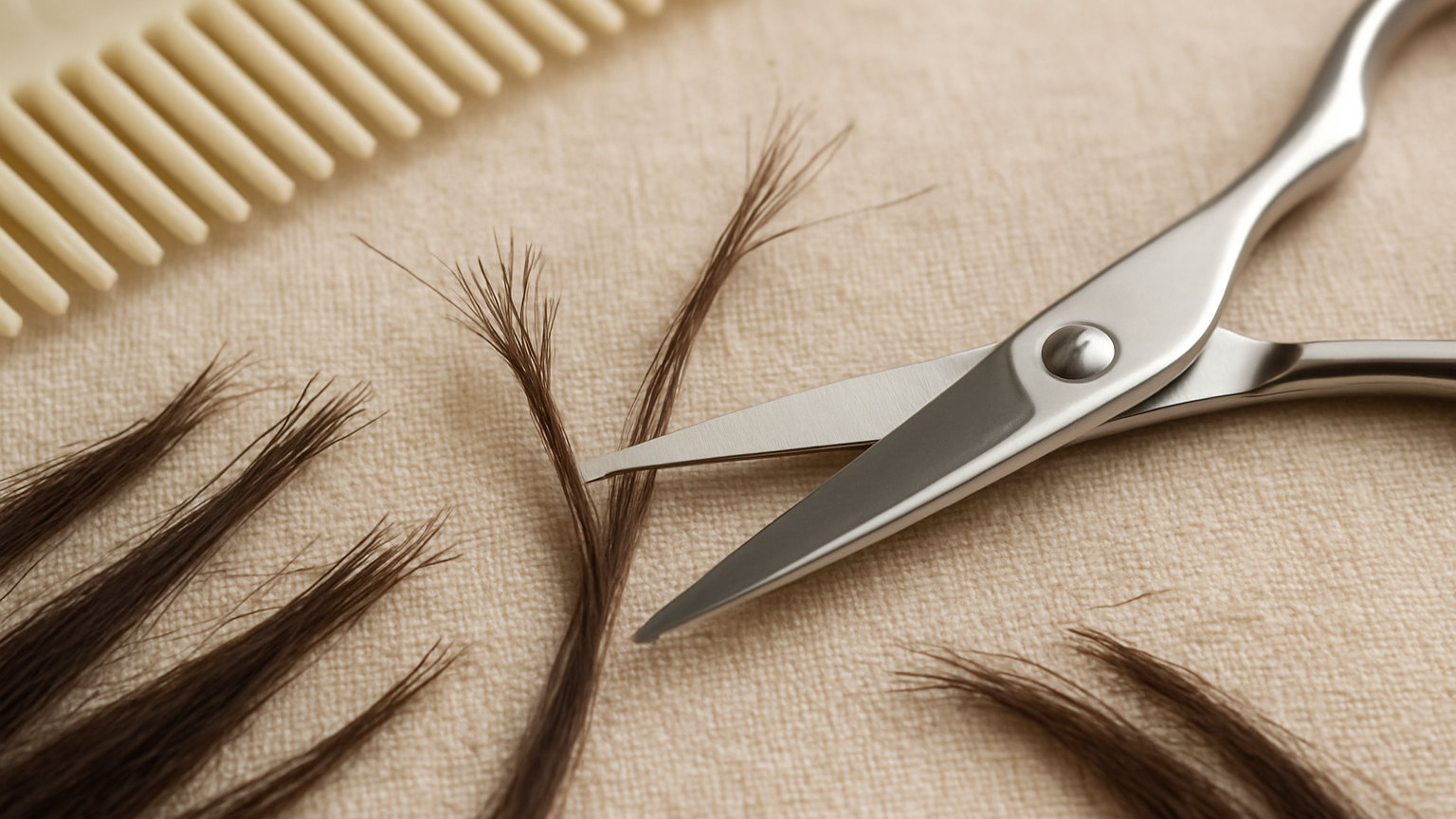
A split end is the cuticle wearing away at the tip and the cortex beneath separating into strands. The important part is what happens next: a split does not stay where it started.
Why do the ends go first?
Because they are the oldest part of the hair. Hair grows around a centimetre a month, so the ends of shoulder-length hair are roughly two years old and waist-length closer to four.
In that time they have been washed several hundred times, brushed thousands of times, exposed to sun, heat and friction, and have had every chemical treatment applied to the whole head. The roots have had none of that.
The cuticle protecting the tip erodes first, and once it is gone the cortex is exposed and begins to fray.
What causes them?
Cumulative damage rather than any single event. Mechanical friction from brushing, towel drying and clothing. Heat styling, particularly at high temperatures or on damp hair.
Chemical processing, which weakens the whole structure. Ultraviolet exposure. Dryness, since dry hair is more brittle and less able to flex.
Tight styles and elastics, which create stress points. And simply time, since even careful handling erodes the cuticle eventually.
Why does leaving them cost length?
Because a split travels. Once the cuticle has failed at the tip, the separation moves upward along the shaft, following the path of least resistance.
The weakened section eventually snaps somewhere above the original split, taking more length than the split itself occupied. That is why hair can grow steadily and never get longer: growth at the root is matched by breakage at the end.
Removing half an inch every few months costs less than allowing a split to travel six inches before the hair breaks.
Can they be repaired?
No. Hair is dead keratin with no living cells, so once the shaft has physically separated nothing rejoins it permanently.
Products described as split end repair contain silicones and polymers that bind the split closed temporarily. The effect is real, cosmetic and washes out. It is useful for appearance between trims and does nothing to stop the split travelling.
Cutting is the only actual solution, and there is no product on any shelf that changes that.
Are there different kinds?
Several, and they indicate different things. A simple two-way split at the tip is ordinary wear.
Multiple splits along one strand, sometimes called a tree, indicates more significant damage. A split appearing in the middle of the shaft rather than at the end suggests mechanical damage at a stress point, often where hair is tied.
White dots along the shaft are a warning sign, indicating the cuticle has worn through and the hair is about to break at that point.
Knots and single-strand knots, common in curly hair, cause splits when combed through and are better cut out individually.
How often should you trim?
Every eight to twelve weeks for most people, and it depends on how much damage the hair sustains rather than on the calendar.
Frequent heat and colour push toward eight weeks. Minimal styling and careful handling can stretch to sixteen.
If you are growing hair out, ask specifically for a dusting, which removes only the damaged tips rather than reshaping. Being clear about that at the appointment matters, since a trim usually means more.
How do you prevent them?
Reduce friction: detangle from the ends upward, squeeze rather than rub with a microfibre towel, sleep on silk or satin, and tie hair loosely and in varying positions.
Reduce heat: lower temperatures, always use protection, and never straighten damp hair.
Keep the ends conditioned, since flexible hair withstands stress better than brittle hair. A leave-in on the last few inches costs little and does more for the ends than anything else.
And protect from sun and chlorine, both of which degrade the cuticle where it is already thinnest.
Can you trim them yourself?
Individually, yes, and cutting your own length is a different matter. Twisting a section and snipping the small hairs that stick out, sometimes called velcro trimming or search and destroy, removes visible splits without shortening the hair.
Use hairdressing scissors rather than kitchen or paper scissors, which are blunt enough to crush the shaft and cause new splits at the cut. Cut cleanly and at a right angle. It is tedious and it genuinely works for maintaining length between proper trims.


